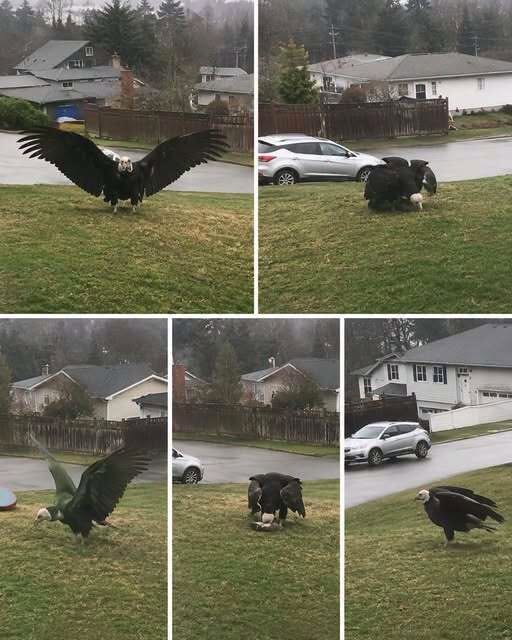
Deep within a secure wildlife facility in Brownsville, a remarkable bird has captured the attention of researchers, conservationists, and curious observers around the world.
Known by locals as the “Giant Eagle of the Border,” the enormous bird has become the center of fascination because of its unusual appearance, powerful presence, and the questions surrounding its origins.
Standing quietly behind reinforced protective barriers, the eagle appears almost unreal. Its massive frame, sharp gaze, and commanding posture make it unlike anything many visitors have ever encountered.
Every movement is carefully observed.
Every behavior is recorded.
Every biological detail is being studied.
For researchers working with the bird, the biggest mystery is not simply its size.
It is where it came from.
The discovery has sparked a wave of scientific investigation, with experts examining everything from physical characteristics to genetic information in an effort to understand this extraordinary animal.
Inside the facility, advanced equipment operates continuously as scientists analyze samples and compare genetic data with known species of large birds of prey.
DNA sequencing technology has allowed researchers to examine the bird at a level that would have been impossible only a few decades ago.
Scientists are comparing its genetic profile with modern eagles, condors, and other powerful flying predators.
Each result provides new information, but also creates new questions.
Some genetic markers appear familiar, suggesting connections to known species.
Other variations have left researchers searching for explanations.
Could the bird represent a rare and previously undocumented population?
Could it be the result of a natural evolutionary path that developed in isolation?
Or does it simply reveal how much remains unknown about the animals that share our planet?
The mystery has attracted attention because the modern world often feels completely explored.
Satellites monitor remote landscapes.
Technology tracks animal populations.
Scientists have mapped countless ecosystems.
Yet discoveries like this remind people that nature still holds surprises.
Even in areas heavily influenced by human activity, hidden stories continue to exist.
The border region where the eagle was found is already a place filled with ecological complexity.
Deserts, forests, mountains, and open landscapes create environments where many species adapt in unique ways.
For generations, wildlife has moved through these areas regardless of human boundaries.
The discovery of the giant bird has renewed interest in the natural history of the region and the creatures that may still remain undocumented.
Researchers emphasize that understanding such animals requires patience.
A single discovery cannot immediately rewrite what is known about biology.
Scientific conclusions require careful testing, repeated studies, and evidence collected over time.
That process has not stopped the public imagination from racing ahead.
For many people, the eagle has become more than a scientific subject.
It has become a symbol.
To local communities, it represents the mystery and power of the land around them.
To conservation groups, it represents the importance of protecting natural habitats before unique species disappear.
To researchers, it represents an opportunity to learn something new about evolution and adaptation.
The attention surrounding the bird has also created discussions about how the region should respond.
Some local officials see the discovery as a potential opportunity for tourism.
They imagine visitors traveling to the area to learn about the unusual animal and experience the environment that produced such a remarkable creature.
However, conservationists warn that excitement must be balanced with responsibility.
Too much attention can create risks.
Wild animals can be harmed when curiosity turns into uncontrolled visitation.
Protecting the bird’s health and natural behavior remains the highest priority.
Community leaders are now considering how to share the story without turning the eagle into a spectacle.
The conversation has also involved indigenous and border communities, many of whom have longstanding relationships with the land and its wildlife.
For them, the eagle is not simply a scientific curiosity.
It is part of a larger story involving history, nature, and cultural identity.
Questions have emerged about who has the right to represent the discovery and how its meaning should be understood.
Some believe the eagle should be celebrated as a regional symbol.
Others argue that the focus should remain on protecting the animal rather than promoting it.
These debates highlight a larger issue that often follows major wildlife discoveries.
When humans encounter something rare, the challenge becomes finding a balance between fascination and respect.
The desire to understand nature must exist alongside the responsibility to preserve it.
Researchers studying the eagle continue gathering information, hoping future findings will provide clearer answers.
They are examining its behavior, diet, physical abilities, and genetic structure.
Each observation adds another piece to the puzzle.
The bird itself remains calm throughout the process.
Observers describe it as alert and intelligent, constantly aware of its surroundings.
Its eyes appear to follow every movement nearby, creating the impression of an animal that is both powerful and deeply aware.
That presence is part of what has made the eagle so captivating.
People are drawn not only to its size but also to the feeling that it represents something larger.
A reminder that the natural world is not as predictable as humans often believe.
The discovery has become a powerful example of how much remains unexplored.
Despite centuries of research, countless expeditions, and modern technology capable of observing the planet from above, nature continues to surprise humanity.
There are still places where unusual adaptations develop.
There are still species that challenge expectations.
There are still stories waiting to be discovered.
Whether future research reveals a completely new branch of avian history or simply provides insight into an extraordinary individual animal, the Giant Eagle of the Border has already made an impact.
It has brought scientists together.
It has inspired communities.
And it has reminded people of a simple truth.
The Earth is far more mysterious than it appears.
In a time when many believe every corner of the planet has been measured and understood, one enormous bird quietly offers a different message.
There are still secrets hidden in the skies.
There are still discoveries waiting beyond the reach of ordinary observation.
And sometimes, the greatest reminders of the unknown come with feathers, wings, and a watchful pair of eyes looking back at us.