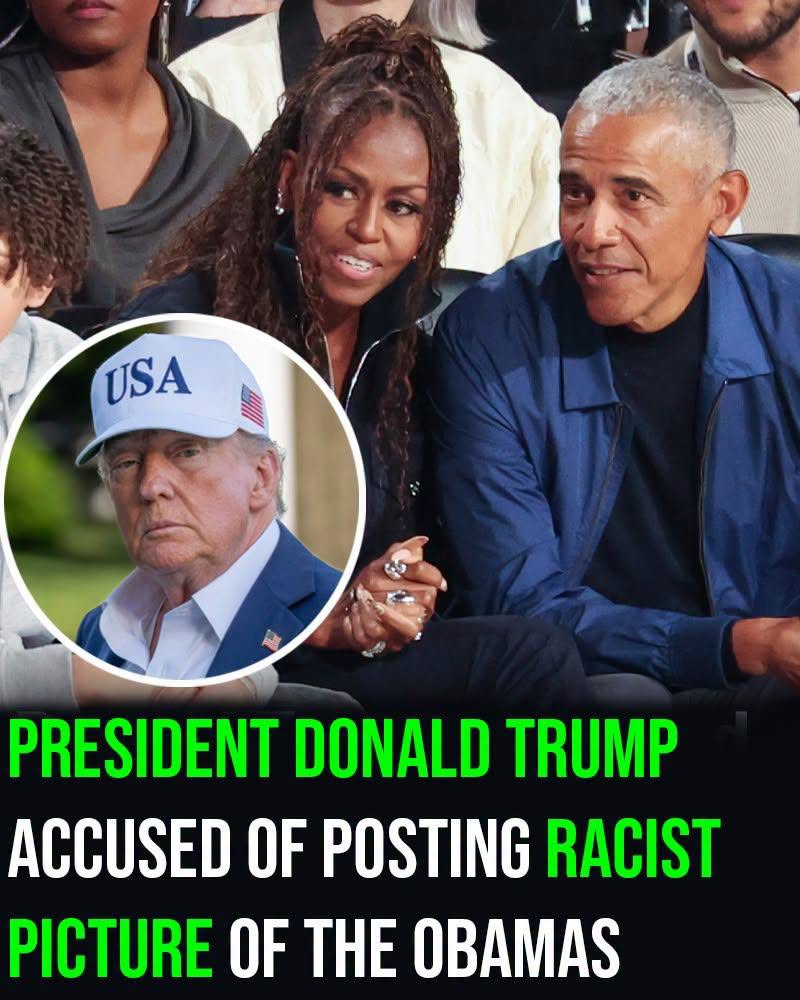
A new controversy surrounding Donald Trump has ignited fierce debate after the former president shared an image involving Barack and Michelle Obama that critics say crossed a line and echoed long-standing racist stereotypes.
The image, which circulated widely online before drawing criticism from political commentators, civil rights advocates, and social media users, showed the former first couple smiling and waving from the stairs of an aircraft covered with various painted messages and symbols.
Among the markings were phrases associated with political movements, including “Yes We Can” and “BLM,” along with Arabic writing translated by some as “alhamdulillah,” meaning “praise be to God.”
While some supporters described the image as political satire, opponents argued that the combination of imagery and references was designed to provoke hostility and reinforce harmful stereotypes.
The debate quickly intensified because it followed another widely criticized image involving the Obamas that was later removed. That earlier post depicted the former president and first lady as apes in a jungle setting, an image that many critics condemned as a racist attack due to the historical use of comparisons between Black people and apes as a tool of dehumanization.
Civil rights advocates argued that such imagery carries a painful historical significance and cannot be dismissed simply as a joke or political criticism.
They said the issue was not only one individual image but what they described as a broader pattern of using exaggerated and inflammatory visuals to target political opponents.
According to critics, these types of posts create controversy by reducing public figures to caricatures rather than engaging with their policies or records.
The latest incident has reopened discussions about the role of political messaging in the digital era, where a single image can spread across millions of screens within minutes.
Supporters of Trump, however, pushed back against accusations of racism and argued that his posts should be viewed within the context of political commentary and criticism of his opponents.
They claim that Trump has frequently used provocative language and imagery throughout his public career and that his critics often interpret his messages in the harshest possible way.
The controversy comes amid renewed attention on other posts and online material connected to Trump that critics have described as offensive or divisive.
One example cited by opponents involved a manipulated image of Barack Obama’s presidential library that portrayed the location in a negative and insulting way.
Critics argued that the image was another attempt to mock Obama personally rather than criticize specific political decisions.
The debate has also included discussion of a resurfaced meme involving Italian Prime Minister Giorgia Meloni, which featured a controversial caption that critics said was disrespectful and inappropriate.
Together, these incidents have fueled accusations from opponents that Trump’s communication style relies heavily on provocation, ridicule, and personal attacks.
They argue that the strategy is intentional: create a viral moment, dominate public discussion, and force opponents to respond.
Political analysts have long noted that Trump’s approach to communication differs significantly from traditional political messaging.
Rather than relying primarily on carefully prepared statements, he has often used social media and visual content to create immediate reactions.
This approach has helped him maintain attention among supporters but has also repeatedly triggered backlash from critics.
The latest controversy highlights the continuing challenge of defining the limits of political satire and public criticism.
For some, harsh political humor is part of democratic debate and should be protected as free expression.
For others, certain images and comparisons cross from criticism into attacks that reinforce harmful social divisions.
The disagreement reflects a larger national conversation about race, politics, and the responsibility of influential public figures.
Because of Trump’s global profile, controversies involving his online activity often extend beyond domestic politics.
His statements and posts are closely watched by foreign governments, diplomats, and international audiences.
With global leaders gathering for major diplomatic discussions, some observers questioned whether the controversy could create additional political complications.
Supporters argue that Trump’s willingness to challenge opponents is part of what attracts his political base.
They view his direct style as a rejection of traditional political language and believe his critics attempt to silence him because they dislike his message.
Opponents, however, argue that public figures have a responsibility to avoid using imagery that can encourage hatred or deepen social divisions.
They believe political disagreement should remain focused on ideas rather than personal attacks involving identity, race, or background.
The debate surrounding the Obama images is part of a much larger discussion about how political figures use digital platforms.
In previous decades, controversial remarks might have taken hours or days to spread.
Today, a single post can become an international story almost instantly.
That reality has changed the way politicians communicate and how the public reacts.
Every image, caption, and message can become a defining moment.
For Trump, this latest controversy adds to a long history of disputes over his public statements and online presence.
His supporters see these moments as examples of his willingness to challenge powerful figures.
His critics see them as evidence of a communication style they believe encourages division.
Regardless of political views, the incident demonstrates how powerful images can be in shaping public debate.
A single photograph or edited graphic can create discussions about history, identity, and the boundaries of acceptable political expression.
As reactions continue, the controversy surrounding the images serves as another reminder of the intense scrutiny faced by one of the most recognizable political figures in the world.
In an era where political battles increasingly take place online, the images leaders share can become just as influential as the policies they promote.
The ongoing debate is unlikely to disappear quickly.
For supporters, it represents another example of Trump refusing to follow traditional political rules.
For critics, it represents a warning about the impact of imagery that they believe crosses into harmful territory.
Either way, the controversy has once again placed the intersection of politics, race, and digital communication at the center of national conversation.