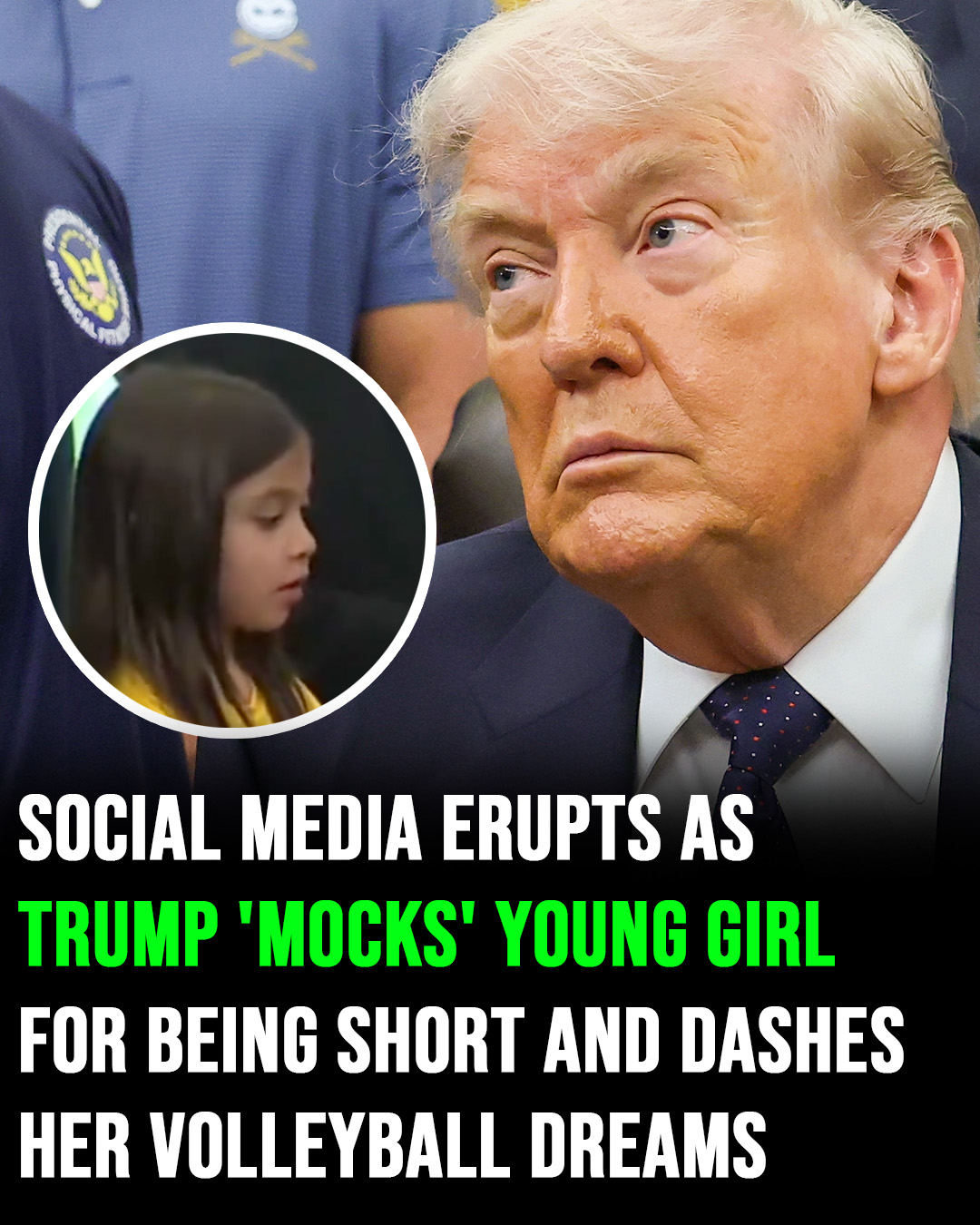
What began as a lighthearted exchange inside the Oval Office quickly exploded into a fierce social media controversy, with millions of people debating whether Donald Trump crossed a line during a conversation with a young girl about her future dreams.
The moment lasted only seconds, yet the reaction that followed revealed how deeply public comments from powerful figures can resonate especially when children are involved.
The encounter appeared simple at first. During a public event attended by families and children, Trump engaged in casual conversation with a young girl who enthusiastically shared her dream of playing volleyball. For many watching, it was the kind of innocent exchange often seen during ceremonial gatherings in Washington. Children speak about ambitions, adults smile politely, and cameras capture the wholesome atmosphere.
But this interaction unfolded differently.
After hearing the girl mention volleyball, Trump reportedly responded by pointing out her height in a way many viewers interpreted as dismissive. Critics immediately accused him of mocking the child and discouraging her aspirations in front of an audience. The clip spread rapidly online, with reactions pouring in across social media platforms within hours.
For some viewers, the issue was not merely about sports or physical ability. It was about the emotional impact of hearing an adult particularly one of the world’s most recognizable political figures—respond to a child’s dream with skepticism instead of encouragement.
Parents, teachers, and former athletes joined the discussion, many recalling moments from their own childhoods when casual remarks from adults left lasting emotional scars. Numerous commenters argued that children often remember dismissive comments for years, especially when those comments relate to appearance or perceived limitations.
The criticism intensified because of the setting itself.
The Oval Office carries enormous symbolic weight. Every interaction there becomes amplified by the power and visibility associated with the presidency. What might have been brushed aside as awkward humor in another setting instead became a national conversation about leadership, encouragement, and the influence adults hold over children’s confidence.
Social media users dissected every detail of the exchange. Some focused on the girl’s reaction, analyzing whether she appeared embarrassed or uncomfortable. Others pointed to the laughter heard in the background, arguing that it made the moment feel even more painful. To critics, the laughter reflected a larger cultural problem in which children’s insecurities are sometimes treated as entertainment rather than handled with care.
Supporters of Trump quickly pushed back against the backlash.
Many argued that the comment was being taken out of context and exaggerated for political purposes. They insisted that Trump was simply being realistic about the physical demands of competitive volleyball, where height can indeed offer advantages at elite levels. Others claimed that the exchange reflected his blunt communication style, which supporters often describe as direct rather than malicious.
Some defenders even argued that encouraging children to understand practical realities is not inherently cruel. In their view, steering young people toward areas where they may excel can be constructive rather than discouraging.
Yet critics countered that realism and encouragement do not have to be opposites.
They argued that adults can acknowledge challenges while still supporting ambition. Countless professional athletes have overcome physical disadvantages through skill, determination, and hard work. Sports history is filled with stories of people who were told they were too small, too slow, or not talented enough—only to later succeed beyond expectations.
That perspective fueled much of the online anger.
To many viewers, the controversy was not about whether the girl would actually become a volleyball star. It was about whether children deserve support when they express dreams, even unrealistic ones. Critics argued that the role of adults is not to immediately define a child’s limitations but to nurture confidence and resilience while allowing growth to happen naturally over time.
The moment also reignited broader debates about Trump’s public communication style.
Throughout his political career, Trump has built a reputation for unscripted remarks, sharp humor, and provocative commentary. Supporters often view this style as authentic and refreshing, while opponents see it as unnecessarily harsh or insensitive. This latest incident quickly became another example cited by both sides in the ongoing cultural divide surrounding his public persona.
For critics, the exchange fit into a larger pattern of comments they believe normalize ridicule and public belittlement. They argued that when influential figures casually mock appearance or limitations, it can shape broader social attitudes, particularly among young audiences.
Supporters, meanwhile, accused critics of overreacting and politicizing a harmless moment involving casual conversation.
As the clip continued circulating online, many people began sharing personal stories connected to the controversy. Former athletes described being underestimated because of height or body type during childhood. Others recalled teachers, coaches, or relatives who either encouraged them despite obstacles or discouraged them before they ever had a chance to try.
Those personal reflections transformed the discussion into something larger than a single political moment.
At its core, the controversy touched on universal experiences nearly everyone understands: childhood ambition, insecurity, encouragement, and the lasting influence of adult words. Most people can remember a moment when someone either believed in them or made them doubt themselves.
That emotional familiarity is part of why the story spread so widely.
Psychologists and educators have long emphasized the importance of encouragement during childhood development. While realistic guidance matters, experts often stress that confidence and persistence are built through support, not immediate limitation. Children frequently grow into abilities over time, and early discouragement can sometimes shape self-perception in lasting ways.
At the same time, others argue that shielding children from practical realities entirely may not prepare them for future challenges. The tension between honesty and encouragement has always existed in parenting, coaching, and mentorship. This incident simply brought that tension into public view through the lens of politics and celebrity.
The reaction also highlighted how modern social media transforms fleeting moments into massive national debates.
Years ago, a brief comment during a private event might have disappeared almost instantly. Today, every gesture, expression, and offhand remark can be clipped, shared, replayed, and interpreted by millions within minutes. Public figures now operate in an environment where even casual interactions carry enormous scrutiny.
In the end, the controversy surrounding Trump’s comment says as much about society as it does about politics.
People are increasingly sensitive to how children are spoken to, particularly in public settings. Conversations about self-esteem, emotional development, and body image have become central cultural issues. What one person views as harmless humor, another may experience as discouragement or humiliation.
That divide explains why reactions to the moment were so dramatically different.
Some saw a blunt but harmless observation. Others saw a powerful adult casually shrinking a child’s confidence in front of cameras. And somewhere between those interpretations lies the larger question that continues to fuel the debate:
When a child shares a dream, should adults focus first on the obstacles standing in the way or on helping them believe they can grow beyond them?