A simple moment on a crowded bus might seem insignificant, but psychologists and social behavior researchers often point out that everyday micro-decisions can quietly reflect how people interpret responsibility, empathy, and priority.
The so-called “Bus Seat Dilemma” is one of those thought experiments designed not to label or judge, but to encourage reflection on how instinctively we respond to others when choices are limited and pressure is subtle but real.
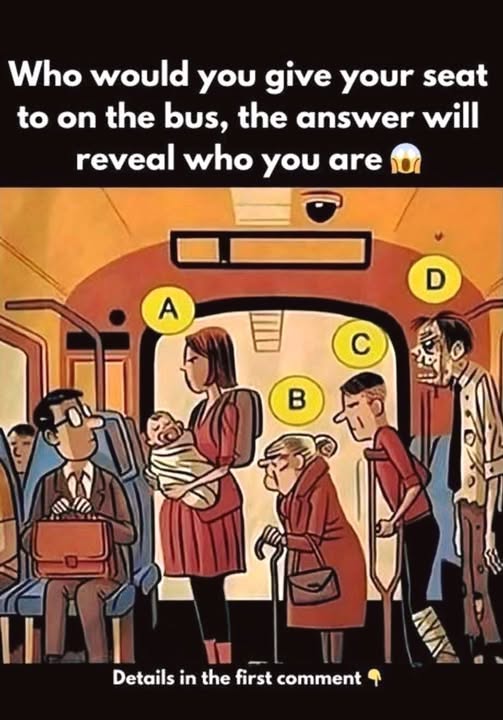
Picture stepping onto a packed bus after a long, exhausting day. The aisle is narrow, passengers are standing close together, and the hum of movement fills the space. The vehicle lurches forward as it makes its way through traffic, and you notice there is only one empty seat left. Around it stand several people who each appear to have a reason they might need it. You cannot help everyone. You can only choose one.
This is where the exercise begins. Your instinctive decision in that moment is believed to reveal something about your internal value system—how you prioritize empathy, urgency, fairness, and social awareness without overthinking.
The first person you might notice is a young mother holding her baby. She looks visibly tired, balancing the demands of caring for an infant while trying to maintain her footing on a moving bus. Her presence often triggers an immediate emotional reaction in many people because it connects deeply with themes of protection, care, and vulnerability.
Those who instinctively offer the seat to the mother are often described as highly empathetic individuals. They tend to prioritize emotional connection and are sensitive to the struggles of others, especially those involving caregiving or dependency. In social environments, they are frequently perceived as warm, nurturing, and supportive, often putting the comfort of others ahead of their own physical needs without hesitation.
The second person is an elderly woman standing near the aisle, holding onto a rail with quiet patience. Her presence represents age, life experience, and the physical realities that come with time. Many cultures place strong importance on showing respect to older individuals, making this choice feel instinctively appropriate to those who value tradition and social courtesy.
Choosing to offer the seat to the elderly woman may suggest a personality grounded in respect for structure, tradition, and established social norms. These individuals often think in terms of duty and etiquette, preferring decisions that align with long-standing principles of politeness and intergenerational respect. They are typically thoughtful in social situations and tend to weigh how their actions reflect broader societal values.
The third person is a man standing on crutches. His posture suggests discomfort and limited mobility, making his need for support immediately visible in a physical sense. Unlike the previous two examples, this scenario emphasizes urgency tied directly to movement and stability.
Those who choose to give the seat to the man on crutches are often viewed as practical and responsive individuals. They tend to focus on immediate physical needs and are quick to act when they see clear signs of difficulty. Their decision-making style is often rooted in real-time awareness rather than emotional or symbolic interpretation. They prefer direct solutions and are comfortable stepping in quickly when assistance is required.
The fourth person is a visibly unwell man who appears weak and unsteady, perhaps struggling with illness or fatigue. His condition is less about mobility and more about overall physical distress, introducing a different kind of urgency that is more subtle but potentially serious.
People who choose to help the sick man are often characterized as highly observant and sensitive to less obvious signs of distress. They may prioritize health-related concerns and interpret subtle cues as signals of deeper need. These individuals often think carefully before acting, but once they assess a situation as serious, they tend to feel a strong sense of responsibility to respond appropriately.
What makes the Bus Seat Dilemma particularly interesting is not the correctness of any answer, but the way each choice reflects a different lens through which people interpret the world. One response emphasizes emotional empathy, another prioritizes social respect, another focuses on physical urgency, and another reflects analytical awareness of distress.
Psychologists often use similar scenarios to study how people make decisions under limited resources. In real life, we constantly navigate situations where we cannot meet every need at once. Whether it is time, attention, or support, we are often required to prioritize without perfect information. These small decisions, repeated over time, contribute to how we are perceived by others and how we understand ourselves.
Importantly, this kind of exercise is not intended to define personality in a rigid way. Human behavior is far too complex to be captured by a single choice. A person might respond differently depending on mood, fatigue, cultural background, or personal experiences. What feels right in one moment may not feel the same in another.
Instead, the value of the Bus Seat Dilemma lies in reflection. It encourages people to pause and consider why they are drawn to certain decisions. Is it compassion? Is it respect? Is it efficiency? Or is it instinctive awareness of urgency? These questions can reveal subtle patterns in how we relate to others.
In everyday life, similar judgments happen constantly and often without conscious thought. We decide who to help first, who to listen to more closely, and where to direct our attention when multiple demands compete. While each individual choice may seem minor, together they form a broader picture of our social instincts.
Some people are naturally inclined toward emotional caregiving, while others prioritize fairness or practical need. Some rely on learned social norms, while others trust immediate perception. None of these approaches are inherently better or worse—they simply reflect different ways of navigating shared space and human interaction.
Ultimately, the Bus Seat Dilemma serves as a reminder that personality is often expressed in quiet, everyday moments rather than dramatic decisions. It is not only about what we choose, but how we arrive at that choice, and what we notice first when faced with competing needs.
In the end, this simple scenario highlights a deeper truth: even in the smallest acts of decision-making, we reveal something about our values, our awareness of others, and the way we instinctively interpret the world around us.