Robert Duvall never needed to demand attention. He had a different kind of power, the kind that could quiet an entire scene with a glance, a pause, or a single carefully delivered line. For more than six decades, he built a career around characters who felt real enough to walk out of the screen and into the lives of the people watching them.
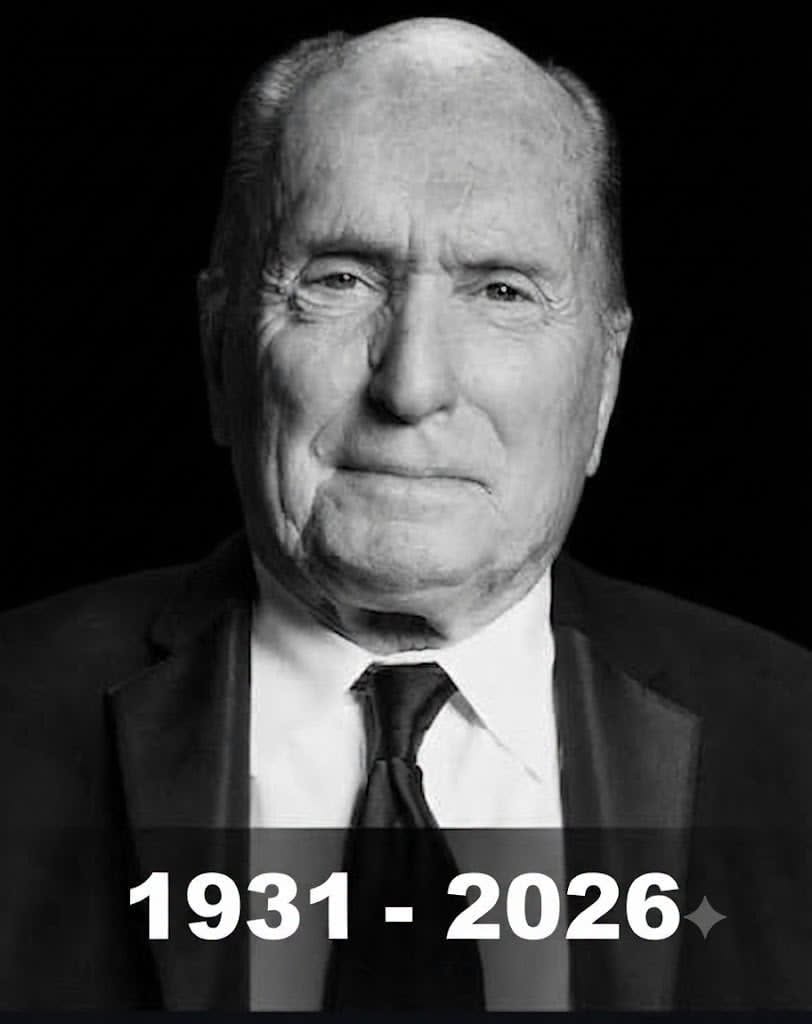
On February 15, 2026, that extraordinary career came to an end. Duvall died peacefully at his home in Middleburg, Virginia, at the age of 95, with his wife, Luciana Duvall, by his side. His death marked the passing of one of the most respected and versatile performers in American cinema.
For audiences around the world, Duvall will forever be connected to some of the most unforgettable films ever made.
He was Tom Hagen in The Godfather, the calm and calculating consigliere whose controlled presence gave the Corleone family a sense of order. He was Lieutenant Colonel Bill Kilgore in Apocalypse Now, a character whose strange combination of military authority, absurdity, and confidence produced one of the film’s most memorable performances. He was Mac Sledge in Tender Mercies, a broken country singer struggling to rebuild his life, a role that earned Duvall the Academy Award for Best Actor.
But reducing Duvall to those performances would miss the very quality that made him special.
He was never simply a star.
He was a character actor who became a star because he understood people.
His characters could be proud, frightened, cruel, funny, exhausted, tender, stubborn, or deeply lost. Sometimes they were several of those things at once. Duvall had an unusual ability to communicate complicated emotions without explaining them.
That gift was already visible early in his career.
One of his first major film appearances came in To Kill a Mockingbird in 1962, where he played Arthur “Boo” Radley. The character barely speaks, yet Duvall made an unforgettable impression. Much of the performance depended on physical presence, expression, and restraint rather than dialogue.
It became an early demonstration of what would eventually become his signature.
Duvall understood that an actor did not always have to speak to control a scene.
Sometimes silence said more.
Over the following years, he became part of the generation that transformed American filmmaking. He appeared in films including MAS*H, The Conversation, The Godfather, The Godfather Part II, Network, Apocalypse Now, The Great Santini, and Tender Mercies.
Each role seemed to reveal another side of him.
Then came The Godfather.
As Tom Hagen, Duvall played a man surrounded by violence who rarely needed to raise his voice. Hagen was an outsider within the Corleone family, yet he became one of its most trusted figures. Duvall gave him intelligence, restraint, loyalty, and a quiet sense of danger.
The performance became one of the defining supporting roles in American film.
Years later, Apocalypse Now offered something completely different.
As Kilgore, Duvall created a character who could appear terrifying one moment and almost comical the next. His famous confidence and bizarre fascination with surfing became part of the movie’s surreal atmosphere. Yet beneath the larger-than-life behavior was an actor who understood exactly how much control was required to make such a strange character believable.
Then came Tender Mercies.
This time, Duvall moved away from spectacle entirely.
Mac Sledge was a washed-up musician whose life had been damaged by alcohol, failed relationships, and years of disappointment. Instead of turning the character into a simple redemption story, Duvall played him as a man learning how to live again one small step at a time.
The performance earned him the Oscar for Best Actor in 1984.
It was the only Academy Award he won, but it represented the culmination of decades spent developing a reputation for extraordinary precision and emotional honesty. Duvall received seven Oscar nominations throughout his career, demonstrating the remarkable consistency of his work across generations.
His career did not stop there.
Duvall continued working well into his later years, appearing in films and television projects while younger generations of performers entered Hollywood.
He also remained willing to take on difficult characters rather than simply repeat the roles that had made him famous.
That willingness helped keep his work fresh.
For many actors, aging in Hollywood can mean gradually becoming invisible. Duvall seemed to resist that fate by continuing to treat acting as a craft rather than a competition for attention.
His work in Lonesome Dove became another major chapter in his legacy. As Augustus “Gus” McCrae, he brought warmth, humor, stubbornness, and vulnerability to a character who became one of television’s most beloved figures.
The performance reminded audiences that Duvall could dominate a screen without relying on theatrical gestures.
He could make a character feel enormous simply by making him human.
Away from the camera, Duvall was also known for his deep commitment to the craft. He had little need for the kind of celebrity culture that often surrounds Hollywood. His reputation was built almost entirely on the work itself.
That may be why his passing feels particularly significant.
Duvall belonged to an era when performers could spend decades developing a body of work rather than becoming famous overnight. His career stretched from the early 1960s into the modern era, connecting generations of filmmaking that otherwise might feel completely separate.
His wife announced his death in a statement describing him as an actor, director, and storyteller whose passion for his craft was matched by his love for the characters he portrayed. She said he had passed away peacefully at home, surrounded by love and comfort.
There was something fitting about that description.
Duvall spent his life telling stories about people who were rarely perfect.
He played criminals, soldiers, fathers, musicians, lawyers, cowboys, politicians, outcasts, and men struggling with their own mistakes. He rarely tried to make them easier to understand than they really were.
Instead, he allowed them to remain complicated.
That may be his greatest contribution.
Robert Duvall showed generations of actors that great performances do not always come from being the loudest person in the room. They can come from observation. From patience. From knowing when to speak and when to remain silent.
His characters often seemed to carry entire histories behind their eyes.
Now the man who spent decades bringing those histories to life has left his own.
His death closes a remarkable chapter in American cinema, but his work remains remarkably alive. New viewers will continue discovering The Godfather, Apocalypse Now, Tender Mercies, Lonesome Dove, and the many other films and performances that made him unforgettable.
The screen will still flicker.
The characters will still speak.
And Robert Duvall will still be there, quietly commanding the frame.
Some actors become famous.
Some become legends.
A rare few become part of the language of cinema itself.
Robert Duvall was one of those few.