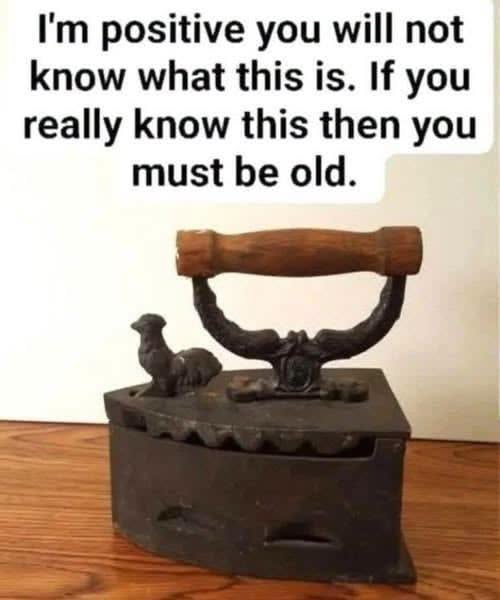
At first glance, the old object looks almost impossible to identify.
Its heavy metal body, unusual shape, hinged lid, and wooden handle make it seem more like a small piece of industrial equipment than something that once sat beside a household wash basin. Yet this curious device was an important part of everyday life long before electric irons became common.
It is a charcoal box iron, an ingenious piece of domestic technology designed to transform glowing embers into a steady source of heat for pressing clothing and household linens.
Today, most people think of ironing as a simple task. Plug in an electric iron, wait for the indicator light, adjust the temperature, and begin. The process is so familiar that it is easy to forget how difficult and physically demanding the same job once was.
Before electricity entered ordinary homes, keeping an iron hot required constant planning.
Earlier versions, often known as sad irons, were essentially solid blocks of cast iron with handles. They had no internal source of heat. Instead, they had to be placed directly on a hot stove or near a fire until they reached the proper temperature.
Once removed from the heat, they slowly cooled.
That meant someone doing a large amount of ironing had to keep several irons available, heating one while another was being used. As soon as the iron became too cool, it had to be exchanged for a hot one.
It was an exhausting cycle.
The charcoal box iron offered a clever alternative.
Instead of relying entirely on an external stove, this type of iron contained a hollow chamber where hot charcoal could be placed. The burning embers acted like a miniature furnace inside the iron, producing heat from within rather than requiring the entire tool to be repeatedly returned to the stove.
The basic idea was remarkably practical.
Charcoal was heated until it became a bed of glowing embers. Those embers were then placed inside the iron’s chamber, where they continued producing heat as the user worked. The warmth traveled through the heavy metal body and reached the smooth soleplate underneath.
That soleplate was the part that actually touched the fabric.
As it moved across damp clothing or freshly washed linen, the heat and pressure flattened wrinkles and created the crisp appearance that households once associated with carefully maintained clothing.
The design also included a lid that could be opened when the charcoal needed attention. Some examples featured decorative or functional latches, including distinctive animal-shaped handles that gave these otherwise practical tools a surprising amount of personality.
The wooden handle served another important purpose.
Because the iron itself became extremely hot, users needed a way to hold and move it without burning their hands. Wood was a natural choice because it did not conduct heat as quickly as metal.
Even so, using a charcoal iron was far from effortless.
The person doing the ironing had to manage the heat carefully. Too little heat meant wrinkles would remain. Too much heat could scorch delicate fabric or leave behind an unpleasant smell. The charcoal also needed enough oxygen to remain hot, making ventilation and airflow important considerations.
There was another problem that modern users rarely have to think about.
Smoke.
Burning charcoal inside a household tool could produce fumes, especially if the fuel did not burn efficiently. Homes had to deal with heat, steam, smoke, and the general discomfort that accompanied large-scale laundry work.
Ironing itself was already physically demanding.
Imagine standing for hours beside a stove or worktable, repeatedly lifting a heavy iron, pressing it across fabric, returning to the laundry pile, and doing it all again. A charcoal box iron might have reduced the need to repeatedly return the tool to the fire, but it certainly did not turn ironing into an easy job.
For laundresses and homemakers, beautifully pressed clothing came at a considerable physical cost.
Yet the charcoal iron represented an important step in the evolution of household technology.
It occupied an interesting position between the old world and the modern one.
It still depended on fire and charcoal, just as earlier household tools had for generations. But unlike a simple solid iron that needed to be reheated constantly, it contained its own heat source.
That small change mattered.
The idea of putting the fuel inside the tool demonstrated a growing desire to make household work more efficient and portable. Instead of treating the iron as a piece of metal that borrowed heat from a stove, designers were beginning to think of it as an independent appliance.
That concept would eventually become even more important when electricity transformed domestic life.
Electric irons eventually eliminated the need for charcoal altogether. With the turn of a switch, heat could be generated inside the appliance without fire, embers, or a smoky room.
Temperature controls later made the process even more precise.
Modern irons can maintain relatively stable temperatures, produce steam on demand, and shut themselves off automatically when left unattended. Compared with a charcoal box iron, they seem almost futuristic.
But the basic purpose has remained exactly the same.
Remove wrinkles.
Create smooth fabric.
Make clothing look finished.
That continuity is what makes antique ironing tools so fascinating.
A charcoal box iron may appear primitive today, but it represents the same human desire that drives countless modern inventions: finding a better way to complete an ordinary task.
For families in earlier generations, clean and neatly pressed clothing was often associated with discipline, respectability, and care. A crisp collar or smooth tablecloth could communicate something about the household that produced it.
The work behind that appearance was rarely visible.
The charcoal iron was part of that hidden labor.
It helped turn freshly washed, wrinkled fabric into something orderly and presentable, even though the person using it might have spent hours battling heat and fatigue to achieve the result.
Today, surviving charcoal box irons have become fascinating historical objects. Collectors appreciate their construction, craftsmanship, unusual shapes, and decorative details. Museums and antique displays sometimes use them to demonstrate how dramatically domestic technology has changed.
For younger generations, the object can be difficult to understand at first.
Why would anyone put burning charcoal inside an iron?
The answer becomes clearer when you remember the world in which it was designed.
There were no power outlets waiting beside the ironing board. No temperature settings. No automatic shutoff. No lightweight steam appliance sitting in a kitchen cabinet.
There was simply fabric, heat, pressure, and human effort.
The charcoal box iron brought those elements together in a surprisingly clever package.
Its heavy body stored heat.
Its internal chamber held the fuel.
Its wooden handle protected the user’s hands.
Its smooth bottom transferred heat and pressure to the fabric.
Everything about it was designed around a practical problem.
And that is perhaps the most interesting thing about this strange vintage object.
It was never intended to become a museum curiosity.
For the people who used it, it was simply a tool.
It belonged to a world where household technology was powered by fire, where laundry could consume an entire day, and where even something as ordinary as ironing required skill, patience, and physical endurance.
The next time you see one of these mysterious old irons, it may be tempting to dismiss it as a strange piece of metal from another era.
But look closer.
Inside that heavy box was a small revolution.
The charcoal box iron did not eliminate the hardships of domestic work, but it made one part of that work more manageable. It showed that even before electricity transformed the home, people were already searching for smarter ways to control heat and reduce repetitive labor.
In that sense, this forgotten object was more than an iron.
It was a bridge.
On one side stood the old household ruled by wood fires, hot stoves, smoke, and manual labor. On the other waited the electric age, filled with switches, thermostats, and appliances that would eventually change everyday life.
The charcoal box iron stood quietly in the middle.
And for generations, it helped turn burning embers into something surprisingly simple: a clean, smooth shirt, a sharp collar, or a perfectly pressed sheet.