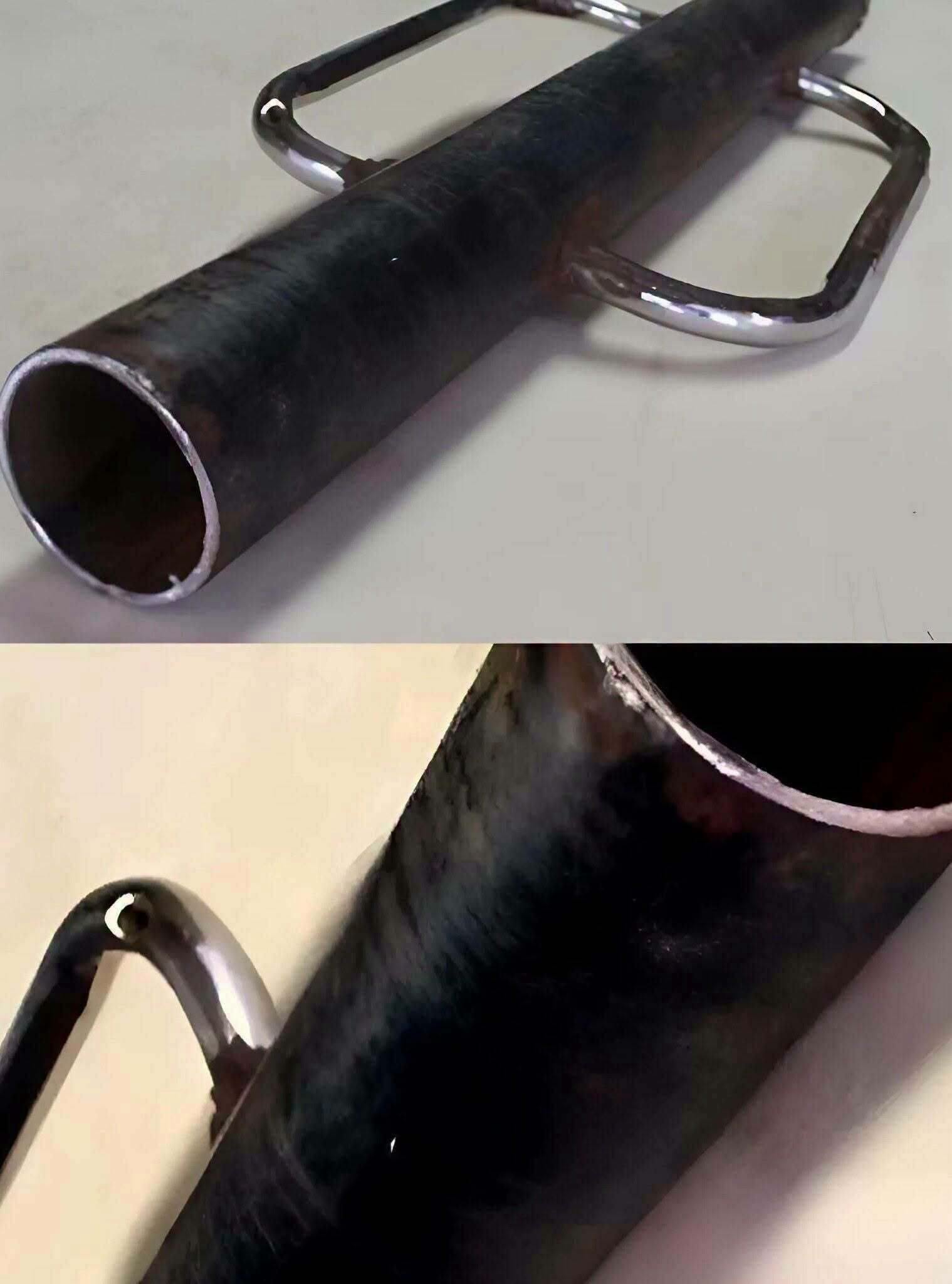
At first glance, it looks like nothing more than a heavy piece of steel.
There are no buttons, no wires, no complicated mechanisms, and certainly nothing about its appearance that immediately tells you what it was designed to accomplish. To someone unfamiliar with farm tools or outdoor construction equipment, it could easily be mistaken for a piece of industrial scrap or some forgotten piece of machinery.
But this simple metal object has one very specific job.
It is a manual post driver, a remarkably straightforward tool designed to force fence posts deep into the ground using nothing more than weight, leverage, and human strength.
And once you understand how it works, the mysterious object suddenly makes perfect sense.
The design is almost surprisingly basic.
A traditional post driver consists of a heavy steel tube with handles attached to the sides. The tube is open at the bottom so it can slide over the top of a fence post. Once positioned correctly, the user lifts the driver upward and then brings it down forcefully.
The impact transfers the weight of the steel directly onto the top of the post.
Then it happens again.
And again.
And again.
With every downward strike, the post moves slightly deeper into the soil.
There is no engine powering the process.
No gasoline.
No electrical outlet.
No complicated controls.
Just a person, a steel tool, and a stubborn piece of ground.
That simplicity is exactly what makes the post driver so effective.
Fence posts need to be firmly anchored if they are expected to survive years of wind, rain, livestock, accidental impacts, and changing weather. Simply pushing a wooden or metal post into soft soil is rarely enough. It needs to be driven deep enough to remain stable.
That is where this unassuming tool becomes invaluable.
Instead of swinging a separate hammer or trying to strike the post with an awkward object, the driver surrounds the post and allows the user to deliver repeated, controlled blows directly downward.
The weight of the tool does much of the work.
The operator lifts.
The operator drops.
The ground gives way little by little.
Eventually, the post reaches the desired depth and becomes firmly embedded in the earth.
The process may sound primitive, but it is actually an excellent example of practical engineering.
The tool does not need to be complicated because its purpose is simple.
It needs to concentrate force in exactly the right place.
The heavy steel body provides momentum.
The hollow center allows the tool to fit over the post.
The handles give the operator control.
And the repeated motion makes it possible to drive posts without requiring a separate power source.
It is one of those designs that demonstrates an important principle of good tools: sometimes the simplest solution is the most useful one.
Manual post drivers can be found in places where fences are constantly being built, repaired, or expanded.
Farmers use them when installing livestock fencing.
Ranchers rely on them when replacing damaged posts.
Gardeners may use smaller versions for garden fencing, trellises, and other outdoor structures.
Construction workers and landscapers can also encounter similar tools when installing posts or stakes.
They are particularly useful in locations where bringing heavy machinery is inconvenient or unnecessary.
Imagine needing to install several fence posts on a remote stretch of land.
You could bring powered equipment, arrange for fuel, deal with maintenance, and maneuver machinery through uneven terrain.
Or you could carry a steel post driver and start working.
That portability is one of its greatest advantages.
It does not depend on a battery.
It does not need to be plugged in.
It does not require an engine to start.
As long as someone can lift it, the tool can do its job.
Of course, using one is not effortless.
A manual post driver can be heavy, especially after dozens or hundreds of repetitions. Driving posts into hard, rocky, or compacted ground can become physically demanding very quickly.
That is why the tool is often associated with agricultural work and outdoor labor where strength and endurance are part of the job.
Yet there is something satisfying about the process.
Each strike produces visible progress.
At first, the post barely seems to move.
Then another strike lands.
The post sinks slightly farther.
Another.
Another.
Eventually, what began as a loose piece of wood standing on the surface becomes a sturdy structural element anchored deep in the earth.
The result is easy to overlook.
Once the fence is complete, nobody thinks about the tool that helped install it.
People notice the finished fence.
They notice the straight line of posts.
They notice the gates, wire, and rails.
But the simple steel driver that helped put those posts into the ground disappears into the background.
That is part of what makes old-fashioned tools so fascinating.
Their importance is often hidden by the very fact that they work.
A good tool does not need to attract attention.
It simply needs to perform its task reliably.
The post driver is a perfect example.
Its appearance has barely changed because there is little reason to redesign something that already solves the problem efficiently.
Modern technology has transformed countless areas of work.
Machines have become faster.
Equipment has become more sophisticated.
Sensors, batteries, motors, and computer controls have found their way into tools that once depended entirely on human effort.
But not every job benefits from adding complexity.
For driving a fence post, the basic requirements remain the same.
You need force.
You need control.
You need repetition.
The steel post driver provides all three.
That is why versions of this tool continue to appear in barns, workshops, farms, gardens, and construction areas.
It may look like an object from another era, but its usefulness has never really disappeared.
There is also something almost symbolic about the tool.
In an age when people expect everything to become automated, the post driver represents a different philosophy.
It reminds us that not every problem requires a machine.
Sometimes the solution is simply a well-designed piece of metal that uses physics efficiently.
The tool converts human movement into useful force.
The operator provides the energy, while the shape and weight of the driver make that energy more effective.
It is a partnership between engineering and physical effort.
And perhaps that is why mysterious objects like this can be so fascinating.
When we see an unfamiliar tool, we tend to judge it by appearance.
If it has no obvious purpose, we assume it must be complicated.
We imagine that it belongs to some specialized industry or forgotten machine.
But the truth can be much simpler.
This particular piece of steel was never designed to impress anyone.
It was designed to hit a fence post.
Over and over.
Until the job was finished.
There is something almost beautiful about that level of practicality.
No unnecessary decoration.
No technology for the sake of technology.
No complicated instructions.
Just a sturdy design that performs exactly the task it was created to perform.
So the next time you encounter a strange steel tube with handles and wonder what on earth it could possibly be used for, look at it a little differently.
It might not be a mysterious industrial relic at all.
It could be one of the simplest and most effective tools ever created for a very ordinary problem.
A fence post needs to go into the ground.
The ground does not want to give up easily.
And this heavy piece of steel was built to make sure the post eventually wins.