
For the families waiting thousands of miles away, news from the USS Abraham Lincoln has become increasingly difficult to hear.
Months at sea can already test the limits of even the most experienced sailors. Long periods away from home, exhausting schedules, cramped living conditions, and the constant demands of military service can take a serious toll. But reports emerging after an unusually prolonged deployment have raised concerns about something more fundamental: whether the crew is receiving the basic care and support it needs to endure such an extended mission.
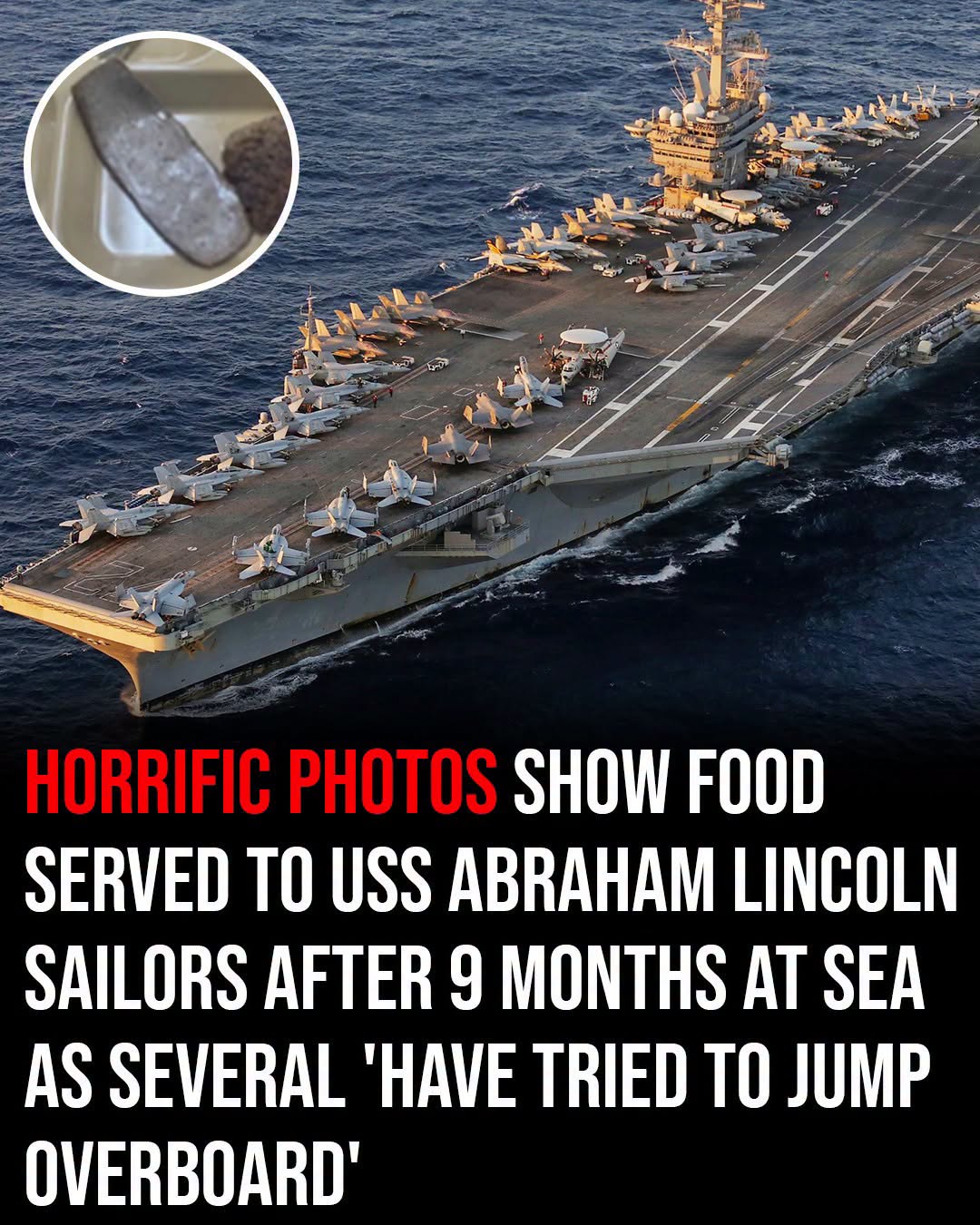
Photographs circulating online have drawn particular attention to the food reportedly being served aboard the carrier. Images showing unappetizing meals, including meat that appears dry or poorly prepared, have sparked criticism and renewed questions about the quality of life available to sailors who have spent months away from home.
For the people watching from shore, those photographs are difficult to separate from the larger human story.
Behind every sailor aboard the ship is a family waiting for a phone call, a message, or the day their loved one finally walks through the front door.
Some relatives have reportedly tried to send packages filled with ordinary comforts from home. Snacks, toiletries, clean socks, personal necessities, and small reminders of normal life can mean far more than their monetary value when someone has been away for months.
But disrupted mail routes and logistical complications have reportedly made it difficult for some packages to reach their intended recipients.
That has left families feeling helpless.
A parent cannot simply drive to the ship.
A spouse cannot drop off a favorite meal.
A sibling cannot stop by after work with something the sailor forgot.
For months at a time, communication can become the only connection between the person serving aboard the carrier and the people waiting at home.
That is why troubling messages can have such a powerful impact.
When sailors describe exhaustion, frustration, or deteriorating living conditions, relatives may have little ability to intervene. They can listen. They can encourage. They can send messages of support.
But ultimately, they have to wait.
And waiting becomes particularly painful when reports begin circulating about problems involving basic necessities.
Questions have been raised about showers, toilets, hot water, food quality, and other aspects of daily life aboard the ship. Any one problem might appear manageable in isolation.
After months of deployment, however, small inconveniences can become enormous sources of stress.
A cold shower is frustrating.
Repeatedly dealing with malfunctioning facilities is exhausting.
Poor meals can become demoralizing when they are part of the daily routine.
And when people are already operating under demanding schedules, even minor problems can begin to feel overwhelming.
The controversy became even more serious because of reports that some sailors had experienced severe emotional distress.
Claims that individuals considered going overboard have fueled intense public concern, although the precise circumstances surrounding individual incidents remain a matter for investigation and verification.
Such reports cannot simply be dismissed as another argument about military living conditions.
Mental health aboard a deployed vessel is a serious issue.
Sailors may be coping with separation from their families, sleep deprivation, work pressure, uncertainty, and the psychological strain that comes from remaining in a confined environment for long periods.
Many service members are trained to keep moving regardless of discomfort.
They are expected to complete their assignments.
They are expected to remain professional.
They are expected to put the mission first.
But that does not mean they stop being human.
Eventually, exhaustion can accumulate.
A person who might easily tolerate a difficult day can struggle when difficult days become weeks and weeks become months.
That is why access to mental-health resources and trusted support systems can be so important during lengthy deployments.
Military officials have emphasized that resources are available and that sailors have access to medical and counseling services. Officials have also pushed back against some of the more alarming descriptions circulating publicly, emphasizing that essential systems and services remain operational.
That response, however, has not ended the controversy.
Instead, the disagreement has created two very different pictures of life aboard the carrier.
One picture describes a ship where crews continue performing their duties under difficult but manageable conditions, supported by established military services and leadership.
The other is painted by worried families and sailors who describe an environment in which prolonged deployment, deteriorating facilities, questionable meals, and emotional exhaustion have combined into something much harder to endure.
The truth may ultimately prove more complicated than either side suggests.
A large aircraft carrier is effectively a floating city.
Thousands of people live and work aboard the vessel, creating enormous demands for food, water, sanitation, maintenance, medical care, and recreation. Keeping every system functioning continuously is a monumental logistical challenge.
At the same time, that complexity cannot become an excuse for ignoring legitimate concerns.
The people serving aboard the ship are not simply numbers on a deployment schedule.
They are sons and daughters.
They are husbands and wives.
They are parents.
They are friends and neighbors.
They are people whose families have sacrificed alongside them.
For those families, the debate is not really about whether a particular meal looked appetizing in a photograph.
It is about whether their loved ones are being treated with the care and dignity they deserve.
That distinction matters.
A photograph of an unpleasant meal can be debated.
A complaint about a broken shower can be investigated.
A malfunctioning toilet can be repaired.
But when multiple concerns appear alongside reports of emotional distress, officials have a responsibility to look beyond individual complaints and ask whether there is a larger problem.
Lawmakers have begun demanding answers, with criticism focusing on whether sailors have been left at sea for too long without adequate relief or support.
The political debate is likely to continue.
Some will argue that military service necessarily involves hardship and that sailors understand the demands when they volunteer.
Others will counter that hardship is not the same thing as neglect and that basic standards should never become optional simply because a mission is difficult.
Both arguments point toward the same underlying question.
How much sacrifice should service members be expected to make before the institution responsible for them must step in and provide meaningful relief?
For the crew of the USS Abraham Lincoln, that question is not theoretical.
It is part of everyday life.
Every meal matters.
Every shower matters.
Every phone call home matters.
Every night of sleep matters.
And every sailor struggling emotionally matters.
The carrier’s long deployment may eventually be remembered for its operational significance, but the stories emerging from inside the ship have created another narrative one centered not on aircraft, missions, or military strategy, but on the people who keep the enormous vessel functioning day after day.
They continue working.
They continue showing up.
They continue doing what they were trained to do.
But the growing public attention surrounding their living conditions has made one thing impossible to ignore.
Even the strongest military machines are ultimately powered by human beings.
And human beings have limits.
For the families waiting on shore, the hope is simple. They want accurate information. They want their concerns taken seriously. They want their loved ones to have decent food, functioning facilities, meaningful support, and a safe path home.
After months of separation, that does not seem like too much to ask.
It is the minimum reassurance every military family deserves when someone they love is serving far from home.