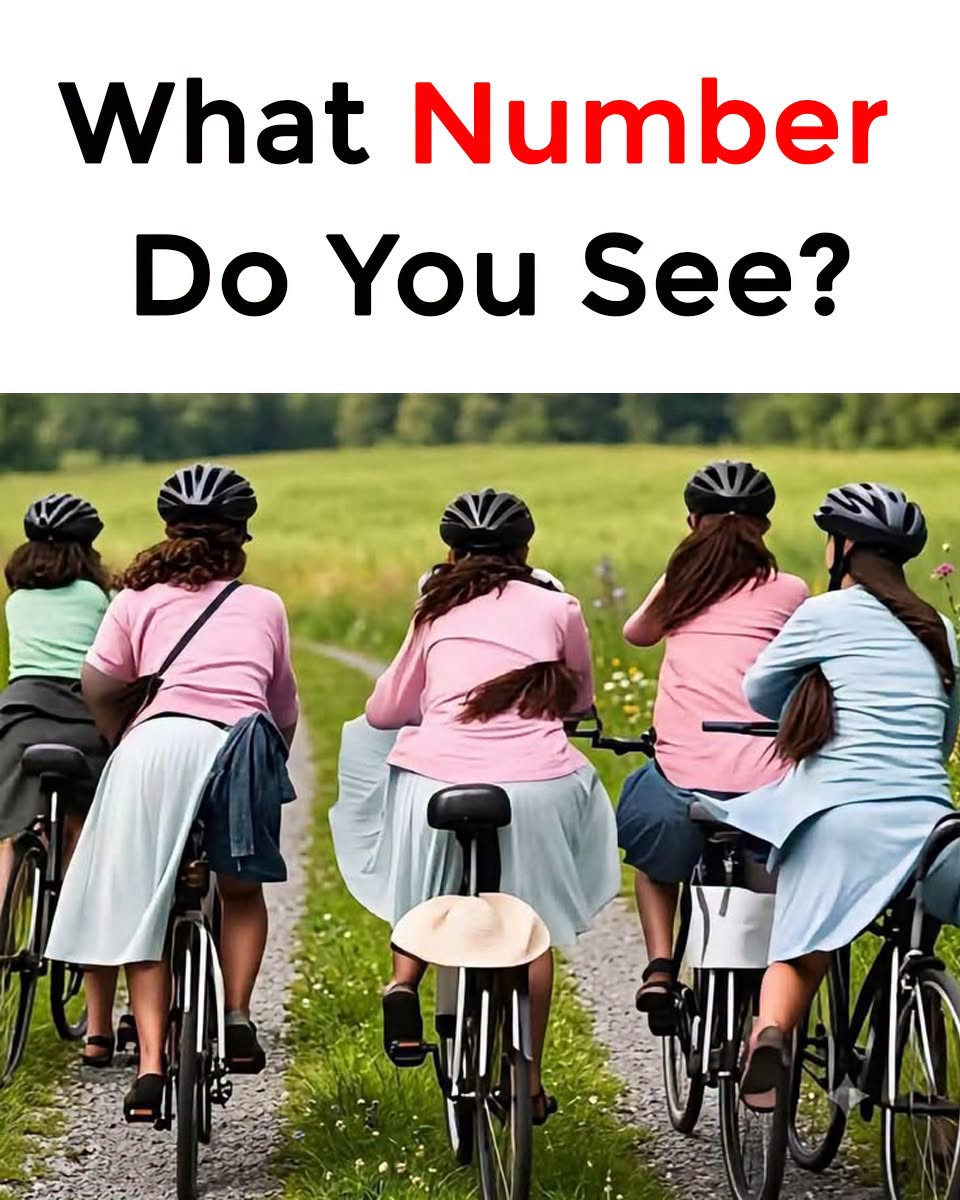
At first glance, the picture looks completely ordinary.
You see a group of people enjoying what appears to be a fun bicycle ride, moving together through the scene as if they are simply out for a pleasant day. There is nothing about the image that immediately suggests a puzzle. No obvious symbols are marked. No arrows point toward a secret location. Nothing appears to be hiding in plain sight.
But there is something hidden inside the photograph.
A number.
And the strange part is that you may not be able to see it no matter how carefully you stare.
That is because this particular optical illusion requires you to stop looking at the picture in the usual way.
Instead, you need to change how you see it.
The challenge sounds almost too simple.
Squint your eyes.
Yes, that is really the trick.
Before reading any further, take another look at the image. Study the cyclists for a moment. Notice their clothing, their bicycles, their positions, and all the small details scattered throughout the photograph.
Now slowly narrow your eyes.
Let the image become blurry.
Do not try to focus harder.
Do the opposite.
Relax your vision and allow the individual details to blend together.
Something surprising should begin to happen.
As the cyclists and their bicycles lose their sharp outlines, the image starts transforming into something completely different. The individual people become less important, while the larger shapes hidden among them begin to stand out.
Your brain starts connecting patterns that were almost impossible to recognize before.
And somewhere across the entire group, a large number begins to emerge.
That number is the answer to the puzzle.
But seeing it may take some patience.
Some people notice it almost immediately after squinting. Others need several attempts before the hidden shape finally becomes recognizable. You may even look directly at the image and feel certain that there is no number there at all.
Then, suddenly, it appears.
Once your eyes catch the pattern, the illusion becomes much easier to understand.
The strange thing about optical illusions is that they often depend on something our brains normally do extremely well.
We are constantly processing enormous amounts of visual information. Every second, our eyes collect countless details, and our brains organize those details into objects, shapes, movement, and meaning.
Most of the time, this happens automatically.
We see a bicycle as a bicycle.
We see a person as a person.
We see a road, a building, a tree, or a group of people without having to consciously analyze every individual line and shadow.
But an illusion like this takes advantage of that automatic process.
The picture contains one obvious layer the cyclists and another hidden layer that only becomes visible when you change the way you look at the scene.
Squinting reduces the amount of fine detail reaching your visual system. Instead of concentrating on individual faces, wheels, clothing, and other small features, your eyes begin picking up broader areas of light and dark.
Those larger patterns can reveal an image that is almost impossible to recognize when everything is sharply focused.
It is similar to stepping backward from a painting.
When you stand close to a painting, you may notice individual brushstrokes.
Move farther away, and those brushstrokes blend together.
A completely different picture can suddenly become visible.
The same basic idea is happening here.
Your eyes are not actually changing the photograph.
The hidden number was already there.
You are simply changing the conditions under which your brain processes the information.
That is what makes this challenge so entertaining.
It is not really a test of intelligence.
You do not need advanced mathematical skills.
You do not need a special talent for puzzles.
You do not even need to be particularly observant.
You simply need to be willing to look at something in an unusual way.
Try narrowing your eyes gradually rather than squeezing them shut completely.
If the number does not appear, blink and try again.
You can also move slightly farther away from the screen.
Sometimes changing the distance makes the larger pattern easier to recognize.
Another useful trick is to avoid staring at one individual cyclist.
Instead, allow your gaze to cover the entire image.
Think of the photograph as one large collection of shapes rather than dozens of separate people.
That change in perspective can make all the difference.
At first, you might see nothing.
Then perhaps you notice a faint curve.
Maybe a vertical line seems to appear.
You may think your eyes are simply playing tricks on you.
Keep looking.
The shapes begin to connect.
Suddenly, the hidden number starts taking form.
And once you recognize it, you may wonder how you missed it in the first place.
That is one of the most enjoyable parts of visual puzzles.
The answer can feel completely obvious after you discover it, even though it was remarkably difficult to see beforehand.
You may even find yourself showing the image to someone else and watching them struggle with the same challenge.
“Just squint,” you might tell them.
But knowing the trick does not necessarily make the number appear immediately.
They still have to experience that moment when the separate details blur together and the larger shape finally emerges.
Optical illusions like this also demonstrate just how complicated ordinary vision really is.
We often assume that seeing simply means looking.
But the brain is constantly interpreting what the eyes receive.
It decides which details matter, which shapes belong together, what objects are present, and what patterns might have meaning.
Sometimes that processing helps us understand the world quickly.
Other times, it can be manipulated to make us see something unexpected.
This puzzle takes advantage of that fascinating process.
The cyclists are real.
The image is real.
The hidden number is real.
But your ability to recognize the number depends on changing the way you process the entire scene.
That is why staring harder may not help.
In fact, concentrating too intensely on individual details can make the illusion harder to see.
The secret is to step away from the details.
Relax.
Squint.
Let everything blend together.
Then look for the larger pattern.
So, before checking the answer, give yourself one final chance.
Look at the original image.
Squint your eyes.
Let the cyclists become blurry.
Do not focus on one person.
Do not search for individual digits.
Instead, look at the entire group as a single shape.
What number appears?
If you spotted it quickly, congratulations.
If you needed several attempts, that is completely normal.
And if you still cannot see it, do not worry. Sometimes the illusion becomes much easier after someone reveals the answer.
The hidden number in this particular image is 769.
Now look at the picture again with that answer in mind.
You may suddenly notice the shapes you were missing before.
And that is the real trick behind the puzzle.
The number was never placed somewhere obvious for you to find.
It was hidden inside the overall pattern, waiting for you to change the way you looked at the image.
Sometimes seeing more clearly means doing something surprisingly simple.
Looking less closely.