At first glance, the challenge seems almost embarrassingly simple.
You look at the pan.
You see the eggs.
You count them.
Done.
Or at least, that is what your brain wants you to believe.
But this seemingly harmless egg puzzle hides a much more interesting problem. The question is not simply about counting what you can see. It is about deciding what the picture actually proves and what your mind is quietly assuming.
That distinction can turn a five-second puzzle into a surprisingly difficult exercise in logic.
How many eggs are really in the pan?
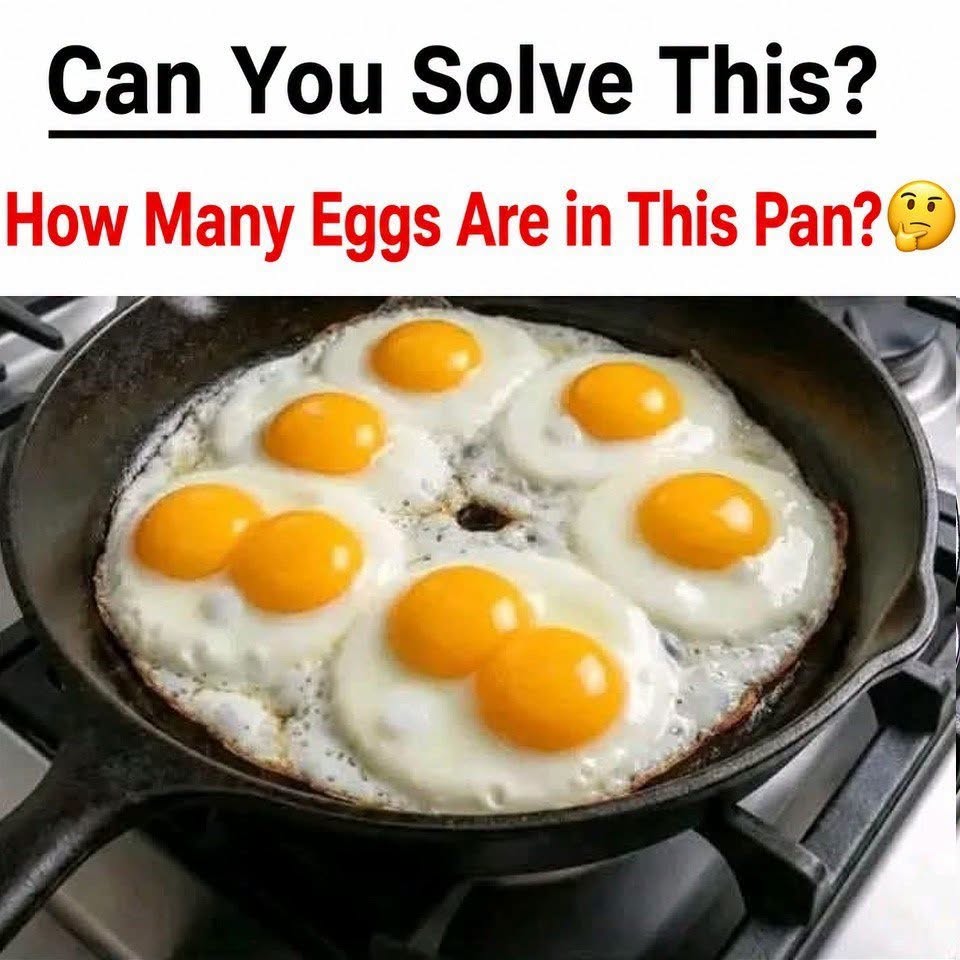
Maybe you immediately answered six.
Perhaps you counted seven.
Maybe you confidently came up with eight.
And if you did, you probably felt fairly certain about your answer.
That is exactly where the puzzle becomes interesting.
Because depending on what the image shows, several different explanations can fit the same visual evidence.
You may be looking at visible yolks, but a yolk does not always equal one egg.
One egg can contain two yolks.
Two eggs can overlap.
An egg white can spread around another egg.
Some parts of an egg may be hidden beneath others.
And unless the picture gives you enough information to rule out those possibilities, claiming that you know the exact number can be more complicated than it first appears.
This is what makes visual riddles so effective.
They encourage us to treat incomplete information as complete.
Your brain sees a familiar object, recognizes the pattern, and immediately begins filling in the missing pieces.
If you see six distinct yolks, for example, your first instinct may be to assume there are six eggs.
That assumption feels natural because most of the time, one yolk does belong to one egg.
But “usually” is not the same as “always.”
A single egg can contain two yolks.
That means six visible yolks could potentially represent six eggs, five eggs, or another number depending on what else is happening inside the pan.
Suddenly, the simple counting exercise becomes a problem of interpretation.
The same thing happens with overlapping objects.
Imagine placing several eggs into a pan and allowing them to spread naturally.
Some whites could overlap.
One egg could partially cover another.
A yolk might be hidden beneath a neighboring egg.
From one angle, you might see several distinct features without being able to determine exactly how many individual eggs produced them.
Your eyes provide evidence.
They do not necessarily provide the complete story.
That is an important difference.
Humans are remarkably good at recognizing patterns. In everyday life, this ability is useful. We rarely need to analyze every object in front of us from scratch.
When you see a chair, you do not stop to count every piece of wood before deciding what it is.
When you see a plate of food, you instantly recognize what you are looking at.
When you see several eggs in a pan, your brain automatically applies familiar rules.
Usually, one yolk means one egg.
Usually, separate yolks mean separate eggs.
Usually, what you can see represents most of what is there.
But puzzles like this deliberately challenge those shortcuts.
They ask you to stop relying on what is typical and start asking what is actually guaranteed by the evidence.
That can be surprisingly uncomfortable.
We like definite answers.
Six.
Seven.
Eight.
Pick one.
Move on.
But sometimes the most accurate answer is not a number.
Sometimes it is, “There is not enough information to know for certain.”
That may sound like avoiding the puzzle, but it can actually demonstrate stronger reasoning.
Good problem-solving is not always about finding an answer as quickly as possible.
It is also about recognizing the limits of the available evidence.
Consider what happens if you decide there are seven eggs.
What evidence proves that?
If you counted seven yolks, you have established that seven yolks are visible.
But have you established that every yolk came from a separate egg?
Not necessarily.
Now suppose you answer six.
Perhaps there are six yolks visible.
But could one of those eggs have contained two yolks?
If so, the number of eggs could be different.
And what about an egg whose yolk is hidden?
The picture might not provide enough information to exclude that possibility either.
This is where assumptions quietly enter the puzzle.
You may not even realize you are making them.
That is one reason these riddles are so effective. They do not necessarily trick your eyesight.
They trick your confidence.
They make you feel as though the answer is obvious before you have actually examined the question.
There is a valuable lesson in that.
Whenever we encounter incomplete information, our minds naturally try to complete the picture.
We create explanations.
We connect patterns.
We make predictions.
And often, that process happens so quickly that we forget the difference between what we observed and what we inferred.
The egg puzzle exposes that difference in a harmless way.
You can separate the evidence from the assumption.
The evidence might be the number of visible yolks.
The assumption might be that each yolk represents a separate egg.
The evidence might be that several whites appear distinct.
The assumption might be that none of them overlap.
Once you separate those two categories, the puzzle becomes much more interesting.
You begin to realize that the image may support several possible answers.
Maybe there really are six eggs.
Maybe there are seven.
Maybe there are eight.
Perhaps the intended answer depends on a specific visual clue that is easy to overlook.
Or perhaps the puzzle was designed precisely to demonstrate that the information provided is insufficient to establish one definitive answer.
That last possibility is often the most frustrating.
People want puzzles to have solutions.
We expect the creator to know the answer.
We assume that if we think hard enough, we will eventually discover the hidden number.
But not every question has enough information to produce certainty.
And recognizing that is not a failure.
It is a skill.
In mathematics, science, journalism, law, and everyday decision-making, understanding uncertainty is essential.
A responsible conclusion should never claim more than the evidence supports.
The pan full of eggs may seem trivial, but the reasoning behind the question is anything but trivial.
It asks you to slow down and challenge your first instinct.
It asks whether you are counting what you actually see or counting what you assume must be there.
It asks whether your confidence comes from evidence or familiarity.
And most importantly, it reminds you that being intelligent does not mean always having an immediate answer.
Sometimes intelligence means knowing when to stop guessing.
So if you looked at the pan and immediately announced six, seven, or eight, take another moment.
Ask yourself why.
What exactly did you count?
Which details are visible?
Which details are hidden?
Could two yolks belong to the same egg?
Could eggs overlap?
Could something be concealed beneath another egg?
And does the picture genuinely provide enough evidence to eliminate every alternative?
If the answer is yes, then you may have solved the puzzle.
If the answer is no, then perhaps the real solution is not a number at all.
Perhaps the real answer is uncertainty.
That is what makes this simple egg puzzle so much more clever than it appears.
The pan is not really testing how quickly you can count.
It is testing whether you know the difference between seeing something and knowing something.
And sometimes, the smartest person in the room is not the one who shouts the answer first.
It is the one who pauses and says, “Wait, do we actually have enough information to know?”