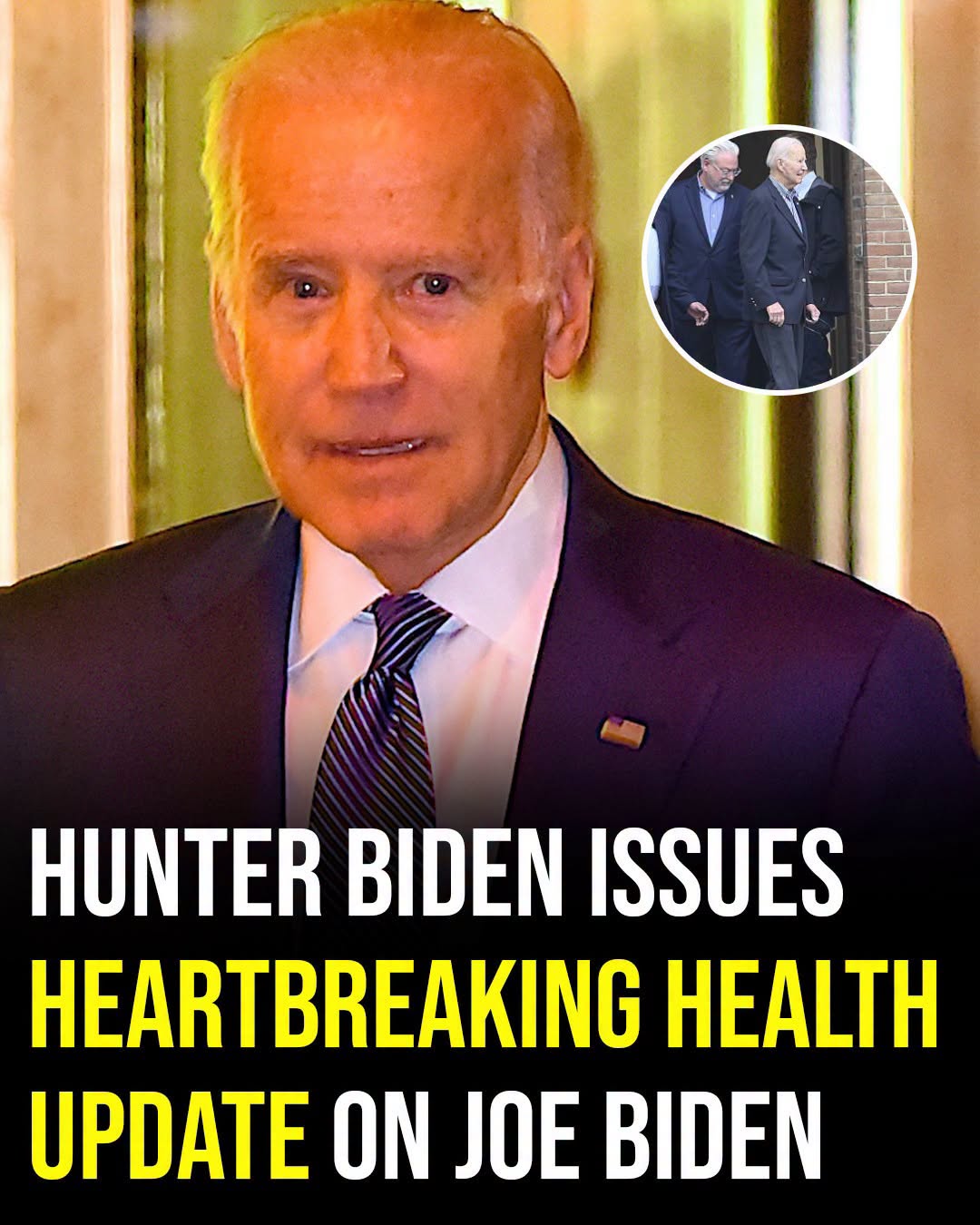
For years, Joe Biden built his public identity around resilience.
Through political battles, personal losses, presidential campaigns, and decades in public life, he repeatedly presented himself as someone who could keep moving forward regardless of what stood in his way. Even when age and exhaustion became subjects of public discussion, Biden continued appearing before cameras, delivering speeches, meeting supporters, and speaking about the country he had spent his life serving.
But behind that familiar public image, his family has been witnessing a much more difficult reality.
Hunter Biden’s recent comments about his father’s health have offered an unusually personal glimpse into the seriousness of the illness facing the former president. Rather than describing a man who is simply aging or slowing down, Hunter portrayed a father dealing with an aggressive illness, significant pain, and a physical decline that has been deeply difficult for the family to watch.
The diagnosis reportedly came after Joe Biden had already left the White House. Doctors discovered prostate cancer that had progressed to his bones, turning what might initially have seemed like a private medical concern into a far more serious battle.
For Hunter, watching his father experience that reality has been heartbreaking.
He described days when the pain becomes extremely difficult and moments when the illness appears to take a noticeable toll on his father’s strength. Yet even as his condition changes, Joe Biden has continued trying to maintain the image of someone who is still capable of carrying on.
That determination is familiar to anyone who has followed Biden’s life.
He has spent decades refusing to allow adversity to define him. Long before reaching the White House, Biden experienced devastating personal tragedies that shaped his character and influenced the way he approached public life. Those experiences helped create the image of a politician who understood grief, loss, and perseverance on an intensely personal level.
Now, however, his family faces a different kind of challenge.
Instead of fighting a political opponent or campaigning for office, Biden is confronting something that cannot be defeated with speeches, strategy, or determination alone.
It is his own health.
Hunter’s comments suggest that this reality can be particularly difficult because his father does not always want to acknowledge just how much the illness has affected him.
That refusal to surrender may be admirable from one perspective, but for family members it can also be painful.
Children often continue seeing their parents as strong figures even when those parents become older and more vulnerable. Accepting that a father who once seemed almost indestructible is now dealing with serious physical limitations can be emotionally overwhelming.
For Hunter, the situation appears to have created a complicated mixture of love, fear, frustration, and admiration.
He is watching someone he knows as a determined and stubborn father confront a disease that has placed limits on his body.
The contrast between Biden’s private condition and his public appearances makes the situation even more striking.
Even while dealing with illness, fatigue, and pain, Biden has continued to make appearances and speak publicly. He has remained engaged with political issues and has continued expressing his belief in the United States and the future of the country.
To observers, those appearances can look ordinary.
But according to Hunter’s account, the reality behind them may be considerably more difficult.
A public appearance that lasts only a short time can require enormous effort from someone whose body is struggling. A smile for photographers can conceal discomfort. A speech can appear effortless to an audience while requiring significant preparation and recovery afterward.
That difference between what the public sees and what a family experiences is one of the most difficult aspects of serious illness.
People often judge public figures by what appears on television or social media. If someone stands upright, speaks clearly, or walks into an event, it can be easy to assume that everything is fine.
But illness does not always announce itself visibly.
Pain can remain hidden.
Fatigue can be masked.
Fear can exist behind a calm expression.
And families are often the people who see the moments that never reach the cameras.
Questions about Biden’s health have existed for years, particularly as he grew older and the physical demands of public life became increasingly visible. Reports about frequent nighttime bathroom trips, for example, have taken on new significance in light of the later diagnosis.
What once might have seemed like an ordinary sign of aging can feel very different when viewed through the lens of a serious medical diagnosis.
Yet it is important to remember that individual symptoms can have many possible explanations. Only medical professionals with access to a patient’s records can determine what those symptoms actually mean.
For the Biden family, however, the discovery of cancer transformed their understanding of what was happening.
The illness had already spread beyond the prostate and into the bones.
That development made the situation considerably more serious and placed the family in a position familiar to millions of people who have watched someone they love battle advanced cancer.
There is no simple emotional response to such a diagnosis.
There is fear.
There is uncertainty.
There are difficult conversations.
There are medical appointments and decisions that can change from one day to the next.
And there is the constant effort to preserve a sense of normal life despite knowing that nothing feels normal anymore.
Hunter’s account also reveals something deeply human about the former president.
Despite the pain and physical decline, Joe Biden apparently continues to believe there is still work worth doing and causes worth discussing.
He continues to speak about America because, after a lifetime devoted to public service, that commitment remains deeply connected to his identity.
For his family, that determination may be both inspiring and difficult.
They can admire his strength while wishing he would slow down.
They can respect his independence while worrying about his health.
They can understand his desire to remain active while knowing that his body may no longer cooperate in the way it once did.
That is the complicated reality of watching a parent grow older.
Eventually, roles begin to change.
The person who once protected you may need protection.
The person who once encouraged you to keep going may need someone else to tell him when it is time to rest.
And the child who once depended on a parent can find himself quietly worrying about how much time remains.
For Hunter Biden, speaking publicly about his father’s condition appears to come from that deeply personal place.
It is not simply a political story.
It is a family story.
Behind the former president, the political controversies, the headlines, and the years of public scrutiny is an aging father whose children are now confronting the vulnerability that comes with serious illness.
Whatever opinions people may hold about Joe Biden’s presidency or political career, cancer has a way of reducing enormous public arguments to something profoundly human.
A family wants more time.
A son wants his father to be comfortable.
A father wants to keep going.
And everyone involved has to face the reality that determination cannot always control what happens next.
Joe Biden spent much of his life telling Americans that difficult moments can be overcome through perseverance.
Now, his family is living through one of those difficult moments themselves.
And perhaps the most powerful part of Hunter Biden’s account is not the political implications or the questions surrounding the diagnosis.
It is the reminder that behind every public figure is a private human being.
The cameras may capture the speeches.
They may record the smiles.
They may document the appearances.
But they cannot always capture the pain that follows when the lights go out.
For Joe Biden, that private battle is now unfolding in the presence of the people who know him best.
And for Hunter, watching his father face that battle appears to have brought home a truth that every family eventually has to confront: even the strongest people we know are still human, and sometimes the person who spent a lifetime refusing to stop is finally forced to confront the limits of his own body.