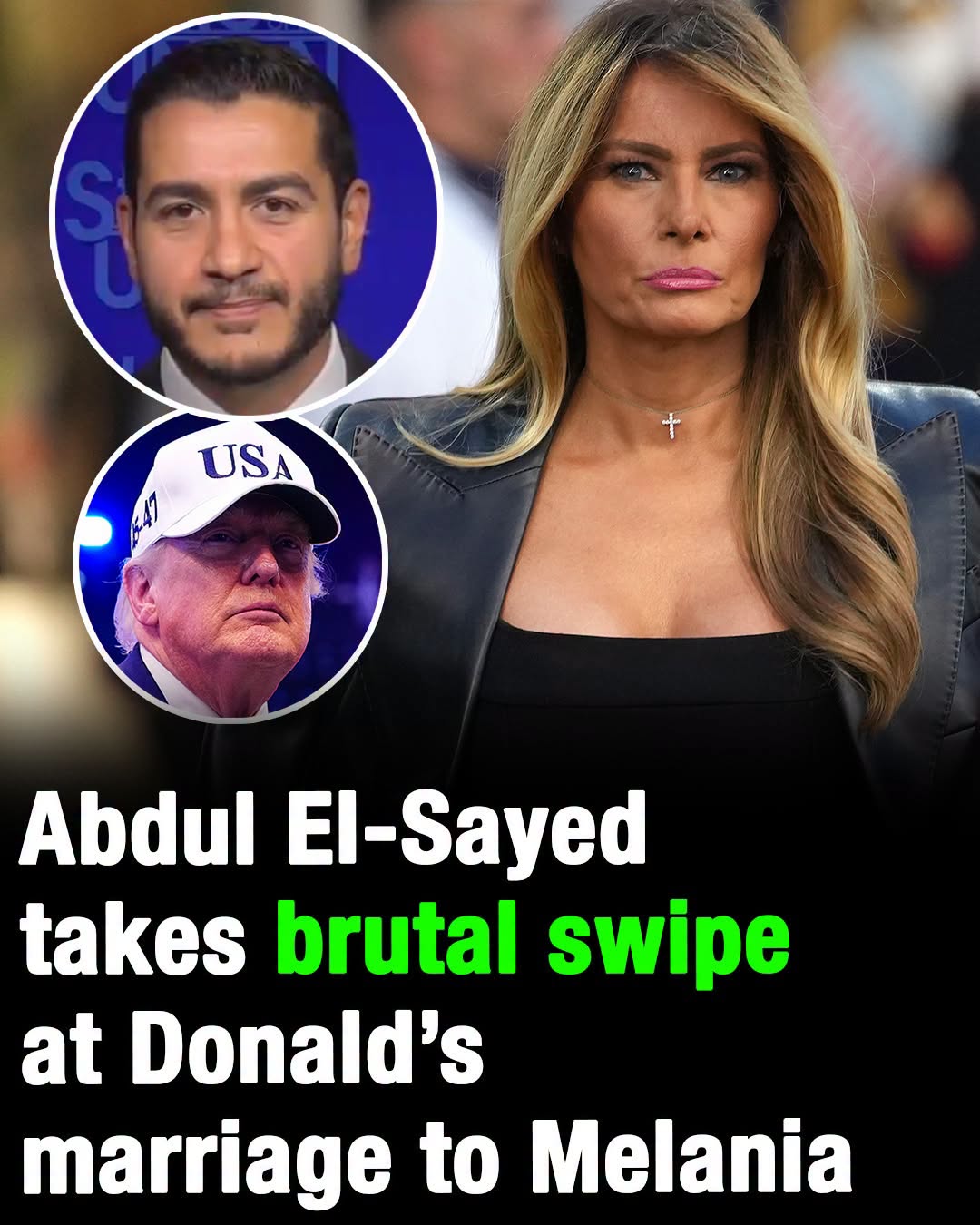
Abdul El-Sayed’s latest attack on Donald Trump went far beyond the usual arguments over policies, political parties, or campaign strategy. Instead, he chose something much more personal, invoking Trump’s marriage to Melania as part of a broader argument about what kind of America voters should want.
The remarks quickly attracted attention because El-Sayed did not simply criticize Trump’s political record. He contrasted what he portrayed as a warm, ordinary family life with the world of wealth, power, and influence that he associates with Trump.
In El-Sayed’s telling, one vision of America is built around everyday moments: sharing pancakes, worrying about the future, raising children, paying for necessities, and trying to build a stable life. The other, he suggested, is dominated by billionaires, political insiders, and powerful figures whose interests can feel far removed from the concerns of ordinary families.
That contrast gave his comments a sharper emotional edge.
Rather than presenting the election as another argument between politicians, El-Sayed attempted to make it feel personal. His message was essentially about the kind of country people believe they are living in and the kind of country they want their children to inherit.
For supporters, that approach may have been exactly the point.
Trump has spent decades cultivating an image built around wealth, celebrity, confidence, and power. His public persona has often been inseparable from his family, business career, television appearances, and political identity. El-Sayed appeared determined to challenge that image by placing it beside a much more intimate picture of American life.
The reference to pancakes was particularly revealing.
It transformed an abstract political argument into something familiar. Breakfast at home, family conversations, financial worries, and hopes for the future are experiences shared by millions of people regardless of political affiliation.
That is where El-Sayed’s criticism gained much of its emotional force.
His argument was not simply that Trump represents a different political ideology. It was that Trump represents a fundamentally different understanding of what matters in American life.
For El-Sayed, the contrast appears to be between ordinary families trying to survive and an elite political culture centered on influence, wealth, and spectacle.
That message is likely to resonate with voters who feel increasingly disconnected from Washington and from politicians who seem to live in a different world.
But there is another side to the controversy.
Political attacks become considerably more complicated when they move from a candidate’s record to his marriage and personal relationships.
Trump’s family life has been discussed publicly for decades, and his marriages have repeatedly become subjects of political commentary. Yet many voters still believe there should be boundaries when campaigns become personal.
Critics of El-Sayed’s remarks could argue that attacking a political opponent’s marriage distracts from the issues voters actually need to consider.
They may ask whether a candidate’s relationship with his spouse should have anything to do with questions about healthcare, taxes, jobs, education, immigration, or the economy.
That criticism is difficult to dismiss.
Personal attacks can generate attention, but attention is not necessarily persuasion. A statement that excites one group of voters can cause another group to conclude that a candidate has crossed a line.
And in a closely watched political contest, that distinction matters.
El-Sayed’s decision therefore represents something of a gamble.
On one hand, it gives him a way to challenge Trump on territory where Trump has traditionally been extremely difficult to compete with: personality.
Trump has built an extraordinary political identity around the idea that he is an outsider who refuses to behave like traditional politicians. His supporters frequently interpret criticism of his personality as proof that established political forces are threatened by him.
By responding with an equally personal argument, El-Sayed risks entering the exact arena Trump has dominated for years.
On the other hand, El-Sayed may believe that refusing to engage with Trump’s personal brand would leave an important part of the political conversation untouched.
Modern elections are rarely fought entirely through policy papers and legislative proposals. Candidates are judged by their character, their families, their behavior, and the stories they tell about themselves.
Voters often ask questions that have little to do with specific legislation.
Who understands my life?
Who respects people like me?
Who seems trustworthy?
Who understands what my family is going through?
Those questions can be more powerful than a detailed campaign platform.
That is why El-Sayed’s comments have attracted attention.
He was attempting to transform a political debate into a cultural one.
Instead of asking only which candidate has the better policies, he was asking voters which vision of American life feels more authentic.
His description of shared meals and family concerns presents politics as something that begins inside the home. Gas prices, grocery bills, school expenses, healthcare costs, and uncertainty about the future are not abstract statistics when they affect a family sitting around the kitchen table.
That framing also explains why his criticism of Trump’s wealth and political connections was connected so closely to his comments about marriage.
The underlying message was that politics should be measured by whether it improves ordinary life, not simply by how impressive a politician looks on television or how many powerful people surround him.
Still, whether voters accept that argument remains another question.
Trump has survived countless controversies throughout his political career. Attacks that might permanently damage another politician have often strengthened his supporters’ loyalty instead.
His political movement has repeatedly demonstrated an ability to turn criticism into fuel, portraying attacks as evidence that the political establishment fears him.
That means El-Sayed’s comments could have an unpredictable effect.
Some voters may see them as a refreshing rejection of political spectacle.
Others may see them as unnecessary personal hostility.
And some may simply wonder why a campaign focused on Michigan’s future needs to spend so much time discussing Donald Trump’s marriage.
That tension illustrates the difficulty of modern political campaigning.
Candidates increasingly operate in an environment where every statement can become a headline, every insult can become a viral clip, and every personal remark can overwhelm a much larger policy discussion.
One sentence can dominate an entire news cycle.
For El-Sayed, that may ultimately be the most important consequence of the controversy.
His remarks have forced attention onto the question he wanted voters to consider: what does America actually look like to the people living in it?
Is it a country defined by political power and billionaire influence?
Or is it a country defined by families trying to make dinner, pay their bills, raise their children, and believe that tomorrow can be better than today?
The answer will not be decided by one speech or one campaign attack.
Nor will it be determined by a candidate’s marriage alone.
But El-Sayed’s remarks have demonstrated something important about the campaign ahead. The battle is not likely to be fought exclusively over policies. It will also be fought over identity, values, character, and competing ideas about what kind of future ordinary Americans deserve.
And that may be why a few remarks about Trump and Melania have generated such a large reaction.
Beneath the personal criticism is a much bigger political argument.
It is an argument about power.
It is an argument about money.
It is an argument about family.
And ultimately, it is an argument about what voters believe America should feel like when they walk through their own front door.