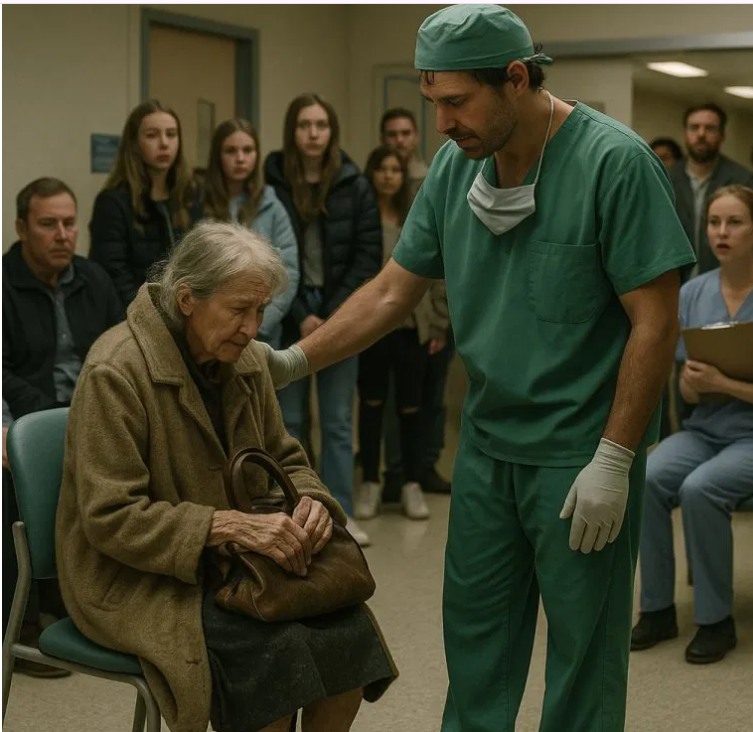
The hospital waiting room hummed with soft conversations, occasional coughs, the crinkle of paper cups, and the flicker of harsh fluorescent lights. People drifted in and out—families clinging together, some nervously pacing, others staring blankly at the walls or scrolling on their phones.
In a far corner, curled in a rigid plastic chair, sat an elderly woman. Her coat was threadbare at the cuffs and worn thin around the collar. Its color had long since faded, and her shoes didn’t match—one brown loafer, the other black. A well-worn leather purse rested on her lap, gripped tightly by both hands as if it held something priceless.
Some avoided her, uncertain if she belonged there at all. Others dismissed her presence as one of those odd sights you sometimes see—a lost soul who wandered in from the streets or sought refuge from the cold.
A woman with salon-perfect curls leaned toward her husband and whispered, “She must be confused. Probably stumbled in from outside.”
Her husband chuckled softly. “Maybe she’s just here for the free coffee.”
Nearby, two teenage girls, dressed in pricey jeans and designer jackets, snickered and imitated the old woman’s slow movements whenever she shifted in her seat or reached into her purse.
Even the hospital staff seemed uncertain. A young nurse, clearly new and awkward, approached with a tentative smile and a clipboard clutched to her chest.
The woman looked up with pale blue eyes that carried a lifetime of stories. She smiled kindly and gently patted the nurse’s hand.
“Yes, dear,” she whispered softly. “I’m exactly where I need to be.”
The nurse gave a confused glance but nodded politely before moving on.
Hours passed.
The crowd shifted, but the elderly woman remained calm and still, as if time itself slowed around her. Occasionally, she glanced toward the double doors leading to the operating rooms, her expression patient and hopeful.
Then, precisely at 3:12 p.m., the double doors swung open.
A surgeon stepped out, still clad in green scrubs and surgical cap, his mask dangling from one ear. He looked exhausted—dark circles under his eyes, sweat dampening his hair—but his gaze was sharp, his movements purposeful.
He walked past the anxious families, the worried fathers, and grieving sons until he stopped right in front of the old woman.
All eyes turned, brows raised in curiosity.
He smiled softly and leaned down, resting a gloved hand gently on her shoulder.
“Are you ready to tell them who you really are now?” he asked, voice clear and loud enough for the entire room.
A stunned silence fell.
The woman’s eyes sparkled with tears. She rose slowly, leaning on the surgeon’s arm for support, then scanned the sea of bewildered, surprised, and embarrassed faces.
Clearing her throat, she began.
“My name is Margaret Greene,” she said softly. “You probably don’t recognize it anymore. Most people don’t. But I used to own the bakery just two blocks from here.”
A few heads nodded quietly—some of the older folks seemed to remember.
“I never married. Never had children of my own,” she continued. “But there was a little boy I took in—a boy who lived upstairs in an apartment above my bakery. He had no father, and his mother worked two jobs but still couldn’t keep the heat on in winter.”
She paused and glanced at the surgeon, who smiled gently back.
“He was always hungry. So I started giving him leftover pastries. Then I let him wash dishes to earn a little money. When I found out he struggled to read, I stayed after closing to help him. When his mother got sick, I helped care for her. When she passed away, I made sure he stayed in school.”
The surgeon stepped forward, his voice steady and warm.
“That boy grew up to be me.”
A collective gasp spread through the room. Eyes widened; jaws dropped in disbelief.
Margaret smiled tenderly, tears glistening in her eyes.
“I’m here today because he’s going into surgery. And because of what I did back then, he had a chance.”
For a moment, the waiting room was silent, the previous whispers and judgments replaced by awe and respect.
The woman with the perfect curls whispered to her husband, “She’s a true hero.”
The teenage girls stopped giggling, now watching with quiet admiration.
Even the staff looked on with reverence.
Margaret sat back down, clutching her battered purse, now carrying a quiet sense of pride.
The surgeon gave her a grateful nod before turning and walking back through the doors.
And in that moment, everyone learned a profound truth: Never judge the quiet, the worn, or the overlooked—because sometimes, the greatest heroes are sitting silently among us.