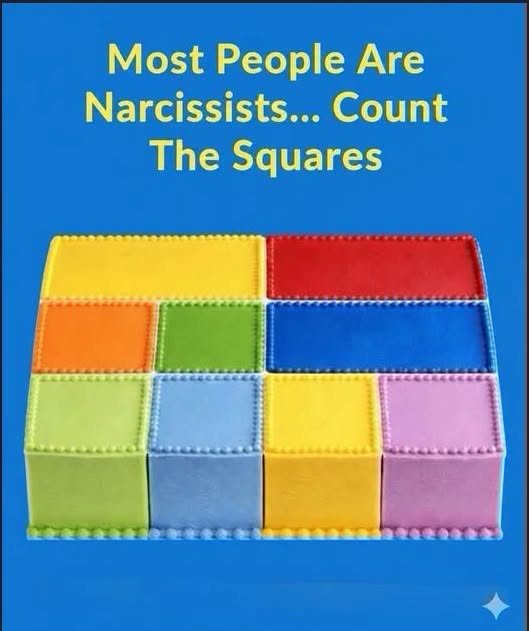
At first glance, it looks like one of the easiest puzzles you will ever encounter.
A simple arrangement of squares.
No complicated equations.
No hidden clues.
No trick wording.
Just one straightforward question:
How many squares can you find?
Most people glance at the image for only a few seconds before confidently announcing an answer.
Some count eight.
Others see ten.
A few proudly declare twelve.
Then someone else replies with an entirely different number.
Within minutes, what seemed like a harmless visual challenge transforms into a heated debate.
People begin defending their answers with surprising passion.
Some insist the solution is obvious.
Others accuse everyone else of overlooking the hidden shapes.
Friends disagree.
Families argue.
Comment sections explode.
How can something so simple produce so many different answers?
The surprising truth is that the puzzle is testing far more than your ability to recognize geometric shapes.
It quietly reveals how your brain processes information, how quickly you jump to conclusions, and how willing you are to question your own assumptions.
That is why these visual challenges have remained popular for generations.
They expose something about the way people think.
When most people first look at the puzzle, their brains immediately search for familiar patterns.
Instead of carefully examining every possible shape, the mind tries to solve the challenge as efficiently as possible.
This shortcut is incredibly useful in everyday life.
Without it, simple tasks would become exhausting.
But shortcuts also create blind spots.
The brain often notices only the most obvious squares first.
Those larger combinations hiding inside the design may remain invisible.
Once we settle on an answer, another powerful mental habit begins to influence us.
Psychologists call it confirmation bias.
Rather than continuing to search objectively, we start looking for evidence that proves our first answer is correct.
Every square we notice afterward seems to reinforce our confidence.
At the same time, we unconsciously ignore information that challenges our conclusion.
The puzzle hasn’t changed.
Our thinking has.
That is why two intelligent people can stare at the exact same image and reach completely different answers.
Each person begins with different assumptions.
One may count only complete, clearly outlined squares.
Another may include larger combinations created by overlapping lines.
A third may mentally construct patterns that someone else never even notices.
Each believes they are following the obvious rules.
Ironically, very few people stop to ask an important question before they begin counting.
What exactly qualifies as a square?
Should every possible combination count?
Only the visible ones?
Only fully enclosed shapes?
Without agreeing on those assumptions first, disagreement becomes almost inevitable.
This same pattern appears far beyond puzzles.
In everyday life, people frequently argue about conclusions without first agreeing on definitions.
Two coworkers debate a project while using different standards for success.
Neighbors argue over responsibility while interpreting the same event differently.
Families disagree because each person remembers the same conversation through a different emotional lens.
The square puzzle becomes a miniature version of these much larger human experiences.
Social media makes the effect even stronger.
Captions often promise dramatic conclusions.
“Only geniuses find them all.”
“Most people fail.”
“If you can’t solve this, your brain works differently.”
Sometimes the claims become even more provocative.
“Your answer reveals your personality.”
“Only narcissists choose this number.”
Suddenly, solving the puzzle feels like proving something about yourself.
Instead of approaching it with curiosity, people become emotionally invested in being right.
Admitting uncertainty begins to feel like losing.
So they defend their original answer with increasing confidence.
Ironically, the puzzle never asked anyone to prove intelligence.
It simply asked them to count.
The emotional competition comes entirely from our own reactions.
There is another fascinating reason people miss so many squares.
Attention has limits.
Although we often believe we see everything in front of us, our brains constantly filter information.
This process allows us to focus on what seems most important.
Without it, every visual scene would become overwhelming.
But filtering also means certain details disappear from awareness.
This phenomenon appears in famous psychology experiments where participants completely fail to notice unexpected objects because their attention is focused elsewhere.
The information exists.
The eyes receive it.
Yet the brain never consciously processes it.
The same thing happens inside many visual puzzles.
The missing squares are often visible from the beginning.
They simply never receive enough attention to enter conscious awareness.
Fortunately, there is an easy way to improve.
Slow down.
Instead of searching randomly, examine the image systematically.
Start with the smallest squares.
Then move to medium-sized ones.
Finally, look for larger combinations built from smaller shapes.
Treat the puzzle less like a race and more like an investigation.
Many people discover additional squares almost immediately after changing their approach.
Others notice shapes they had completely overlooked during their first attempt.
The image itself remains exactly the same.
Only the method changes.
Perhaps that is the greatest lesson these puzzles offer.
Success often depends less on intelligence than on patience.
The willingness to pause, question assumptions, and reconsider first impressions frequently produces better results than rushing toward certainty.
Life works much the same way.
Many of the world’s most difficult problems cannot be solved by reacting quickly.
They require careful observation.
They require listening.
They require the humility to recognize that our first answer may not be complete.
The square puzzle quietly rewards those qualities.
It reminds us that confidence should never replace curiosity.
Sometimes another person truly does see something we missed.
That possibility is not a threat.
It is an opportunity.
Because every new perspective expands our own.
The next time someone asks how many squares you can find, resist the urge to answer immediately.
Take another look.
Count again.
Question your assumptions.
You may discover that the most valuable part of the challenge is not finding one more square.
It is discovering how easily certainty can give way to deeper understanding when we are willing to look just a little longer.
In the end, the puzzle is not really about geometry.
It is about perception.
And sometimes, changing the way we look changes everything we are able to see.