
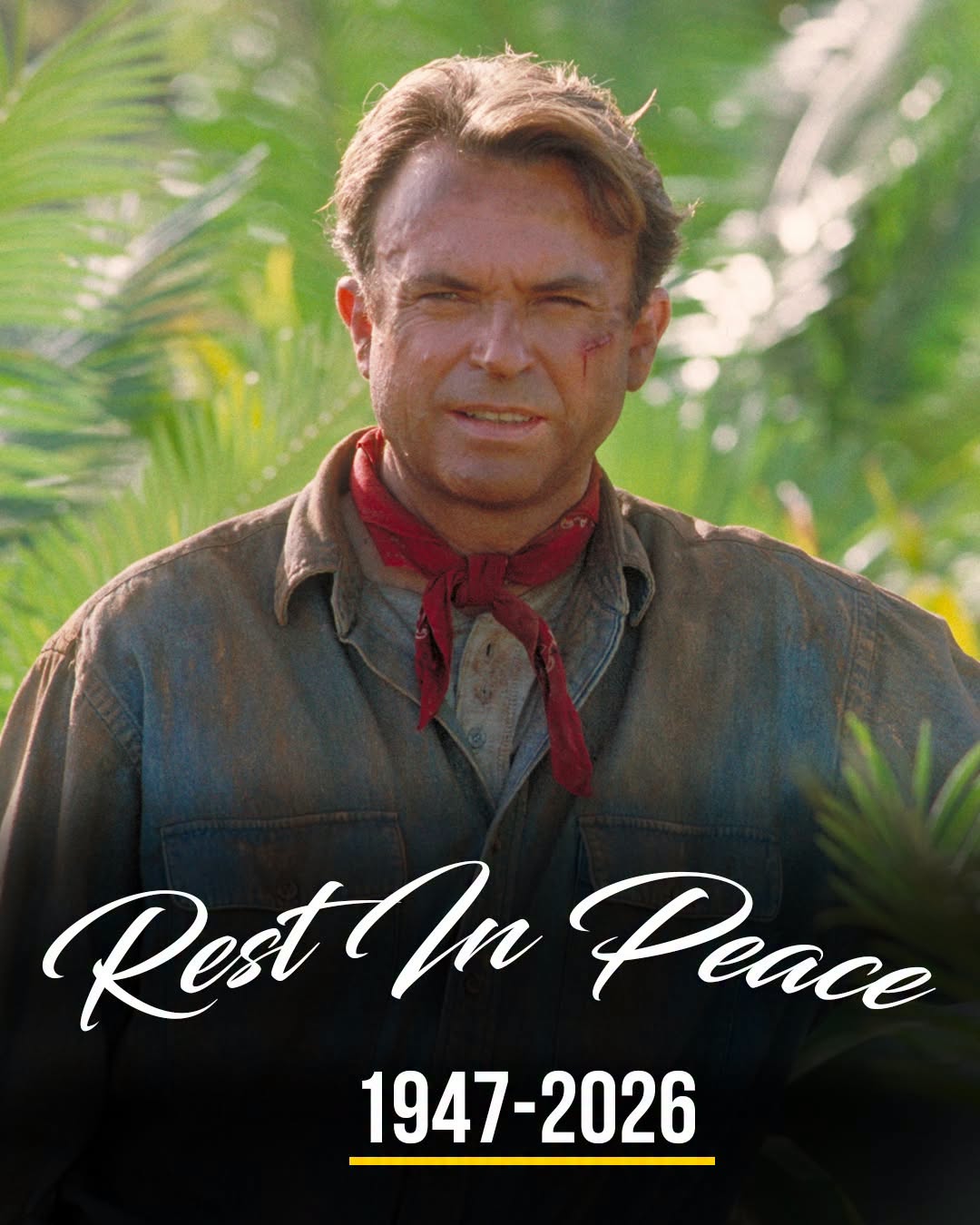
The world has lost a performer whose quiet strength, remarkable talent, and unmistakable presence made him one of cinema’s most respected figures. Sam Neill, the New Zealand actor whose career stretched across generations and genres, has died at the age of 78 after a sudden and unexpected decline. His family shared that he passed away surrounded by loved ones in Sydney, Australia, with the dignity and privacy that defined much of his life away from the spotlight. They also noted that he remained cancer-free following his earlier battle with blood cancer.
For millions of fans around the world, however, Sam Neill will forever be remembered as Dr. Alan Grant, the paleontologist whose calm intelligence and reluctant bravery anchored the original Jurassic Park. His wide-eyed reaction to seeing dinosaurs brought back to life became one of the most unforgettable moments in modern movie history.
But reducing Neill’s legacy to one role would never capture the full story.
Behind the famous character was an actor who spent decades building a career defined by versatility, humility, and a rare ability to make even complicated characters feel deeply human.
Neill was never the kind of performer who demanded attention.
Instead, he earned it.
His strength came from subtle expressions, quiet confidence, and the ability to communicate entire emotions without saying a word. Whether he was portraying a hero, a villain, a troubled father, or an ordinary person facing impossible circumstances, Neill brought a sense of honesty that audiences trusted.
Born in Northern Ireland in 1947 and raised in New Zealand, Neill’s path to international fame was not an overnight success story. He began his career far from Hollywood’s biggest stages, slowly building recognition through work in New Zealand and Australian cinema before becoming known around the world.
His breakthrough came through performances that showcased his emotional range rather than simple movie-star appeal.
Films such as My Brilliant Career, Dead Calm, The Piano, and The Hunt for Red October demonstrated that Neill could move effortlessly between intense drama, suspense, historical stories, and major Hollywood productions.
Then came Jurassic Park.
Released in 1993, the Steven Spielberg blockbuster changed cinema forever. The film introduced audiences to a world where dinosaurs walked the Earth again, combining groundbreaking visual effects with unforgettable storytelling.
At the center of that chaos was Alan Grant, a character who was intelligent, practical, and initially uncomfortable around children. Neill played him not as a traditional action hero, but as a realistic person forced into extraordinary circumstances.
That made the character even more memorable.
When audiences watched Grant stare in disbelief at living dinosaurs, they were not simply watching an actor react. They were experiencing the wonder of discovery through him.
The role became iconic and connected Neill with generations of fans.
Children who watched Jurassic Park in theaters grew up with his performance as part of their childhood memories. Decades later, new audiences discovered the film and formed the same connection.
Yet Neill’s life and career extended far beyond Isla Nublar.
He continued working steadily for decades, appearing in television and film projects that allowed him to explore different sides of his craft. His performances often carried the same qualities people admired about him personally: intelligence, warmth, and a sense of authenticity.
Away from acting, Neill was also known for his love of nature, farming, and his vineyard in New Zealand. His life outside Hollywood reflected the same grounded personality that appeared on screen. He enjoyed simple pleasures and often spoke about animals, land, food, and everyday experiences with genuine enthusiasm.
Even after achieving international fame, he never seemed consumed by celebrity.
Instead, he maintained a reputation as someone who valued relationships, creativity, and a quieter way of living.
In 2022, Neill revealed that he had been diagnosed with angioimmunoblastic T-cell lymphoma, a rare form of blood cancer. He later shared that treatment had put the cancer into remission, allowing him to continue working and enjoying life.
His openness about illness showed another side of him.
Rather than hiding the difficult moments, he spoke honestly about fear, uncertainty, and gratitude. His willingness to discuss his experience helped many people who were facing their own health challenges.
For fans, learning about his illness created a deeper appreciation for the person behind the performances.
Neill was not simply the calm scientist running from dinosaurs.
He was a real person who faced hardship with the same quiet resilience that defined many of his characters.
Following news of his death, tributes poured in from colleagues, filmmakers, and fans across the world. Many remembered not only his acting ability but also his kindness, humor, and generosity.
That combination made his loss feel especially personal.
Some actors are remembered because of the size of their fame.
Others are remembered because of the connection they created.
Sam Neill belonged to the second group.
He did not build his career around being the loudest person in the room. He built it around being believable.
He made audiences care.
He made characters feel real.
He brought humanity to every story he entered.
For many people, his passing feels like the end of an era not because Hollywood has lost only a famous actor, but because it has lost one of its most dependable and sincere performers.
The image of Alan Grant standing in awe as dinosaurs move across the landscape will remain forever.
But so will the many other moments: the dramatic performances, the quiet scenes, the unexpected roles, and the countless memories created over a career that lasted more than five decades.
Sam Neill leaves behind a legacy that cannot be measured by box office numbers or awards alone.
It lives in the audiences who felt something when they watched him.
It lives in the filmmakers who respected his craft.
It lives in the characters that continue to exist every time someone presses play.
In the end, Sam Neill’s greatest achievement may have been something far simpler.
He made people believe.
And long after the final credits roll, that is the kind of legacy that never disappears.