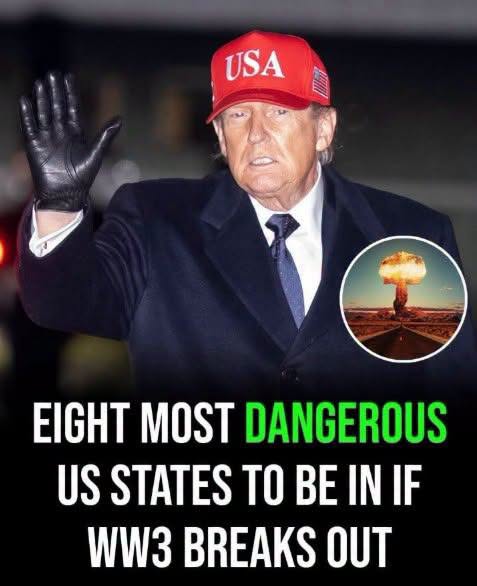
The idea of a global conflict reaching American soil feels almost impossible to imagine. For generations, many people have viewed the United States as geographically protected by two vast oceans and its distance from most major conflicts. But in a world shaped by advanced missiles, cyber warfare, satellites, and long-range weapons systems, geography alone no longer guarantees complete safety.
If a large-scale war involving major world powers ever erupted, experts have long pointed out that certain areas would likely become more strategically important than others. The risk would not simply come from being part of a country involved in conflict. It would come from location, infrastructure, military importance, and the role a region plays in national defense.
The most vulnerable places would likely be areas connected to military operations, major transportation networks, energy systems, technology centers, and critical industrial facilities.
A major conflict would not only be about explosions or direct attacks.
The consequences could spread far beyond the initial impact.
Power outages, communication failures, supply shortages, economic disruption, and strain on emergency services could affect millions of people even far away from any battlefield.
While no one can predict exactly what would happen in a hypothetical World War III scenario, certain states contain assets that would make them strategically significant in any major confrontation.
Here are eight states often considered among the areas that could face higher risks because of their military, economic, or strategic importance.
1 Washington
Washington State is home to one of the most important naval facilities in the United States: Naval Base Kitsap.
Located near Puget Sound, the base plays a major role in the nation’s submarine capabilities and strategic defense operations. The region is also connected to major aerospace and technology industries, including companies involved in advanced engineering and defense-related work.
Because of its military importance and its location along the Pacific coast, Washington could become strategically significant during a conflict involving major powers in the Pacific region.
Beyond direct military concerns, a large-scale disruption could affect transportation, energy networks, and the highly connected communities around Seattle and other major cities.
2 California
California’s size, economy, and military presence make it one of the most strategically important states in the nation.
The state contains numerous military installations, naval facilities, aerospace companies, research centers, and major ports.
Southern California in particular has long been a center of military activity, with large bases and access to the Pacific Ocean. The state is also home to some of the country’s largest population centers, including Los Angeles and San Diego.
In a major conflict, densely populated areas with important infrastructure could face increased risks.
However, California’s vulnerability would not only come from military targets. The state’s enormous population means that any disruption involving power, transportation, or supply chains could create significant challenges.
3 Virginia
Virginia holds a unique position because of its connection to national defense and government operations.
The state is home to major military facilities, including the world’s largest naval base, Naval Station Norfolk. The Hampton Roads region contains important naval infrastructure and supports a large military community.
Virginia is also close to Washington, D.C., and contains many government-related facilities and defense organizations.
Because of these connections, the state would likely be considered strategically important during any major international crisis.
The same factors that make Virginia important during peacetime could also make certain areas more vulnerable during wartime.
4 Texas
Texas is often described as an economic powerhouse, but its importance extends far beyond energy production.
The state contains military installations, major ports, aerospace facilities, and some of the country’s most important energy infrastructure.
Texas plays a central role in oil and natural gas production, making it critical to the national economy. It is also home to large cities, including Houston, Dallas, and San Antonio.
A major conflict could make energy infrastructure especially important because fuel supplies are essential for military operations, transportation, and daily life.
The state’s enormous size could offer some protection in rural areas, but key urban and industrial zones would remain strategically significant.
5 Florida
Florida’s geography makes it both unique and strategically important.
The state sits between the Atlantic Ocean and the Gulf of Mexico and contains important military facilities, space operations centers, and naval installations.
Florida is also home to Cape Canaveral, one of the most recognized space launch locations in the world. Modern conflicts increasingly depend on satellites for communication, navigation, and intelligence, making space infrastructure a major consideration.
Additionally, Florida’s coastal cities and large population centers could face challenges from disruptions affecting transportation, electricity, and emergency systems.
6 North Dakota
North Dakota may seem surprising on this list because it does not have the population or international profile of states like California or Texas.
However, its importance comes from military assets located within the state.
North Dakota has facilities connected to strategic missile systems and long-range defense operations. These installations are part of the United States’ broader deterrence strategy.
Because of this role, certain locations in the state could be considered strategically significant.
At the same time, the state’s rural nature means many communities are far removed from major urban centers and could face very different circumstances during a crisis.
7 New York
New York is one of the world’s most influential economic centers.
New York City is a global hub for finance, communication, media, transportation, and international business. Its symbolic and economic importance makes it one of the most recognized cities in the world.
A major international conflict would not only involve military targets. Economic systems and communication networks could also become strategically important.
The dense population of the New York metropolitan area would create additional challenges during any major emergency, including evacuation, resource distribution, and maintaining essential services.
8 Hawaii
Hawaii’s location in the Pacific makes it one of the most strategically important places in the United States.
The state is home to the headquarters of the U.S. Indo-Pacific Command and numerous military facilities.
Its position between North America and Asia gives it enormous military significance, especially in scenarios involving tensions in the Pacific.
However, Hawaii’s isolation also creates unique challenges. Because supplies must travel thousands of miles, any major disruption to transportation routes could quickly affect access to fuel, food, and other necessities.
What Would Actually Determine Survival
While certain areas may be considered higher risk because of their strategic importance, no location guarantees safety.
A major global conflict would create uncertainty everywhere.
The ability to respond would depend on many factors: emergency planning, access to resources, community cooperation, communication systems, and individual preparation.
Many experts emphasize that resilience matters as much as geography.
Having clean water, emergency supplies, basic medical knowledge, alternative energy sources, and strong relationships with neighbors can make a significant difference during any crisis.
The safest communities would not necessarily be the ones that experience no disruption.
They would be the ones capable of adapting when normal systems fail.
Ultimately, the greatest lesson from any discussion about a potential World War III scenario is that survival would depend on more than where someone lives.
It would depend on preparation, cooperation, and the ability of people to support one another when uncertainty arrives.
Because in any crisis, the strongest defense may not only be technology or geography.
It may be the strength of the communities standing together.