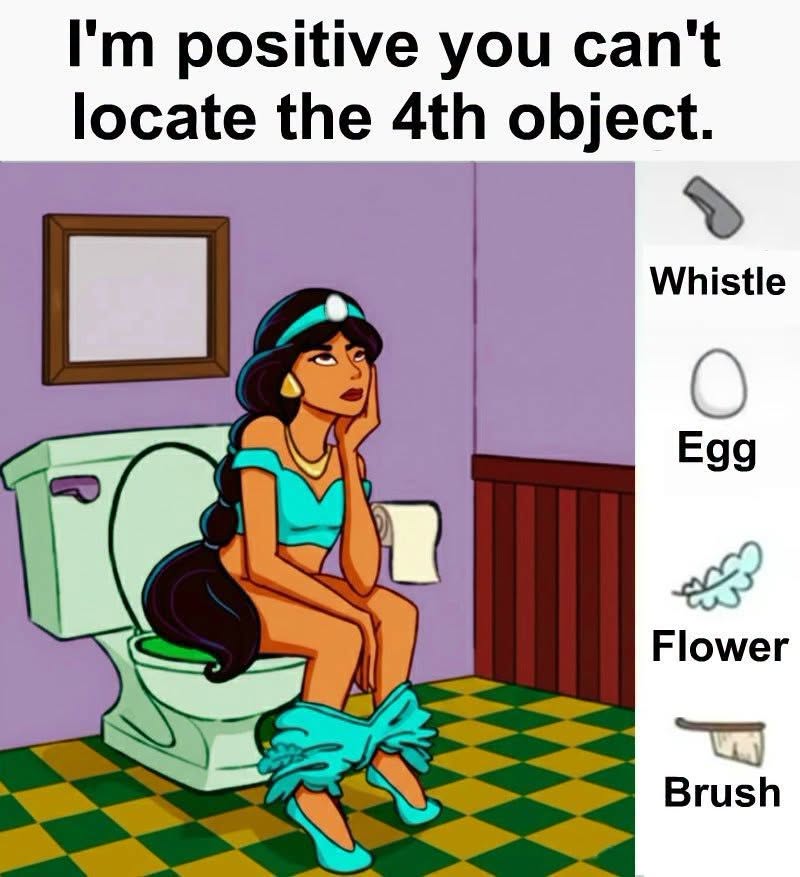
At first glance, it looks like a simple little puzzle. A colorful image filled with ordinary details, shapes, and distractions. Somewhere inside it are four hidden objects waiting to be discovered: a whistle, an egg, a flower, and a paintbrush.
Most people approach challenges like this expecting a quick victory. They scan the picture for a few seconds, move their eyes across the details, and assume the answer should immediately appear.
But when it doesn’t, something interesting happens.
The frustration arrives almost instantly.
People begin looking harder, but not always better. Their eyes move faster, their patience disappears, and the simple act of searching starts to feel strangely difficult. Some people give up within moments, convinced the objects are too well hidden or that they simply do not have the ability to find them.
Yet the real challenge of this picture is not actually about eyesight.
It is about attention.
It reveals how easily the human mind becomes discouraged when something does not provide an immediate reward.
We live in a world built around speed. Messages arrive instantly. Answers appear with a quick search. Entertainment changes every few seconds. Because of this, many people have trained themselves to expect immediate results.
When something requires patience, concentration, and a slower approach, the brain often reacts with resistance.
A hidden object puzzle exposes that reaction in a harmless way.
The moment someone thinks, “I can’t find it,” they are often not describing a problem with their vision. They are describing a moment where their brain has reached the edge of its comfort zone.
The image has not changed.
The objects were there from the beginning.
What changes is the way the person is looking.
At first, the brain searches using familiar patterns. It looks for objects where it expects them to be. It tries to recognize obvious shapes and familiar outlines.
But hidden-picture puzzles are designed to break those expectations.
The whistle may not look like a whistle immediately.
The egg may blend into another shape.
The flower may hide among colors and patterns that trick the eye.
The paintbrush may appear as nothing more than a random line or unusual detail.
The brain has to adjust.
It has to stop searching for what it assumes an object should look like and start observing what is actually there.
That moment of adjustment is where the puzzle becomes fascinating.
Many people describe the experience of finding a hidden object as almost magical. One second, they see nothing. The next second, the object suddenly becomes obvious, almost as if it appeared out of nowhere.
But the object did not appear.
Their brain simply learned how to recognize it.
This is one of the most interesting things about human perception. We do not simply see the world as it exists. Our brains constantly organize, filter, and interpret information. Sometimes that process helps us move quickly through life. Other times, it causes us to overlook things that are right in front of us.
A hidden picture reminds us that seeing is not always the same as noticing.
There is a difference between looking and truly paying attention.
You can stare directly at something and still miss it because your mind has already decided what it expects to find.
That is why these puzzles are more than entertainment.
They reveal a small but powerful truth about human behavior.
The way someone approaches a hidden-object challenge often mirrors the way they approach difficult moments in life.
Do they keep searching when the answer is not immediately clear?
Do they change their strategy when the first attempt fails?
Do they remain curious, or do they quickly decide they are incapable?
These questions apply far beyond a simple picture.
Think about the goals people abandon too early.
The new skill they quit because progress feels slow.
The career change they avoid because the path is uncertain.
The conversation they never start because they fear they will not know what to say.
The opportunity they ignore because the solution is not obvious at first glance.
Many things in life feel impossible not because they truly are impossible, but because people stop searching before they discover another way.
The hidden picture creates a tiny version of that experience.
It gives the brain a chance to practice patience.
It teaches that confusion is not always a sign of failure.
Sometimes confusion is simply the stage before understanding.
The people who find all four objects are not necessarily those with better eyesight. Often, they are simply the ones willing to slow down, observe carefully, and keep going after the first attempt fails.
That is an important lesson in a culture where quitting has become easy.
When something does not work immediately, people often assume the problem is their ability rather than their approach.
But sometimes the answer is not to try harder in the same way.
Sometimes the answer is to look differently.
A hidden whistle, egg, flower, and paintbrush may seem like a small challenge, but they represent something much larger.
They remind us that our brains are constantly learning.
They show us that frustration can be temporary.
They prove that the things we cannot see at first may become obvious once we give ourselves enough time.
The most surprising part of these puzzles is not finally discovering the hidden objects.
It is realizing how close they were all along.
The solution was never missing.
The opportunity was never gone.
The only thing that changed was the attention we gave it.
Four hidden objects.
One simple image.
And one powerful reminder: sometimes the hardest things to find are the things we stop looking for too soon.