Almost everyone has done it.
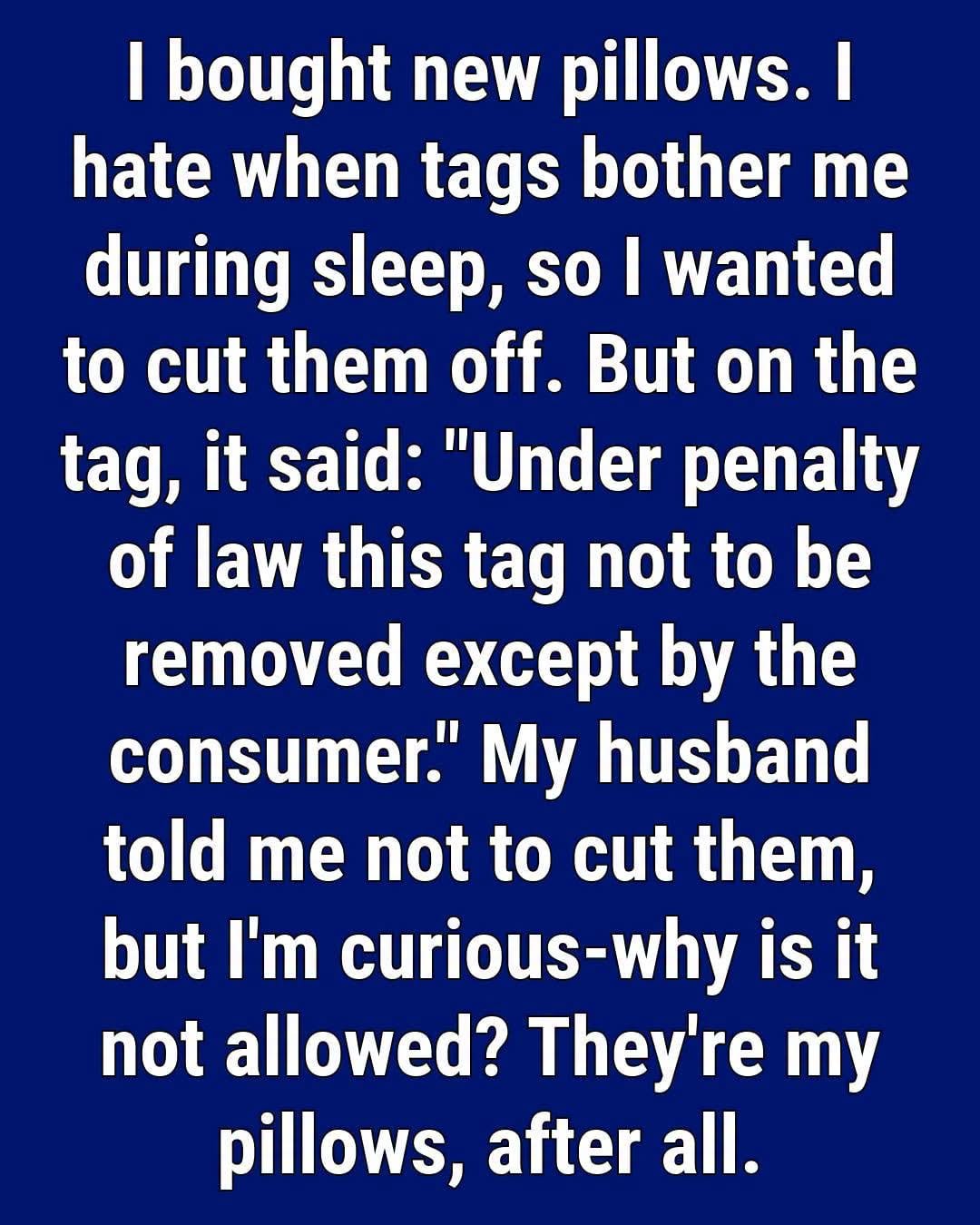
You buy a brand-new pillow, peel away the plastic, fluff it up, and then notice that stiff white tag scratching against your face. Printed across it, in bold capital letters, are words that sound surprisingly serious:
“UNDER PENALTY OF LAW THIS TAG NOT TO BE REMOVED EXCEPT BY THE CONSUMER.”
For many people, those words spark an instant moment of hesitation.
Is it actually illegal to cut this off?
Could removing the tag somehow violate federal law?
Why would something as ordinary as a pillow come with a warning that sounds more appropriate for classified government documents?
For decades, countless people have believed that removing a pillow tag could result in a fine or even legal trouble. Parents warned their children not to touch them. Grandparents repeated the same advice. The myth became so widespread that many adults still pause before grabbing a pair of scissors.
The truth, however, is much less dramatic—and far more interesting.
The warning was never really written for you.
Long before modern manufacturing standards existed, the bedding industry had a serious problem.
Unscrupulous manufacturers were secretly stuffing mattresses, pillows, comforters, and upholstered furniture with whatever inexpensive materials they could find. Old rags, dirty fabric scraps, contaminated feathers, worn-out clothing, and even unsanitary waste sometimes ended up inside products sold as brand new.
Consumers had no easy way to know what they were buying.
A pillow might look soft and clean on the outside while hiding low-quality or unhygienic materials inside.
Public health officials and consumer advocates became increasingly concerned.
Eventually, governments introduced regulations requiring manufacturers to identify exactly what filling materials were used in their products.
The solution was surprisingly simple.
Every mattress, pillow, and upholstered item would carry a permanent label listing the contents.
Manufacturers were required to leave that label attached while the product remained in stores so inspectors, retailers, and customers could verify exactly what was inside.
That is where the famous warning originated.
The words “Under Penalty of Law” were directed primarily at manufacturers, distributors, and retailers—not the person who ultimately bought the product.
The label had to stay attached until it reached its final owner.
Once the product was purchased, everything changed.
The final owner became the consumer mentioned directly on the tag.
That means you.
If you bought the pillow, you are legally free to remove the label whenever you want.
There is no fine.
No criminal charge.
No hidden government rule waiting to catch people with scissors.
You can cut the tag off the moment you bring the pillow home if it bothers you.
Despite this, the myth has refused to disappear.
Part of the reason is psychological.
The phrase “Under Penalty of Law” immediately captures attention.
Most people stop reading after those words.
Few continue to the final phrase:
“…except by the consumer.”
That small sentence changes everything.
Yet it is also the part people most often overlook.
As the years passed, the misunderstanding spread through families.
Children saw parents leave the tags attached.
Parents repeated warnings they had heard growing up.
The original purpose gradually faded from memory, while the fear remained.
Today, millions of people still believe the tags are untouchable.
Ironically, many of the people following the rule are precisely the people who are allowed to ignore it.
Although you can remove the tag without concern, there are actually a few reasons why you might consider leaving it attached—or at least saving it.
Those small labels contain more information than many people realize.
They usually identify the materials inside the pillow.
Memory foam.
Down.
Polyester fiberfill.
Latex.
Cotton.
They often include cleaning instructions that can help extend the life of the product.
Some labels also display manufacturing information, batch numbers, or product identification codes.
These details can become surprisingly useful if you ever need warranty service or wish to replace the item with the same model.
If the pillow develops a defect, the information on the label can make it much easier to identify exactly which product you purchased.
For donated or resold bedding, the label may also reassure future owners about the product’s contents.
Even so, keeping the tag is entirely optional.
Comfort comes first.
If the label scratches your neck or annoys you while sleeping, removing it is perfectly acceptable.
Many people also wonder why similar labels appear on mattresses, cushions, stuffed furniture, and other upholstered products.
The reason is exactly the same.
The regulations were designed to ensure transparency about filling materials.
Consumers deserve to know what is hidden beneath the fabric.
The labels serve as a simple guarantee that manufacturers cannot secretly substitute inferior materials without disclosure.
In many ways, these rules were an early form of consumer protection.
Long before nutrition labels appeared on food packaging, bedding labels were already informing buyers about what they were purchasing.
They helped create accountability within the manufacturing industry.
Without them, dishonest companies would have far more opportunities to cut corners.
Fortunately, modern manufacturing standards are significantly stronger than they once were.
Strict regulations, inspections, and quality controls make it much more difficult for unsafe filling materials to reach consumers.
Still, the labels remain.
Not because your pillow is dangerous.
Not because cutting them off is illegal.
But because they continue serving as a record of the product’s construction.
The next time you notice that familiar warning sewn into a pillow, you’ll probably smile instead of worrying.
What once sounded like a terrifying legal threat is actually a historical reminder of an era when consumers needed protection from dishonest manufacturing practices.
The wording may seem intimidating, but its purpose has always been surprisingly practical.
It exists to protect buyers—not punish them.
So if that tag keeps brushing against your cheek every night, go ahead and grab the scissors.
You won’t be breaking the law.
You’ll simply be exercising the exact right that the label quietly gives you.
The warning that frightened generations was never really about stopping consumers.
It was about making sure businesses stayed honest.
And once you become the owner, the decision belongs entirely to you.