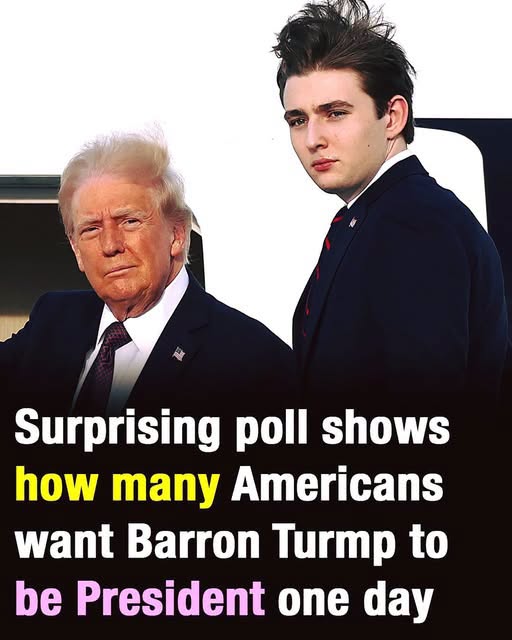
A newly released public opinion survey has reignited discussion about one of America’s most politically charged family names, offering a surprising glimpse into how voters feel about the possibility of Barron Trump one day entering politics.
While the youngest son of Donald and Melania Trump has remained largely outside the political spotlight, the poll suggests that his name alone is already enough to generate strong opinions about a potential future role in public life.
The findings arrive at a time when the Trump family continues to occupy a central place in American political conversation. Donald Trump’s presidency and ongoing political influence have left a deep and lasting imprint on the national landscape, shaping debates over leadership, governance, and ideology. Supporters view him as a disruptive force who reshaped politics, while critics see him as a polarizing figure who intensified divisions. That split perception has extended beyond his own career and into broader curiosity about his family.
According to the survey, public sentiment toward the Trump name remains sharply divided, reflecting the same polarization that has defined American politics in recent years. Respondents who support Donald Trump tend to view his family as a continuation of his political movement, while opponents often express concern about the expansion of political influence within a single family. This environment has naturally led to speculation about whether any of his children could eventually carry forward his political legacy.
Among them, Barron Trump has recently become a subject of growing public attention, despite maintaining a relatively private life. Unlike his older siblings, who have participated more actively in business, media, and political circles, Barron has remained largely focused on his education and personal development. Now a young adult studying at New York University’s Stern School of Business, he has not announced any political ambitions or public career plans.
However, the combination of his family background and increasing media curiosity has placed him in occasional public discussions about the future of political leadership within the Trump family. These conversations are not based on any declared intention from Barron himself, but rather on broader speculation about political dynasties in the United States, where family names sometimes reappear across generations in public office.
The poll explored hypothetical scenarios in which Barron Trump might one day consider a political career. Among Republican respondents, a notable portion expressed openness to the idea of him entering politics in the future, particularly if it were to occur after reaching the constitutional age requirement for presidential eligibility. Some respondents indicated that the Trump name continues to carry political weight and could remain influential in future elections, depending on how public sentiment evolves over time.
At the same time, the survey also revealed significant resistance to the idea of altering constitutional rules to accommodate any individual candidate. When asked about lowering or changing the minimum age requirement for presidential eligibility, most respondents across the political spectrum rejected the idea. Even among those who expressed favorable views of Barron Trump personally, there was little support for modifying established legal standards to accelerate political participation.
This distinction is important, as it suggests that while curiosity about Barron Trump’s future exists, it is largely constrained by respect for institutional rules. Many respondents appeared willing to imagine him as a future political figure only within the framework of existing constitutional guidelines, rather than through special exceptions or structural changes.
Broader results from the poll indicated that the general public remains cautious about political dynasties, even in cases where individual family members have not yet entered public life. While some respondents acknowledged that political families are not uncommon in American history, others expressed concern about concentrating political influence within a single lineage. This tension between openness to legacy and resistance to perceived dynastic politics was a recurring theme throughout the survey.
Political analysts interpreting the data noted that Barron Trump’s current popularity or political viability cannot be meaningfully assessed, given that he has not yet taken any public political stance. Instead, they argue that the responses reflect attitudes toward the Trump name itself rather than toward Barron as an individual political figure. In that sense, the poll may reveal more about the country’s ongoing reaction to Donald Trump’s legacy than about the future of his son.
Another factor contributing to public interest is the growing role of younger generations in shaping political communication. In recent reporting, Barron Trump has occasionally been mentioned in connection with discussions about modern media strategy, particularly in relation to platforms and influencers that appeal to younger voters. These references, however, remain informal and unconfirmed in terms of any direct political involvement.
Campaign advisers and political observers have increasingly acknowledged that digital platforms, podcasts, and social media personalities now play a significant role in reaching younger audiences. Within that context, even indirect associations with figures from politically prominent families can generate speculation about future influence. Still, no evidence suggests that Barron Trump has engaged in formal political activity or campaign involvement.
Outside of speculation, Barron’s daily life remains focused on education and personal development. He has maintained a relatively low public profile compared to other members of his family, rarely appearing in political events or public commentary. This distance from politics has contributed to a sense of mystery around him, which in turn fuels periodic media interest and public curiosity.
Despite this attention, the survey underscores that most Americans remain skeptical about altering foundational political rules for speculative future candidates. Even among those who expressed interest in the idea of Barron Trump entering politics someday, there was broad agreement that constitutional eligibility requirements should remain unchanged.
Ultimately, the poll highlights a familiar dynamic in American public life: the intersection of political legacy, public curiosity, and institutional stability. While the Trump name continues to command attention across the political spectrum, the idea of Barron Trump as a future political figure remains entirely hypothetical.
For now, he remains a private individual still shaping his own path, while public speculation continues to project possibilities onto a future that has yet to take form. The survey does not point to any imminent political development, but it does reveal how strongly the American public remains engaged with the idea of political families and the uncertain question of what comes next.