Parenting in the modern era has never been more visible, or more heavily scrutinized. Every decision, from feeding routines to school choices and even simple outings, can be recorded, shared, and dissected by millions of strangers online within minutes.
For many parents, this constant exposure has turned everyday family life into something that can unintentionally become public debate material.
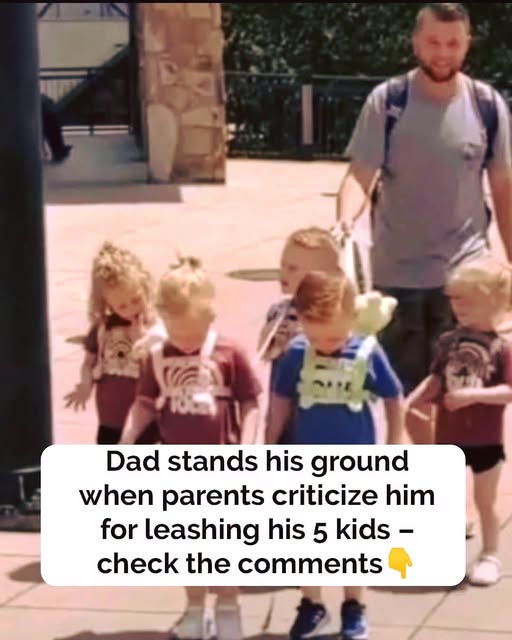
That is exactly what happened to Jordan Driskell, a father of quintuplets whose parenting approach recently went viral after a short video showed his five young children walking in public wearing child safety harnesses.
What might have been an ordinary family outing quickly escalated into a global conversation about safety, parenting, and judgment in the digital age.
Jordan Driskell, a young father in his early thirties, is raising five children who were all born at the same time. As quintuplets, the children share the same age and developmental stage, meaning their energy levels, curiosity, and need for constant attention are all happening simultaneously. Even in controlled environments, managing one child at that age can be challenging; managing five creates an entirely different level of responsibility.
From early on, Driskell and his family had to develop strategies to safely navigate everyday activities. Simple tasks like walking through parking lots, visiting public attractions, or shopping in crowded stores required careful coordination. Like many parents of multiple young children, they initially relied on a large multi-seat stroller designed to keep all five children together in one place.
At first, the stroller helped bring structure and safety to their outings. It allowed the children to stay close while giving the parents some control over movement in busy environments. However, as the children grew older and more active, the limitations of the stroller became increasingly clear. The children wanted to walk, explore, and interact with their surroundings, making it difficult for them to remain seated for long periods.
The family found themselves at a crossroads familiar to many parents of young, energetic children: balancing safety with independence.
Over time, the Driskells began exploring alternative solutions that would allow the children more freedom of movement while still ensuring they remained safe in crowded or unfamiliar environments. One of the options they chose was the use of child safety harnesses, sometimes referred to informally as “leashes,” which are designed specifically for young children.
These harnesses are not intended as restraints in the punitive sense, but rather as safety tools. They allow children to walk independently while remaining physically connected to their parent, reducing the risk of wandering off in busy or high-risk public areas such as airports, amusement parks, or crowded tourist destinations.
For Driskell’s family, the harnesses provided a practical solution: the children could move freely, but the parents could maintain proximity and supervision at all times.
The situation gained widespread attention after footage of one of their outings, including a visit to an aquarium, was uploaded online. The video showed all five children walking alongside their parents while wearing the safety harnesses. Within hours, the clip spread rapidly across social media platforms, attracting millions of views and sparking a flood of comments.
As often happens with viral parenting content, the reaction was deeply divided.
Critics argued strongly against the use of harnesses, suggesting that children should not be “restrained” in public and expressing discomfort with what they perceived as treating children like pets. Some commenters insisted that proper supervision and behavioral training should be sufficient without the need for physical devices. Others voiced concern about the emotional implications of using such tools in public spaces.
For these critics, the image alone was enough to trigger strong opinions, regardless of the context behind the decision.
However, an equally strong group of supporters defended the parents’ choice. Many pointed out that raising five children of the same age in crowded environments is an extraordinary challenge, and that safety must take priority over public perception. Supporters emphasized that child safety harnesses can be essential tools in preventing accidents, especially in situations where a moment of distraction could lead to a child getting lost or injured.
From this perspective, the decision was not about control, but about protection.
The debate also drew input from parenting and child development discussions more broadly. Experts in the field often note that safety harnesses can be appropriate in certain stages of early childhood, particularly when children are highly mobile and not yet able to consistently follow verbal instructions in complex environments.
These tools, they explain, are meant to supplement supervision rather than replace it. They serve as temporary safety measures while children gradually develop the cognitive and behavioral skills needed for independent movement in public spaces.
As children grow older, experts generally recommend transitioning away from such devices, encouraging independence through instruction, trust, and guided experience.
In Driskell’s case, however, the viral nature of the video meant that the focus shifted away from developmental nuance and toward public perception. The same moment viewed through a lens of practicality by some was interpreted as controversial by others.
The discussion quickly expanded beyond one family and became a broader reflection of how parenting is judged in the digital age.
Social media has created an environment where everyday decisions can be amplified into global debates. A single clip, taken out of context or viewed without explanation, can generate strong emotional reactions from viewers who bring their own experiences, values, and assumptions to what they see.
In this environment, parenting is no longer a private matter. It becomes something publicly evaluated, often without full understanding of the circumstances behind the choices being made.
Despite the criticism, many voices have also emphasized an important counterpoint: that families should be trusted to make decisions based on their own realities. Every household operates under different conditions, and what may appear unusual from the outside may be entirely necessary within the context of that family’s daily life.
For the Driskell family, the decision to use harnesses reflects a practical approach to managing safety in a uniquely demanding situation. Rather than relying solely on strollers or verbal commands, they chose a method that allowed both mobility and supervision in environments where risks can change quickly.
Ultimately, the story highlights a larger truth about modern parenting: it exists under constant observation. Choices that were once private are now subject to instant public reaction, often shaped more by appearance than by context.
The debate surrounding Jordan Driskell and his quintuplets is not just about harnesses or parenting tools. It is about how quickly judgment forms in a digital world, and how easily intention can be lost in translation when life is viewed through a screen.
And in the center of that debate are five young children simply walking beside their father, unaware that an ordinary family outing had become an international talking point.