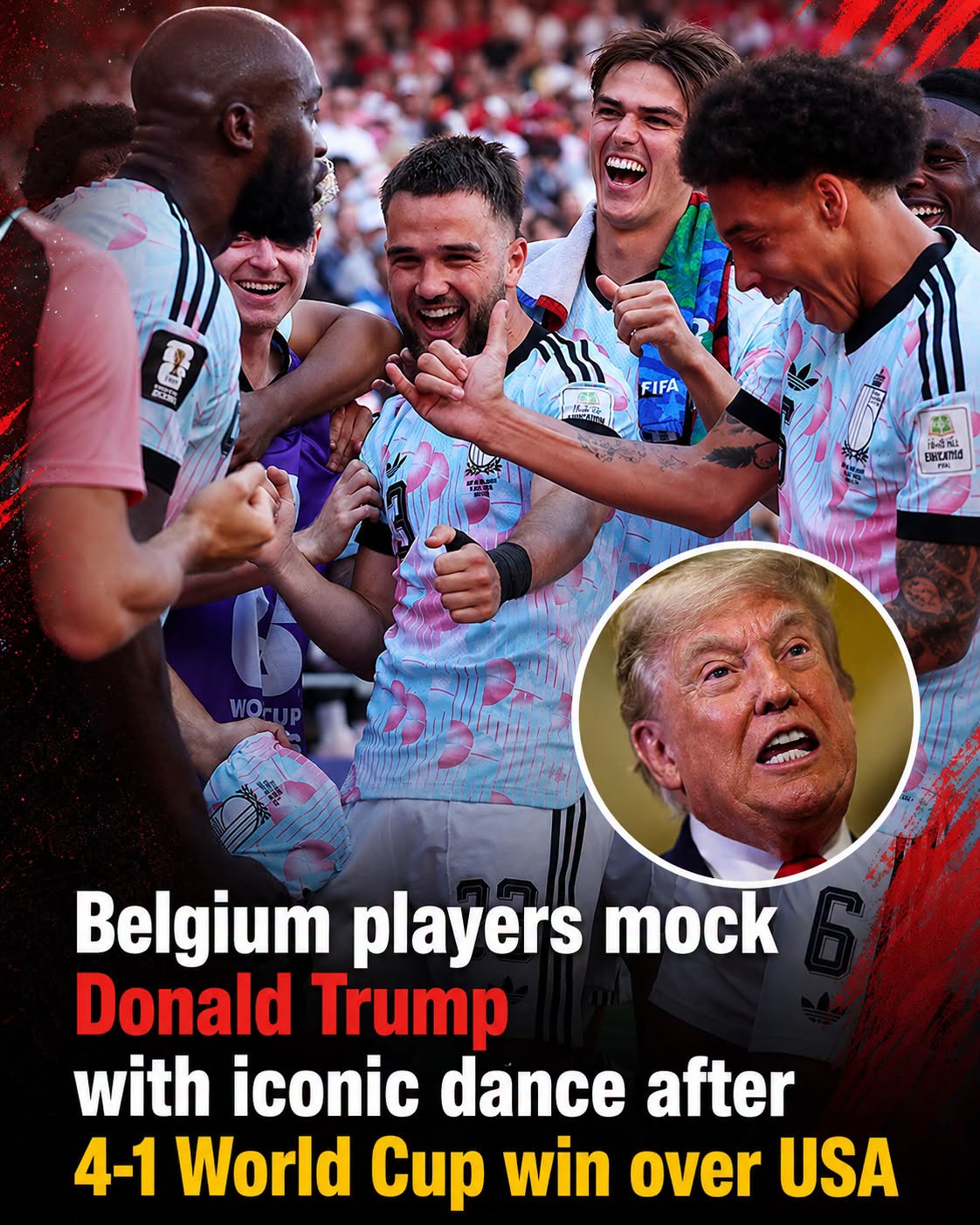
Belgium’s victory over the United States in the FIFA World Cup Round of 16 was already destined to dominate headlines, but it was what happened after the final goal that sparked an entirely different conversation.
The European side produced one of their strongest performances of the tournament, defeating the co-hosts 4-1 in front of a stunned crowd in Seattle. While the result alone was enough to send Belgium into the quarterfinals and end the United States’ World Cup campaign, the celebrations that followed quickly became one of the most discussed moments of the match.
Within minutes, videos spread across social media showing several Belgian players celebrating in a way many viewers immediately recognized.
The gesture wasn’t random.
It appeared to imitate the dance move that became closely associated with Donald Trump during the 2024 presidential campaign.
The celebration instantly divided opinions online, with some fans calling it humorous gamesmanship while others viewed it as a pointed response to the controversy that had surrounded the match long before kickoff.
In truth, the game had carried far more tension than a typical knockout fixture.
Before either team stepped onto the field, discussions centered on a decision involving United States striker Folarin Balogun.
Balogun had previously received a suspension after being sent off during an earlier international match. Initially, it appeared that he would miss the crucial encounter against Belgium.
However, the suspension was later lifted, allowing the forward to return to the starting lineup.
The decision generated significant debate among supporters, analysts, and members of the Belgian camp, many of whom questioned the timing and circumstances surrounding the reversal.
Reports and speculation suggested that political attention surrounding the case had only intensified the discussion, placing additional focus on the fixture before the opening whistle.
Whether those debates affected the players mentally is impossible to know.
What became clear, however, was that Belgium entered the match determined to let their football provide the strongest response possible.
From the opening minutes, Belgium controlled possession with confidence.
Their midfield dictated the tempo, moving the ball patiently while limiting the United States’ opportunities to build meaningful attacks.
Whenever the Americans attempted to press forward, Belgium responded with composed passing and intelligent movement that repeatedly created space.
The United States struggled to establish any sustained rhythm.
Playing in front of home supporters naturally brought enormous expectations, but Belgium appeared unfazed by both the atmosphere and the occasion.
Instead of allowing the crowd to influence the match, they steadily increased the pressure.
Eventually, their persistence paid off.
Belgium broke through with the opening goal, immediately shifting momentum firmly in their favor.
The United States attempted to respond, showing flashes of determination and energy, but Belgium remained organized defensively and dangerous whenever they attacked.
Every successful move seemed to increase their confidence.
As the match progressed, Belgium continued creating chances while the American defense found itself under constant pressure.
Additional goals followed, each one making the task facing the home side increasingly difficult.
Although the United States managed to find the net once, Belgium never truly looked in danger of losing control.
Their attacking combinations remained sharp throughout the contest.
By the closing stages, the outcome had become increasingly clear.
Then came the decisive moment.
Deep into stoppage time, Romelu Lukaku added Belgium’s fourth goal, putting the result beyond any remaining doubt.
The striker calmly finished the opportunity before turning toward teammates already beginning to celebrate.
What happened next immediately caught everyone’s attention.
Several Belgian players gathered together and began performing exaggerated dance movements that closely resembled the dance associated with Donald Trump during his recent political campaign.
The routine, featuring rhythmic arm movements and distinctive body motions, had become widely recognized after appearing repeatedly at campaign rallies and public appearances.
Seeing it recreated on a World Cup stage immediately fueled online discussion.
Television cameras captured the celebration from multiple angles, ensuring millions of viewers witnessed the moment live.
Clips spread rapidly across social media platforms within minutes.
Some users interpreted the celebration as playful banter following an emotionally charged victory.
Others believed it represented a direct response to the pre-match controversy that had surrounded Balogun’s eligibility.
Neither the Belgian players nor coaching staff immediately provided detailed explanations about the celebration itself, allowing speculation to continue.
As often happens in modern sport, the post-match conversation expanded well beyond tactics and statistics.
Instead of focusing solely on Belgium’s impressive performance, many discussions centered on whether political symbolism belongs in sporting celebrations.
Some argued athletes have always used celebrations to express emotion, personality, or respond to outside criticism.
Others felt football should remain separate from political references altogether.
Regardless of individual opinions, there was little disagreement about Belgium’s football.
Their victory was fully deserved.
Across ninety minutes they demonstrated greater composure, sharper finishing, and superior control in nearly every area of the game.
For the United States, the defeat marked a disappointing conclusion to a tournament filled with high expectations.
As one of the competition’s co-hosts, hopes had been growing that the team could produce a memorable run deep into the knockout rounds.
Instead, they now faced an earlier-than-expected exit and difficult questions about what comes next.
Players acknowledged their disappointment while expressing gratitude to supporters who had backed them throughout the tournament.
Attention now shifts toward evaluating the campaign and preparing for future international competitions.
Belgium, meanwhile, leaves Seattle with enormous momentum.
The convincing scoreline sends a strong message to the remaining teams that they possess both the quality and confidence required to compete for the World Cup title.
Their combination of experienced veterans and emerging talent continues to make them one of the tournament’s most dangerous sides.
Yet despite the quality of their football, it may ultimately be their celebration that remains one of the tournament’s most replayed moments.
Whether viewed as harmless humor, competitive confidence, or subtle commentary on the controversy surrounding the match, the dance ensured Belgium’s victory would be remembered for more than the final score.
Long after the goals are forgotten, fans are likely to remember the moment when a dominant World Cup performance ended with one unexpected celebration that instantly became one of football’s biggest talking points.