For decades, Colin Mochrie has been known for making millions of people laugh.
As one of the beloved stars of Whose Line Is It Anyway?, he built a reputation through quick wit, kindness, and an ability to find humor in almost any situation. Audiences admired not only his comedic talent but also his warm personality, both on and off the stage.
But one of the most meaningful moments of his life had nothing to do with comedy.
It came when his daughter, Kinley, shared something deeply personal with her family.
When Kinley came out as transgender, Colin’s response was immediate and unwavering.
There was no hesitation.
No uncertainty.
No conditions.
He simply chose love.
Rather than focusing on public opinion or outside criticism, Colin made it clear that his daughter remained exactly who she had always been—a cherished member of the family who deserved support, respect, and acceptance.
For him, nothing about that fundamental relationship had changed.
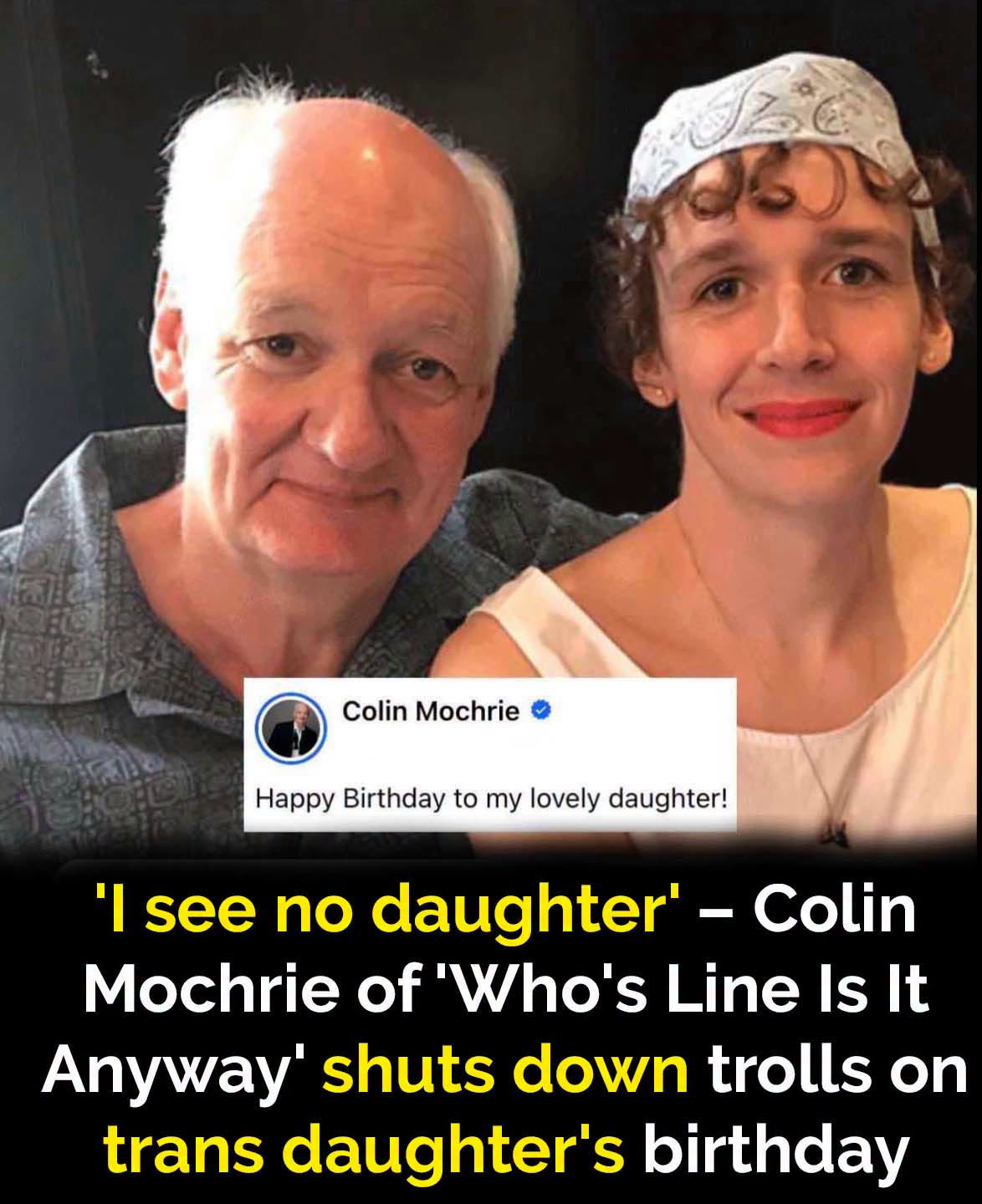
When Kinley celebrated her birthday, Colin shared a heartfelt message honoring her.
He described her as everything he and his wife had ever hoped for in a child, expressing the same pride and affection any parent might feel while celebrating their son or daughter.
To many people, it was simply a father expressing love.
To others, it became something much bigger.
The post quickly attracted attention online.
Thousands of people responded with encouragement, celebrating the family’s openness and the visible bond they shared.
But alongside the supportive messages came criticism from individuals who objected to Colin’s public support for his daughter.
Social media, which often amplifies both kindness and hostility, became the stage for an intense wave of reactions.
Some users questioned his decision to speak publicly.
Others directed harsh comments toward Kinley herself.
For many families, this kind of online hostility can be overwhelming.
Instead of responding with anger or lengthy arguments, Colin addressed the situation in his own unmistakable style.
His message was brief, calm, and deeply personal.
Rather than attacking those who criticized his family, he expressed sadness for them.
He suggested that the people spreading hate had lost something far more important than an online debate their compassion.
His words reflected disappointment rather than hostility.
It was a response that many people described as graceful, choosing empathy over conflict.
Instead of escalating the conversation, he reminded readers that kindness remains a choice, even during difficult moments.
The reaction to his message was immediate.
Support poured in from around the world.
Parents raising transgender children shared stories of their own families, thanking Colin for publicly demonstrating unconditional acceptance.
Many explained how meaningful it was to see a well-known public figure stand beside his child without hesitation.
For some, it offered reassurance during their own parenting journeys.
Others simply appreciated seeing a family refuse to let negativity define their story.
Mental health professionals, educators, advocates, and longtime fans also joined the conversation.
Many noted that family support plays an essential role in the emotional well-being of transgender young people.
They praised Colin and his wife for focusing on what mattered most: ensuring their daughter knew she was loved.
Throughout the discussion, one message appeared repeatedly.
People admired not only what Colin said but also how naturally he said it.
There was no dramatic announcement.
No attempt to seek praise.
Just a father speaking about his child with pride.
At another point, Colin offered an explanation that resonated with countless readers.
He described Kinley as being the same person she had always been.
The only difference, he suggested, was that she was finally able to live openly and authentically.
His comparison was simple.
The person remained the same.
Only the outward expression had changed.
That perspective reflected how his family viewed the transition not as losing someone they loved, but as supporting the same individual while allowing her to be herself.
Kinley has also spoken about her family’s acceptance.
She explained that she never doubted her parents would support her.
Knowing she could rely on them provided comfort during a period that can often be filled with uncertainty for many transgender individuals.
Their relationship became an example of trust built over many years.
It also highlighted an important reality.
Family support does not eliminate every challenge.
Public criticism still exists.
Misunderstandings still happen.
But having people who stand beside you can make an enormous difference when facing those challenges.
For Colin, being a father has always come before being a celebrity.
His career introduced him to millions of viewers, but his greatest responsibility remained within his own home.
Supporting his daughter was never presented as a public relations decision or a political statement.
It was simply an expression of parental love.
That authenticity is one reason so many people connected with his message.
The conversation also sparked broader discussions about acceptance, empathy, and the role families play during significant moments in a person’s life.
Many parents shared stories about learning, listening, and growing alongside their children.
Others reflected on the importance of creating homes where young people feel safe expressing who they are.
The overwhelming response demonstrated that while social media often highlights conflict, it can also become a place where encouragement spreads quickly.
Thousands of strangers used the opportunity to remind Kinley that she was supported.
Many thanked Colin for using his public platform to show compassion rather than division.
His response ultimately became larger than the criticism that inspired it.
Instead of being remembered for online hostility, the story became one about family.
About choosing understanding instead of fear.
About responding to negativity without surrendering kindness.
Colin Mochrie has spent much of his life making audiences laugh.
But in this moment, he reminded many people of something even more lasting.
Sometimes the strongest response is not found in clever jokes or heated arguments.
Sometimes it is found in standing beside the people you love without hesitation.
His family’s story serves as a simple but powerful reminder that unconditional love does not require perfect understanding.
It begins with acceptance.
It grows through compassion.
And it remains strongest when offered without conditions.
For Colin, that has never seemed complicated.
His daughter is still his daughter.
His pride has never changed.
And no amount of criticism from strangers has been enough to weaken the bond that continues to define their family.