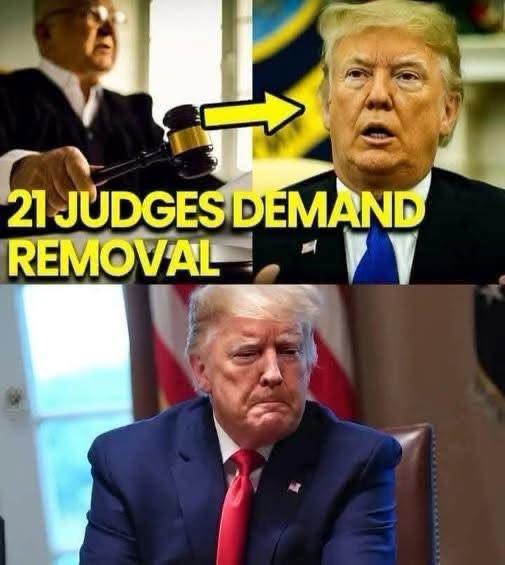
The letter itself was only a few pages long, but the shockwaves it created spread far beyond the walls of Congress.
For many Americans, the most surprising part was not what the judges wrote. It was the fact that they wrote anything at all.
Federal judges are known for their restraint. They rarely enter political debates, avoid public commentary, and often allow their decisions to speak for them. Their authority depends heavily on the perception that they stand apart from partisan conflict. That is why the decision by twenty-one judges to publicly warn lawmakers immediately captured national attention.
What began as a formal statement quickly became something larger: a debate about democracy, institutional trust, and the role judges should play when they believe the political system itself is under pressure.
Supporters viewed the letter as an act of courage.
Critics viewed it as a dangerous crossing of lines.
Everyone agreed that it was unusual.
The judges reportedly felt that remaining silent was no longer enough. Their concerns centered on behavior they believed threatened respect for democratic institutions and the rule of law. Although the letter carried no legal authority and created no direct consequences, its significance came from the identities of the people signing it.
Judges rarely step into public political disputes.
When they do, people pay attention.
For decades, the American judiciary has relied on distance from politics as one of its greatest strengths. Judges are expected to interpret the law, not campaign for causes or publicly criticize political figures. Their legitimacy depends on public confidence that they remain impartial.
That tradition made the letter feel extraordinary.
Some legal experts described it as an institutional warning.
Others called it an institutional failure.
The disagreement quickly spread across television networks, social media, political circles, and legal communities.
Supporters argued that judges have a responsibility to speak when they believe democratic norms are being challenged. They pointed out that judges are not isolated observers but participants within the constitutional system. If they genuinely fear damage to the rule of law, they argued, silence could itself become a form of negligence.
These supporters viewed the judges as guardians of democratic principles.
To them, the letter represented conscience.
The critics saw something very different.
They argued that judges stepping into political debates risk undermining the very neutrality that gives the courts their authority. Once judges appear to take sides in political conflicts, opponents argued, public trust may begin to erode.
If judges become political actors, critics asked, who remains above politics?
This question quickly became central to the debate.
Inside Washington, lawmakers reportedly disagreed sharply about how seriously the warning should be taken. Some described it as a constitutional alarm bell.
Others dismissed it as political activism.
The divisions reflected a broader reality that has become increasingly familiar in modern American politics: nearly every action is interpreted through a partisan lens.
Even judges.
Even warnings.
Even silence.
The situation revealed how difficult it has become for institutions to maintain public trust when political tensions run high. Actions once considered neutral can appear partisan. Statements intended as warnings can appear as attacks.
The meaning of events often depends less on what happened than on who is interpreting them.
For many Americans, the judges’ intervention felt unsettling precisely because it challenged long-held expectations.
Judges are supposed to remain quiet.
Judges are supposed to remain neutral.
Judges are supposed to stay above political conflict.
Yet the signatories appeared to believe that extraordinary circumstances required extraordinary action.
Their decision forced the public to confront difficult questions.
What happens when judges believe democratic institutions are under threat?
What responsibilities do they have beyond the courtroom?
At what point does silence become dangerous?
At what point does speaking become dangerous?
The answers remain deeply contested.
Legal scholars have noted that American history contains examples of judges speaking publicly during periods of national crisis, although such moments are rare. The judiciary has occasionally entered public debates during times of war, civil rights struggles, and constitutional disputes.
But these moments have almost always been controversial.
They raise uncomfortable tensions between two important principles.
Judicial independence.
Democratic accountability.
The judges involved reportedly understood that their decision would attract criticism. Some observers believe they deliberately accepted that risk because they considered the circumstances unusually serious.
Others believe they underestimated the consequences.
Either way, the reaction demonstrated how fragile institutional trust has become.
For some Americans, the judges became heroes.
For others, they became partisans.
The same letter produced entirely different conclusions.
Social media intensified these divisions.
Supporters praised the judges for speaking truth to power.
Critics accused them of abandoning neutrality.
Political commentators debated their motives.
Legal analysts debated their authority.
Ordinary citizens debated whether they felt reassured or alarmed.
The judges themselves largely remained silent after the initial statement.
That silence, too, became part of the story.
Without further explanation, people projected their own interpretations onto the letter.
Some saw fear.
Some saw courage.
Some saw politics.
Some saw principle.
The episode also exposed a larger problem facing democratic societies.
Institutions depend heavily on public trust.
Courts rely on trust.
Congress relies on trust.
Elections rely on trust.
When confidence begins to weaken, even routine actions can become controversial.
A warning becomes a political statement.
A statement becomes a controversy.
A controversy becomes another source of division.
The judges may have hoped to strengthen confidence in democratic institutions.
Instead, their intervention revealed how deeply divided perceptions have become.
Even the idea of neutrality itself now faces scrutiny.
Can anyone truly remain outside politics?
Can institutions avoid political interpretation?
Can warnings be separated from ideology?
These questions extend far beyond one letter.
They touch nearly every institution in public life.
Universities.
Media organizations.
Courts.
Government agencies.
Many Americans increasingly struggle to distinguish between institutional authority and political influence.
The judges’ statement became another example of this tension.
Its actual legal impact was minimal.
Its symbolic impact was enormous.
In the end, the story does not offer clear heroes or villains.
It offers uncertainty.
The judges believed they had something important to say.
Their critics believed they should have remained silent.
Both sides claimed to defend democracy.
Both sides claimed to protect institutions.
The result was not resolution.
It was reflection.
The letter exposed fears that already existed beneath the surface.
Fears about institutions.
Fears about politics.
Fears about the future.
Perhaps that explains why the public reaction became so intense.
People were not simply debating a letter.
They were debating whether institutions still work.
Whether trust still exists.
Whether warnings still matter.
And perhaps the most unsettling question of all remains unanswered.
If warnings from respected institutions become ordinary, how many can a democracy absorb before people stop hearing them altogether?