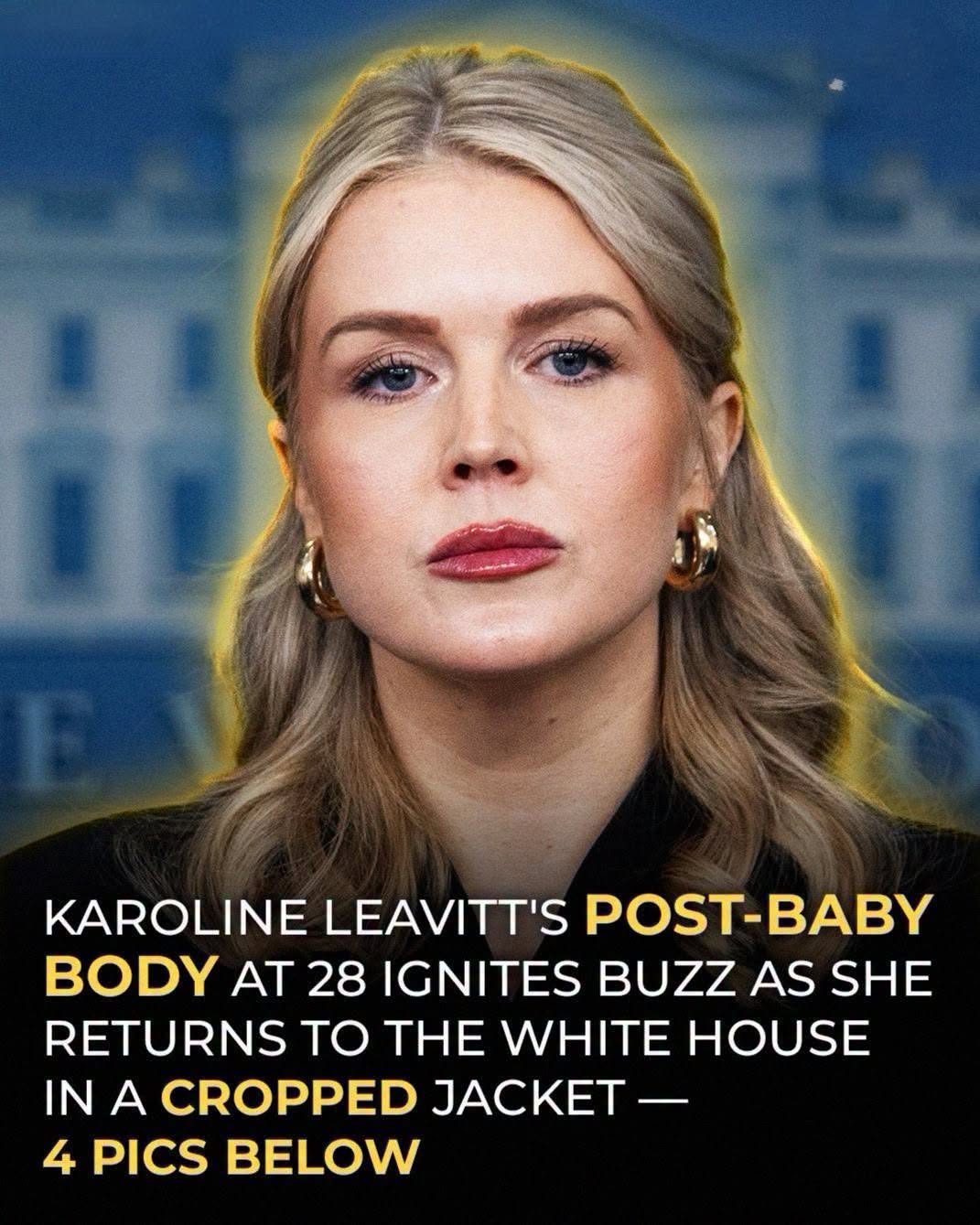
Only eight weeks after welcoming her child, Karoline Leavitt stepped back into one of the most demanding environments in American politics.
Cameras followed her every movement, reporters analyzed every appearance, and social media reacted instantly. Yet what surprised many people was not a policy statement, a political exchange, or a press briefing.
It was simply the way she looked.
Photographs from her first major public appearance after giving birth spread rapidly online. Instead of political headlines dominating the conversation, attention shifted toward her appearance, confidence, and composure. Comment sections filled with praise from supporters who admired her ability to return to such a demanding role so quickly.
Many people focused on her style.
Others noticed her calm expression.
Some simply wondered how someone who had recently become a mother could appear so composed while carrying one of the most visible jobs in politics.
For Karoline Leavitt, however, the photographs captured only a small part of the reality.
Behind the polished appearance stood a woman balancing motherhood, marriage, public service, and intense political pressure all at the same time.
Returning to work after childbirth is challenging for many women.
Returning to one of the most visible political positions in the country creates an entirely different level of pressure.
Every statement is analyzed.
Every appearance becomes news.
Every expression can generate headlines.
And unlike many professions, politics rarely allows moments of privacy.
Leavitt’s return highlighted an increasingly familiar challenge facing modern working mothers: how to pursue professional ambitions without sacrificing family life.
For many supporters, her appearance became symbolic.
She represented a younger generation of women attempting to navigate careers and motherhood simultaneously.
She represented ambition.
She represented resilience.
She represented the reality that many women face every day, although under far less public circumstances.
Social media users quickly shared their reactions.
Many praised her appearance.
Others expressed admiration for her ability to return to work so quickly.
Comments focused on her energy, confidence, and apparent ability to manage both professional responsibilities and family life.
Yet public images often conceal private struggles.
Leavitt herself has spoken openly about some of the emotional challenges that come with balancing motherhood and a demanding career.
Leaving young children behind for work can create feelings of guilt.
Long travel schedules become more difficult.
Unexpected political events do not pause because a family needs attention.
The demands of public office continue regardless of personal circumstances.
For many parents, these struggles feel familiar.
The difference is that most people experience them privately.
Leavitt experiences them publicly.
Every decision can become a topic of discussion.
Every absence can generate questions.
Every choice is subject to public interpretation.
Her story has also attracted attention because of her age.
At only twenty-eight years old, she occupies a highly visible position in national politics while also beginning a new chapter as a mother. The combination of youth, political prominence, and family responsibilities has made her particularly visible in public discussions.
Supporters see her as evidence that young women can succeed in both family and professional life.
Critics sometimes question the pace and demands of such a lifestyle.
The conversation extends beyond politics.
It touches broader questions about modern expectations placed upon women.
Can women pursue demanding careers while raising young children?
Can they succeed in both worlds?
Must they choose between ambition and family?
These questions have no simple answers.
Leavitt’s marriage has also attracted attention, particularly because of discussions surrounding the age difference between her and her husband. Public curiosity about their relationship has generated headlines and social media conversations, adding another layer of scrutiny to her personal life.
For public figures, personal decisions often become public debates.
Relationships become stories.
Families become topics of discussion.
Private moments become public images.
Leavitt has experienced all of this while simultaneously adjusting to life as a new mother.
Despite the attention, many of the images shared publicly reveal simpler moments.
Nursery photographs.
Family gatherings.
Quiet moments at home.
Pictures that show not a political figure, but a parent.
These glimpses into family life often resonate strongly because they remind people that public figures experience many of the same challenges as everyone else.
Sleepless nights.
Feeding schedules.
Exhaustion.
Concern.
Joy.
The transition into parenthood changes lives regardless of occupation.
Yet politics rarely slows down.
Press briefings continue.
Meetings continue.
Travel continues.
Public expectations continue.
The pressure to appear composed remains constant.
This is perhaps why so many people reacted strongly to her appearance.
The photographs showed confidence.
They showed professionalism.
But they also represented something larger.
For many working mothers, the expectation to immediately return to normal can feel overwhelming. Society often celebrates women who appear to manage everything perfectly while overlooking the emotional and physical challenges that accompany motherhood.
Leavitt’s public return became part of this larger conversation.
Some people praised her strength.
Others questioned whether modern work culture expects too much from women.
Many simply admired her determination.
Political careers have always demanded sacrifices.
Family life demands sacrifices as well.
Balancing both requires constant adjustment.
Leavitt’s experience highlights how these competing responsibilities can coexist, even if imperfectly.
No photograph captures the entire reality.
No public appearance reveals every struggle.
No social media comment tells the full story.
Behind every image are long days, difficult decisions, and private moments that remain unseen.
The attention surrounding her appearance also reflects broader cultural changes.
Today, public figures are often judged not only by their professional performance but also by how they manage personal responsibilities.
Motherhood itself has become part of the public conversation.
People no longer simply discuss policies.
They discuss parenting.
Family.
Balance.
Lifestyle.
Expectations.
For some observers, Leavitt represents the possibility that women no longer need to choose between career and family.
For others, she represents the growing pressure placed on women to succeed in every area simultaneously.
Both perspectives reveal important truths.
Modern women often face expectations that can seem impossible to satisfy.
Be successful.
Be present.
Be available.
Be accomplished.
Be perfect.
The reality is far more complicated.
Perhaps that is why her return generated such strong reactions.
People were not simply looking at a political figure.
They were seeing a mother returning to work.
They were seeing ambition and responsibility existing side by side.
They were seeing someone attempting to navigate two demanding worlds at once.
The photographs captured elegance and confidence.
But they also captured something deeper.
They showed a woman refusing to believe that motherhood and ambition must exist in opposition.
As she continues balancing family life with one of the most visible jobs in politics, the attention surrounding her will likely continue.
Some people will focus on politics.
Others will focus on family.
Many will continue watching to see how she manages both.
Because beyond the headlines, the photographs, and the public appearances lies a story that resonates far beyond Washington.
It is the story of a working mother trying to succeed in every part of her life.
And for millions of women facing similar struggles, even under very different circumstances, that story feels remarkably familiar.