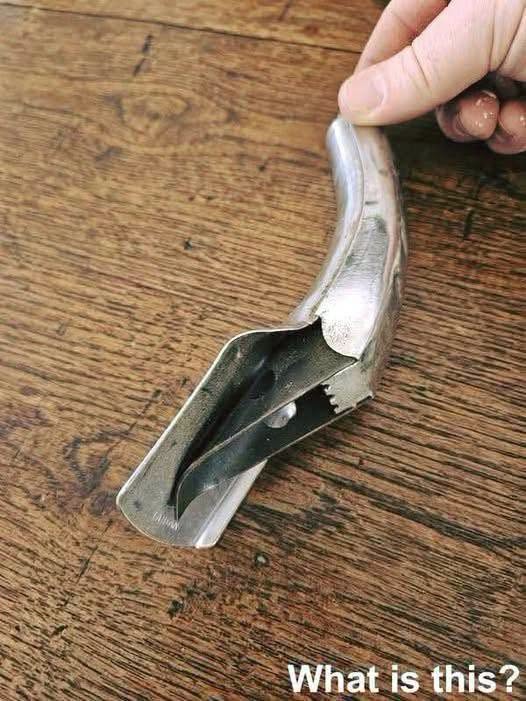
It was the kind of object that instantly captures attention.
Hidden among a collection of old tools inside a dusty toolbox, it looked mysterious, purposeful, and oddly familiar all at once. Its heavy metal construction suggested durability. Its unusual curves hinted at a specific function. Yet despite careful examination, nobody seemed entirely sure what it actually was.
At first glance, it appeared to belong to another era.
The object lacked any labels, instructions, or markings that could easily reveal its purpose. It sat quietly among ordinary wrenches, screwdrivers, and rusted hardware, standing out precisely because it looked so different from everything around it.
Curiosity spread quickly.
When a photograph of the tool was shared online, people immediately began offering theories. Some were serious. Others were wildly imaginative.
One person believed it was a specialized device used by mechanics decades ago.
Another insisted it was part of an industrial machine no longer manufactured.
Someone else suggested it might have belonged to a railroad worker.
The theories kept coming.
As more people joined the discussion, the object transformed from a forgotten tool into a fascinating puzzle.
Its design seemed deliberate enough to serve an important purpose, yet obscure enough that very few people could confidently identify it.
That combination proved irresistible.
The internet loves a mystery.
Especially when it involves an object that appears to come from another time.
Soon, thousands of viewers were studying every detail.
They zoomed in on photographs.
They compared it to vintage tools.
They searched through catalogs and historical references.
Some became convinced it was connected to carpentry.
Others argued that it belonged to the automotive industry.
A few even proposed that it originated from a trade that had nearly vanished from modern life.
What made the object particularly intriguing was its simplicity.
Modern tools often reveal their purpose immediately.
A hammer looks like a hammer.
A wrench looks like a wrench.
But older tools frequently relied on specialized knowledge that has gradually disappeared over generations.
As technology changes, so do the skills associated with it.
Tasks that once required unique equipment are now completed by machines, computers, or entirely different processes.
Because of this, many tools that were once common become unrecognizable over time.
The mysterious object seemed to belong to that category.
It felt like a relic from a forgotten world.
A world where craftsmanship was learned through apprenticeships.
A world where workers developed expertise that was passed down through families and trades.
A world where every tool served a specific purpose understood only by those who used it daily.
As speculation intensified, the object began inspiring larger conversations.
People shared memories of grandparents who worked with their hands.
Others recalled exploring old workshops filled with unfamiliar devices.
Many admitted they had discovered similar objects in garages, barns, or attics and never learned what they were.
The discussion became about more than the tool itself.
It became a conversation about memory.
About history.
About how quickly everyday knowledge can disappear.
A generation ago, countless people might have recognized the object immediately.
Today, even experienced hobbyists struggled to identify it.
That realization fascinated many observers.
It highlighted an unusual truth.
Most objects are not mysterious because they are rare.
They become mysterious because the context surrounding them vanishes.
Without context, even the simplest tool can seem impossible to understand.
Imagine finding a modern smartphone hundreds of years in the future.
Without electricity, networks, or software, future observers might invent elaborate theories about its purpose.
The same phenomenon happens whenever we encounter objects disconnected from the world that created them.
Eventually, experts began weighing in.
Some examined the shape.
Others analyzed the construction techniques.
Slowly, a clearer picture emerged.
The object was not a lost invention.
It was not a secret industrial device.
It was not evidence of some forgotten technology.
Its purpose turned out to be far more ordinary than many people expected.
Like countless tools throughout history, it had been designed to perform a practical task efficiently and reliably.
The dramatic mystery surrounding it existed largely because the original context had been lost.
Once that context returned, the object suddenly seemed much less mysterious.
Yet something interesting happened.
Even after its likely identification was revealed, many people remained captivated.
Not because the answer was shocking.
But because the journey had been so engaging.
The tool had accomplished something unexpected.
It had forced people to pause.
To observe.
To think.
To imagine.
In a world overflowing with instant answers, that experience felt surprisingly refreshing.
Most people encounter thousands of objects every day without giving them a second thought.
This strange piece of metal interrupted that pattern.
It encouraged curiosity.
It reminded people that every manufactured object has a story.
Someone designed it.
Someone built it.
Someone depended on it.
Someone likely spent years using it as part of their daily routine.
Even the most ordinary tool represents human effort.
It reflects a problem that needed solving and a solution created through experience and ingenuity.
That perspective transformed the discussion.
The object was no longer simply a tool.
It became a symbol of forgotten work.
Of skilled hands.
Of generations who built, repaired, measured, crafted, and created using tools that modern society rarely remembers.
There is something strangely moving about that realization.
Entire careers can disappear within a few decades.
Industries evolve.
Methods change.
Technologies replace old systems.
And the tools once considered essential slowly become curiosities.
Yet they remain physical evidence that those lives and professions existed.
Each worn edge.
Each scratch.
Each carefully shaped curve tells part of that story.
Perhaps that is why people were so fascinated.
The mystery was never truly about identifying the object.
It was about reconnecting with the past.
It was about imagining the hands that once held it.
The workshops where it was used.
The problems it solved.
The routines it supported.
In many ways, the tool became a reminder of how fragile collective memory can be.
What seems ordinary today may become unrecognizable tomorrow.
The technologies we take for granted will eventually become artifacts.
Future generations may stare at them with the same curiosity and confusion.
That thought gives even the simplest object unexpected significance.
In the end, the mysterious tool turned out to be far less extraordinary than many imagined.
Yet its real value was never its function.
Its value was the conversation it inspired.
For a brief moment, an overlooked piece of metal sitting quietly in an old toolbox became a bridge between generations.
It reminded people that history is not only found in museums or textbooks.
Sometimes it hides in garages.
Sometimes it gathers dust on forgotten shelves.
And sometimes it waits patiently inside a toolbox, daring someone to ask a simple question:
What is this?
That question alone was enough to bring the past back to life.