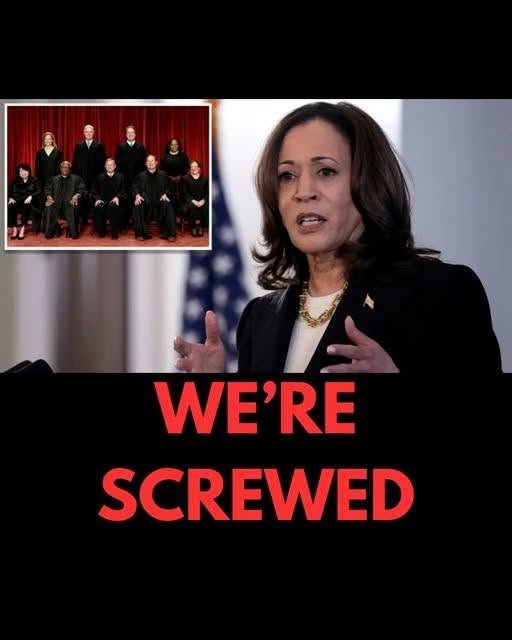
What began as a discussion about democracy quickly became one of the most explosive political debates in the country.
When Kamala Harris renewed support for major institutional reforms, including changes to the Supreme Court, the Electoral College, and representation for Washington D.C. and Puerto Rico, the reaction was immediate and intense. Supporters described her proposals as necessary updates to a political system they believe no longer reflects modern America. Critics called them dangerous attempts to rewrite the rules of government.
Within hours, political leaders, commentators, and activists from both sides were trading accusations, each arguing that the future of American democracy itself was at stake.
The controversy reaches far beyond individual policy proposals.
At its core lies a deeper question that has divided Americans for years: who holds power, how that power is distributed, and whether the institutions created centuries ago still function as intended in the twenty-first century.
For Harris and many Democrats, these institutions increasingly appear disconnected from the country’s changing demographics and voting patterns.
For Republicans, those same institutions serve as essential safeguards that prevent sudden political swings and preserve constitutional balance.
The result is a political conflict that touches nearly every major institution in American life.
One of the most controversial proposals involves the Supreme Court.
Calls to expand the number of justices have gained attention following several landmark decisions that dramatically reshaped issues involving abortion, voting rights, and executive authority. Advocates argue that the Court has become increasingly ideological and no longer reflects the views of a majority of Americans.
They believe reforms could restore public confidence and reduce political imbalance.
Critics strongly disagree.
Conservatives argue that expanding the Court would establish a dangerous precedent in which every political party adds justices whenever it gains power. They warn that such actions could transform the Court into a permanently political institution, undermining its independence and legitimacy.
For many Republicans, the Supreme Court remains one of the final barriers preventing rapid political change.
The Electoral College represents another major point of division.
Harris and other Democrats have argued that presidential elections should be decided by the national popular vote. They point to recent elections in which candidates won the presidency despite receiving fewer total votes nationwide.
Supporters believe every vote should carry equal weight regardless of geography.
Opponents argue that the Electoral College protects smaller states and ensures that presidential candidates campaign across the entire country rather than focusing only on large urban populations.
They contend that eliminating the system would concentrate political influence in a handful of major cities while reducing the importance of rural communities.
The debate over statehood for Washington D.C. and Puerto Rico has generated equally passionate responses.
Supporters argue that millions of American citizens deserve full congressional representation and voting rights. They view statehood as an issue of fairness and democratic participation.
Critics counter that statehood efforts are motivated primarily by political advantage, since both areas are generally expected to favor Democratic candidates.
As these proposals gained attention, Republican leaders accused Harris and her allies of attempting to alter the rules whenever elections or court decisions fail to produce desired outcomes.
Some conservative commentators described the reforms as efforts to dismantle longstanding institutions that have guided the country for generations.
They argue that the American system intentionally distributes power across multiple institutions to prevent any single political movement from gaining complete control.
From their perspective, preserving those institutions protects stability.
Democrats see the situation very differently.
Many argue that existing structures increasingly weaken the political influence of growing populations in urban areas and minority communities. They point to congressional district maps, voting laws, and representation disparities as evidence that some voices carry greater weight than others.
Harris has repeatedly argued that certain political strategies effectively limit participation and representation.
Her comments about redistricting and voting access have sparked particularly strong reactions.
Supporters believe she is addressing longstanding concerns about fairness and representation.
Critics accuse her of using inflammatory language that further deepens political divisions.
Meanwhile, progressive voices have continued to push for even broader reforms.
Some lawmakers argue that current political structures no longer reflect the demographic, cultural, and economic realities of modern America. Others warn that refusing to address these concerns will only increase frustration and distrust.
The language surrounding these debates has become increasingly dramatic.
Some political figures describe the current moment as a battle for democracy itself.
Others warn that rapid institutional change could permanently damage public confidence in government.
As both sides intensify their rhetoric, compromise appears increasingly difficult.
The disagreement is not simply about policies.
It is about competing visions of the country.
One side sees institutions that require modernization and reform.
The other sees institutions that provide stability and protection.
Both believe they are defending democracy.
Both believe the stakes are extraordinarily high.
Public trust in government has already declined significantly over recent decades.
The courts, Congress, elections, and political parties have all experienced growing skepticism from voters across the political spectrum.
These reform debates now unfold against that backdrop of declining confidence.
Every proposal becomes more than a policy discussion.
It becomes a test of legitimacy.
Many Americans watching these arguments feel increasingly frustrated by the constant political conflict.
Others view this period as an inevitable struggle over the future direction of the country.
As elections approach and political divisions deepen, the pressure surrounding these issues will likely continue to grow.
The larger question may not be whether institutional changes eventually occur.
History shows that American institutions have evolved repeatedly over time.
The more immediate question is whether those changes can happen through cooperation rather than confrontation.
For now, the battle over courts, elections, representation, and political power remains unresolved.
Supporters of reform believe they are correcting structural imbalances.
Opponents believe they are defending constitutional principles.
Neither side appears willing to retreat.
What began as policy proposals has become something much larger.
It is now a struggle over how Americans understand democracy itself.
The outcome may shape not only future elections but also the level of trust citizens place in the institutions that govern them.
In the end, the debate is not simply about who wins the next political battle.
It is about which vision of America will define the rules by which future generations live, vote, and govern.