
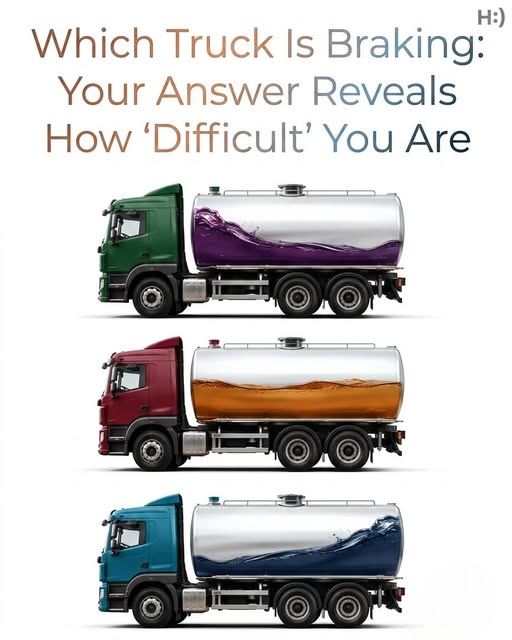
At first glance, it looks like a simple puzzle. Three trucks appear on the screen, each carrying a tank partially filled with liquid.
The question seems straightforward: which truck is braking? Most people answer almost instantly, convinced the solution is obvious. Yet within seconds, arguments begin. One person confidently chooses the red truck. Another insists it has to be the green one. Someone else points to the blue truck and says the physics are undeniable.
Suddenly, what looked like a harmless visual challenge becomes something strangely personal.
That is the hidden power behind these viral “truck tests.” They are rarely just about mechanics, liquid motion, or braking force. Instead, they tap into something deeper: the way people organize information, trust assumptions, and build meaning from incomplete details. The trucks become symbols, and the answer people choose often feels connected to how they see themselves.
Online, these puzzles spread because they promise more than a right answer. They offer identity. They suggest that a split-second decision might reveal how someone handles pressure, conflict, relationships, or uncertainty. Whether or not those claims are scientifically meaningful is almost irrelevant. What matters is that people want to believe the choice says something true about them.
The classic truck puzzle usually works like this: one truck’s liquid tilts forward, another backward, another remains more level. Viewers are expected to remember a basic principle of motion. When a vehicle brakes, inertia pushes liquid toward the front. When it accelerates, liquid shifts backward. Simple enough in theory. Yet many people still choose differently, not because they are incapable of understanding physics, but because human perception rarely operates as logically as we imagine.
The brain does not calmly calculate every visual detail. It reacts emotionally, intuitively, and symbolically long before logic fully arrives. That process is what makes these puzzles fascinating.
A person who quickly selects the red truck may later discover online descriptions claiming they are emotionally direct, fast-moving, and action-oriented. According to these interpretations, they trust instinct over analysis and prefer solving problems immediately rather than sitting in uncertainty. They are described as decisive personalities who dislike hesitation and often lead during stressful situations.
The green truck, meanwhile, is usually linked to overthinkers and analyzers. People who choose it are said to search for hidden meaning beneath obvious appearances. They supposedly question surface-level explanations and prefer depth over speed. Personality descriptions attached to this choice often portray thoughtful, introspective individuals who process situations carefully before acting.
Then there is the blue truck, frequently associated with emotional balance and caution. Those who choose it are often described as steady personalities who dislike extremes and seek stability in chaotic environments. They are portrayed as diplomatic, measured, and emotionally controlled even during pressure.
Of course, none of these descriptions are scientifically proven. They are broad enough that many people recognize parts of themselves regardless of which truck they picked. That phenomenon is part of why these tests feel strangely convincing. Humans naturally search for personal meaning in vague statements, especially when those statements appear insightful or emotionally flattering.
Psychologists sometimes refer to this tendency as the Barnum effect the reason horoscopes, personality quizzes, and generalized psychological profiles can feel uncannily accurate. The brain fills in gaps, selectively remembers matching details, and ignores contradictions. In other words, the truck puzzle works less like a scientific evaluation and more like a storytelling machine.
But that does not mean the puzzle is meaningless.
In fact, its popularity reveals something genuinely important about human behavior. People are deeply curious about themselves. They want frameworks that help explain why they react differently from others. Even simple visual puzzles become opportunities for self-reflection because humans are natural pattern-seekers. We constantly build narratives from fragments.
The truck puzzle also exposes how quickly assumptions form. Most people answer before carefully analyzing the image. They rely on instinct, prior experience, or visual shortcuts. That process mirrors real-life decision-making more than many realize.
Every day, people make judgments with incomplete information. They assess situations rapidly, often based on emotion or pattern recognition rather than deliberate logic. In relationships, workplaces, and social conflicts, assumptions frequently arrive before evidence. The truck test becomes a tiny simulation of that mental habit.
Interestingly, debates over the “correct” answer often become more emotional than the puzzle itself deserves. People defend their interpretation passionately, even after learning the physics explanation. That reaction reveals another human tendency: once individuals publicly commit to a conclusion, changing their mind can feel psychologically uncomfortable.
Social media intensifies this effect. Platforms reward certainty, confidence, and quick reactions rather than careful reconsideration. As a result, puzzles like these evolve into miniature battlegrounds where observation skills mix with ego, identity, and emotional attachment.
Yet the most revealing part of the truck puzzle may not be which answer people choose, but why they believe their answer reflects personality in the first place.
Humans crave mirrors. We constantly search for reflections of ourselves in stories, symbols, and systems. A truck carrying liquid becomes more than a truck because the mind transforms it into metaphor. The puzzle gives people permission to explore identity indirectly, without the vulnerability of direct self-analysis.
That is why these tests spread so rapidly online. They are interactive narratives disguised as logic challenges. They invite participation while promising emotional insight. Even skeptics often engage because the format is irresistible: choose quickly, then discover what your answer “says” about you.
In reality, the choice may reveal very little about personality and much more about attention patterns or familiarity with motion principles. Someone knowledgeable about physics might identify the braking truck correctly regardless of emotional tendencies. Another person might misread the liquid direction simply because they glanced too quickly. Observation skills, visual focus, and prior experience often matter more than hidden psychological truths.
Still, the emotional appeal remains powerful because people rarely experience themselves as collections of data. They experience life through stories. Personality quizzes, visual illusions, and symbolic puzzles all provide temporary frameworks for understanding identity in a complicated world.
The truck test also highlights how perception itself is deeply subjective. Two people can look at the same image and notice entirely different details. One focuses on the liquid angle. Another notices wheel position. Someone else reacts emotionally to color or movement. The brain filters reality selectively based on habits, experiences, and expectations.
This subjectivity extends far beyond puzzles. In real life, people often believe they are responding objectively to events when they are actually interpreting those events through emotional filters. Arguments, misunderstandings, and social divisions frequently emerge not because individuals see different facts, but because they assign different meanings to the same information.
The trucks become a surprisingly accurate metaphor for modern life itself.
Everyone believes they are observing reality clearly. Everyone feels certain their interpretation makes sense. Yet perception is never as neutral as people imagine. Emotions, memories, fears, and desires quietly shape what feels “obvious.”
Perhaps that is why these visual puzzles remain so addictive. They reveal something unsettling but deeply human: the mind cannot resist turning uncertainty into narrative. Presented with incomplete information, people instinctively build stories to explain what they see.
Some stories become identities.
Others become arguments.
And sometimes, a simple image of three trucks carrying liquid turns into a reflection of how people navigate pressure, trust instinct, defend assumptions, and search for meaning in a world overflowing with ambiguity.
In the end, the puzzle is not truly about braking trucks at all. It is about the astonishing speed with which the human mind transforms observation into identity.