The moment the curtain dropped at Trump National Doral, the crowd fell into a strange mix of applause, silence, and disbelief.
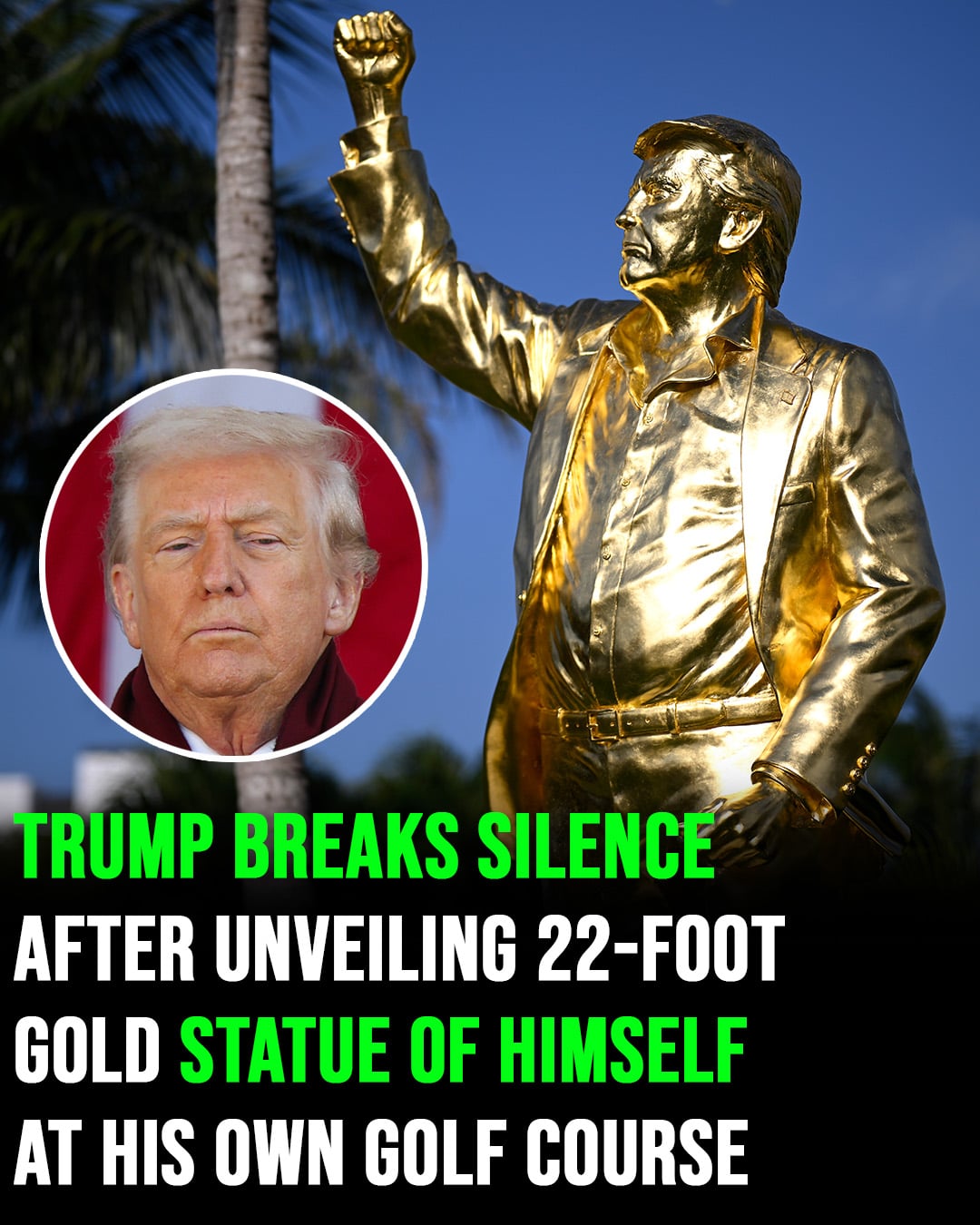
Towering above the palm-lined property stood a gleaming 22-foot gold statue of Donald Trump, its polished surface catching the Florida sunlight so intensely that guests shielded their eyes as cameras flashed from every angle. For supporters gathered at the private unveiling, the monument represented triumph, survival, and unwavering loyalty. For critics watching online only moments later, it became something entirely different: a symbol of political devotion pushed into unsettling new territory.
Within minutes, images of the statue spread across social media platforms and cable news broadcasts, reigniting the national debate surrounding Trump’s influence, legacy, and the increasingly emotional culture built around his political movement. The statue itself, reportedly valued at approximately $300,000, had been financed through contributions from cryptocurrency investors, political supporters, and small-dollar donors who viewed the project as a tribute to what they described as Trump’s resilience through years of legal battles, assassination threats, impeachment proceedings, and relentless political warfare.
The event had been carefully staged. Gold lighting reflected off nearby surfaces. Patriotic music played softly across the golf course grounds. Guests moved through the venue speaking in hushed but excited tones, some dressed in formal attire while others wore red hats and campaign-style memorabilia. Several attendees described the atmosphere less like a political fundraiser and more like a deeply personal gathering centered around shared belief and emotional connection.
At the center of the ceremony stood Pastor Mark Burns, one of Trump’s longtime allies, who delivered remarks that immediately drew widespread attention online. Speaking to the crowd beneath the massive statue, Burns insisted the monument was not intended as worship but as recognition of what he described as divine protection surrounding Trump’s life and political journey.
“We worship Jesus Christ alone,” Burns declared while gesturing toward the towering gold figure behind him. “This is about survival. This is about perseverance. This is about a man who endured what many believed would destroy him.”
His comments reflected the emotional tone that defined much of the evening. To supporters gathered there, Trump was not merely viewed as a former president or political figure. Many described him as a fighter who survived extraordinary attacks from media institutions, political opponents, prosecutors, and powerful establishment forces. Some attendees openly referenced the attempted assassination at a Pennsylvania rally in 2024, calling the statue a reminder that Trump had “been spared for a reason.”
The symbolism of gold itself was impossible to ignore. Trump’s public identity has long been associated with luxury, wealth, and highly visible branding. Gold accents have appeared throughout his hotels, residences, airplanes, and business properties for decades. But transforming that aesthetic into a towering statue elevated the imagery into something far more provocative.
The monument depicts Trump standing confidently with one arm raised slightly, dressed in a suit and tie, his facial expression sculpted into what supporters described as determination and critics mocked as self-glorification. The metallic finish gives the statue an almost surreal appearance under direct light, creating a spectacle that many attendees described as overwhelming in person.
Trump himself did not stand beside the monument during its unveiling. Instead, he phoned into the event while Pastor Burns held a microphone near the speakerphone so the crowd could hear him directly. His remarks were brief but emotional.
“I just want to say thank you,” Trump told supporters gathered below the statue. “Thank you for your love, your loyalty, and your unbelievable support through everything. We’ve been through a lot together, and I’ll never forget it.”
Those simple words triggered loud applause from attendees, several of whom were visibly emotional. Some wiped away tears while others lifted phones into the air to record the moment. For many there, the statue symbolized not arrogance but endurance.
Yet outside the gates of Trump National Doral, the reaction was dramatically different.
Critics across the political spectrum immediately seized on the imagery, arguing that the statue reflected a movement increasingly centered on personality rather than policy. Commentators compared the spectacle to displays more commonly associated with authoritarian political cultures, where leaders are immortalized through oversized monuments and grand symbolism.
Social media erupted with arguments almost instantly. Supporters described the backlash as proof that Trump continues to dominate American cultural conversation unlike any other political figure. Critics countered that the statue represented dangerous levels of political idolization.
The divide exposed something much deeper than disagreement over a sculpture. It revealed how emotionally charged modern American politics has become. To one side, Trump represents resistance against elite institutions and establishment power. To the other, he symbolizes a cult of personality that threatens democratic norms. The gold statue instantly became a visual battlefield where those opposing narratives collided.
Even among conservatives, reactions varied. Some praised the monument as theatrical but harmless, calling it a celebration of political resilience and branding genius. Others quietly expressed discomfort, worrying that the imagery risked alienating moderate voters who already view Trump’s movement as excessively personality-driven.
Meanwhile, supporters argued that critics completely misunderstood the emotional context behind the project. Many pointed to years of investigations, indictments, media scrutiny, and assassination threats directed toward Trump. From their perspective, the statue was not about worship but recognition of survival against overwhelming odds.
One attendee reportedly described the monument as “proof he never broke.”
That phrase spread widely online because it captured the emotional loyalty many supporters continue to feel toward Trump. For them, the statue is less about power and more about endurance. They see a man repeatedly attacked yet politically surviving in ways few expected possible.
But critics insist symbolism matters regardless of intention.
Political historians noted that giant statues have historically served as tools of mythology, transforming living figures into larger-than-life symbols that blur the line between leadership and reverence. Some analysts argued that even if supporters view the monument positively, the imagery itself inevitably carries uncomfortable historical echoes.
The location of the unveiling also added symbolic weight. Trump National Doral is not just a golf course it is one of the most visible extensions of Trump’s personal brand. Hosting the statue there reinforced the merging of politics, celebrity, luxury, and identity that has always defined Trump’s public image.
In many ways, the monument reflects the transformation of American politics into something increasingly emotional, visual, and performative. Modern political movements are no longer driven solely by policy platforms. They are fueled by symbols, identity, loyalty, and spectacle. The gold statue captured all of those forces at once.
For some Americans, the image felt inspiring. For others, deeply unsettling.
But almost nobody ignored it.
That may ultimately be the point. Trump has always understood the power of spectacle better than most political figures in modern history. Whether through rallies, branding, television appearances, or dramatic imagery, he consistently creates moments impossible to look away from. The statue instantly joined that long tradition.
As nighttime settled over Doral after the ceremony ended, the giant gold figure remained illuminated against the darkening sky while guests slowly departed the property. Some stopped to take final photographs. Others simply stood quietly staring upward, as though trying to process what the monument represented not only about Trump, but about the country itself.
Because beneath all the outrage, admiration, mockery, and symbolism lies a larger truth: the statue is ultimately a mirror. People see in it whatever they already believe about power, patriotism, leadership, ego, faith, or America’s future.
And perhaps that is why the image spread so quickly and sparked such fierce reaction. It was never just a statue. It became a national test of perception, forcing Americans to confront what they honor, what they fear, and how deeply divided the meaning of leadership has become in the modern age.