Years after one of the most controversial fashion moments in modern political history, the conversation has erupted once again and this time, it was reignited by one of Hollywood’s most respected voices.
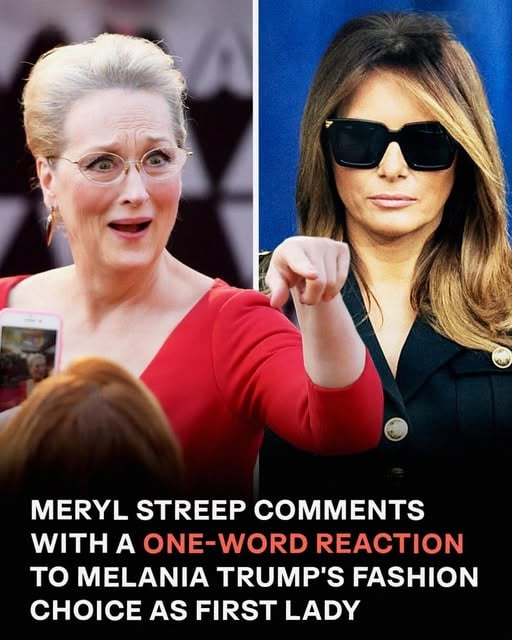
During a powerful new interview with Vogue, acclaimed actress Meryl Streep reflected on the growing role of symbolism, image, and public responsibility in modern culture. But it was her comments surrounding Melania Trump and the now-infamous “I Really Don’t Care, Do U?” jacket that immediately captured public attention and reopened a debate many believed had finally faded.
What began as a single outfit choice in 2018 has now evolved into something much larger than fashion. For critics, it became a symbol of emotional distance during one of the most painful immigration controversies in recent American history. For supporters, it represented a media frenzy spiraling around a message that may never have meant what people assumed. Yet years later, the image still refuses to disappear.
The photograph itself remains unforgettable. Melania Trump stepping onto a plane wearing an olive-green jacket with large white lettering printed across the back: “I Really Don’t Care, Do U?” At the time, she was traveling to visit migrant children at a detention facility near the Texas border amid national outrage over family separations. The timing instantly transformed the jacket from a fashion item into a cultural flashpoint.
The backlash was immediate and fierce. Across television, newspapers, and social media, the image spread at astonishing speed. To many Americans, especially those horrified by images of separated families and children in detention facilities, the jacket felt impossible to separate from the suffering dominating headlines. The message appeared cold, detached, and painfully mismatched with the gravity of the moment.
Melania Trump later stated that the jacket’s message was directed toward the media rather than migrant children or affected families. Her explanation was echoed by members of the administration, who argued that critics intentionally distorted the meaning for political purposes. But by then, the damage or the symbolism, depending on perspective had already taken root in public consciousness.
That is the tension Meryl Streep addressed in her recent remarks. Without turning the conversation into a direct political attack, Streep reflected on how public figures no longer control the meaning of the images they create. In an era dominated by instant photography, viral reactions, and permanent digital archives, she argued that appearance itself becomes communication. Every gesture, expression, and article of clothing carries emotional and cultural weight far beyond personal intention.
Her comments struck a nerve because they touched on something deeper than a single controversy. They raised questions about whether public figures can truly separate image from responsibility anymore. Can a jacket simply be a jacket when cameras follow every movement? Can symbolism be dismissed once millions of people emotionally connect it to a national crisis?
For many observers, the answer is no.
Fashion has always carried hidden language. Royal families, presidents, celebrities, activists, and even revolutionaries have long understood that clothing communicates values, identity, and allegiance before a single word is spoken. A carefully chosen color can project unity. A designer can signal wealth, power, nationalism, rebellion, or accessibility. In modern politics especially, appearance has become part of strategic storytelling.
But the Melania Trump jacket controversy revealed what happens when symbolism spirals beyond anyone’s ability to contain it.
What made the moment especially explosive was not simply the phrase itself, but the emotional timing surrounding it. The United States was deeply divided over immigration policy. Images of crying children, overcrowded detention centers, and desperate parents dominated public discussion. Emotions were already raw. Against that backdrop, the jacket appeared to many not merely insensitive, but surreal.
Some critics described it as one of the most tone-deaf public appearances ever associated with a First Lady. Others argued the outrage became disproportionate and symbolic of a media environment eager to weaponize every visual detail connected to the Trump administration. The divide reflected the larger polarization already consuming American political culture.
Streep’s comments revived the debate because they focused less on partisan politics and more on empathy. Her argument centered on the idea that public figures cannot afford to underestimate the emotional meaning audiences attach to imagery. Once an image enters the world, intention competes with interpretation—and interpretation often wins.
That reality has become even more powerful in the age of social media. A single photograph can define reputations for years. Moments are frozen, reposted, memed, debated, and emotionally reinterpreted thousands of times across platforms. Context shrinks while symbolism expands. What once might have been forgotten after a news cycle now becomes permanent digital memory.
The jacket itself has effectively become cultural shorthand. Mentioning it instantly recalls debates about compassion, political branding, media outrage, immigration policy, and emotional disconnect. Few fashion items in modern political history have carried such lasting symbolic impact.
Interestingly, the controversy also highlighted the unusual position of First Ladies in American culture. Though unelected, they are often expected to embody national empathy, elegance, and emotional reassurance. Their clothing choices are analyzed with extraordinary intensity. Every appearance becomes part fashion commentary, part political interpretation, and part cultural projection.
Melania Trump’s public image always existed somewhat differently from previous First Ladies. She often maintained a more distant and private presence, rarely engaging publicly with controversy in emotional terms. To supporters, this reflected dignity and restraint. To critics, it sometimes appeared detached. The jacket incident amplified those perceptions dramatically.
Meanwhile, Meryl Streep’s involvement added another layer because of her longstanding reputation as both an actress and cultural commentator. Over decades, she has become associated not only with artistic excellence but with reflections on morality, power, gender, and responsibility in public life. Her words carry influence precisely because she tends to speak carefully rather than constantly.
That is partly why the interview exploded online so quickly. Many people interpreted her remarks not simply as criticism of one moment, but as commentary on modern leadership itself. In her view, visual choices are no longer separate from ethical communication. Whether intentional or accidental, images shape emotional truth in the public mind.
Others pushed back strongly, arguing that critics continue unfairly obsessing over a jacket while ignoring broader political realities or policy complexities. Some defended Melania Trump by insisting the backlash reflected projection rather than evidence of cruelty. They viewed the incident as proof that symbolism can be manipulated as aggressively as facts.
Yet regardless of political perspective, one thing remains undeniable: the image endured.
Years later, people still remember exactly where they were when they first saw that photograph. Few political fashion moments achieve that level of permanence. Most disappear into archives. This one became history.
What makes the controversy so enduring is that it touches on something universally human: the fear that appearances can reveal uncomfortable truths. Whether people saw arrogance, frustration, defiance, exhaustion, or simple miscalculation in the jacket depended largely on their existing beliefs. But the emotional reaction was real.
In many ways, the debate reflects the broader condition of modern public life. We now live in a world where symbols travel faster than explanations. Images often reach audiences before context does. Emotional reactions harden before clarification arrives. Public figures must navigate an environment where every visual decision carries unpredictable consequences.
The jacket was never just fabric. It became a mirror reflecting political division, media culture, and conflicting ideas about empathy itself.
And now, thanks to Meryl Streep’s remarks, that mirror has been lifted once again for the public to stare into.