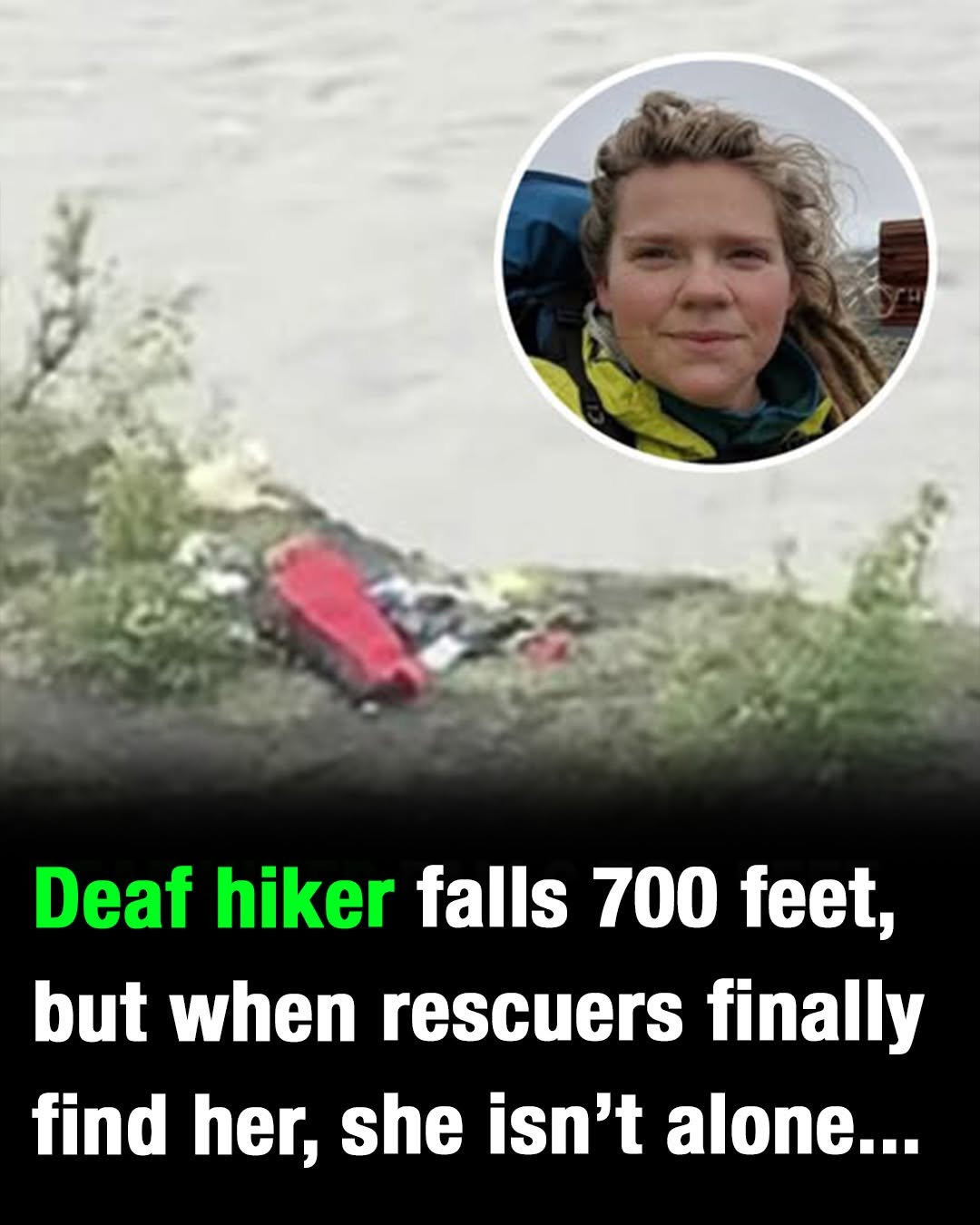
For many adventurers, Alaska represents the ultimate test of endurance. Its vast landscapes are breathtaking, but they can also be unforgiving.
Towering mountains, icy rivers, and endless stretches of wilderness attract hikers from around the world seeking challenge and solitude. Yet in these remote regions, nature can change from beautiful to dangerous in a matter of moments.
For Amelia Milling, what began as a personal adventure turned into a fight for survival and an extraordinary story of companionship that few could have imagined.
Amelia had traveled to Alaska eager to experience the wilderness on her own terms. An experienced outdoors enthusiast and a deaf hiker, she embraced challenges that pushed her beyond her comfort zone. Her plan was simple: spend several days hiking through the rugged terrain, immerse herself in nature, and enjoy the independence that solo travel can offer.
The wilderness promised peace and adventure.
Instead, it became a nightmare.
While traversing a steep, snow-covered area, Amelia lost her footing. In an instant, the stable ground beneath her disappeared, and she began sliding uncontrollably down the mountainside.
Snow and ice rushed around her.
She tumbled hundreds of feet.
By the time she finally stopped, she was bruised, shaken, and disoriented.
The fall had carried her far from the trail.
In the vast Alaskan backcountry, even a small mistake can become life-threatening. Distances are enormous, temperatures can drop quickly, and rescue may be hours or even days away.
Amelia assessed her injuries as best she could.
She was hurt, exhausted, and alone.
Though she was still able to walk, she had no clear sense of direction. The landscape stretched endlessly around her in every direction, a maze of snowfields and mountains where landmarks seemed to disappear into the horizon.
As daylight faded, the reality of her situation became impossible to ignore.
She was lost.
For anyone stranded in the wilderness, isolation can become as dangerous as injury itself. The cold seeps into the body. Fatigue clouds judgment. Fear grows heavier with every passing hour.
For Amelia, the silence of the wilderness felt especially profound.
Night was approaching.
Help seemed impossibly far away.
Then something unexpected appeared in the distance.
At first, she noticed movement against the white landscape. A pale figure moved steadily across the snow.
Her first thought was alarming.
Could it be a wolf?
The animal approached calmly, showing no sign of aggression. As it drew closer, Amelia realized it was not a wild predator at all.
It was a dog.
And around its neck was a collar.
According to accounts later shared about the incident, the dog was named Nanook, a local husky known by residents and hikers in the area. The friendly canine had reportedly developed a reputation for accompanying outdoor enthusiasts and occasionally appearing where people least expected him.
But on this day, his arrival felt almost miraculous.
Nanook approached without hesitation.
He stayed close.
And then, remarkably, he refused to leave.
For someone stranded alone in one of the harshest environments on Earth, the presence of another living being can provide something powerful: hope.
Amelia suddenly found herself no longer facing the wilderness entirely by herself.
The husky remained beside her as she attempted to navigate back toward safety. At times, he seemed to move ahead as though guiding the way, only to pause and wait for her to catch up.
Whether by instinct, training, or simple loyalty, Nanook appeared determined to stay with the injured hiker.
As temperatures dropped overnight, the challenges multiplied.
Cold can become deadly in Alaska, even during seasons that seem relatively mild. Exposure is a constant threat, especially for injured hikers with limited supplies.
That night, Nanook remained nearby.
His presence offered more than companionship.
It offered comfort.
In moments of crisis, emotional support can become as important as physical survival. Fear often feels smaller when we are not alone.
For Amelia, the dog’s quiet companionship helped carry her through the uncertainty of the night.
Morning brought new challenges.
Continuing her journey required crossing difficult terrain, including icy water.
At one point, while attempting to navigate a river crossing, disaster nearly struck again.
The current proved stronger than expected.
Amelia lost her footing and was swept into the cold water.
Frigid rivers can be extraordinarily dangerous. Cold shock, exhaustion, and powerful currents create life-threatening conditions within seconds.
As she struggled against the current, Nanook reportedly sprang into action.
Accounts later shared about the rescue describe the husky entering the water and helping pull her toward safety by grabbing her backpack.
In that moment, what had already felt extraordinary became almost unbelievable.
Again, the dog remained by her side.
Eventually, realizing the seriousness of her situation, Amelia activated her emergency GPS beacon.
Modern rescue technology can dramatically improve survival odds in remote regions, but emergency beacons are only effective if the person using them remains alive long enough for rescuers to arrive.
By the time search teams located her, Amelia had endured injury, exposure, exhaustion, and isolation.
And beside her sat Nanook.
When rescuers arrived, they reportedly found not only a stranded hiker awaiting help, but also a loyal canine companion who had stayed through the ordeal.
The image captured hearts around the world.
Stories like Amelia’s resonate because they remind us that survival often depends on unexpected acts of kindness—and sometimes those acts come from animals.
Scientists have long documented the remarkable bond between humans and dogs. For thousands of years, dogs have served as companions, protectors, workers, and guides. Their ability to form deep social connections with people remains one of the most extraordinary relationships in the natural world.
Nanook’s actions, whether driven by instinct, familiarity, or simple affection, became a powerful example of that bond.
For Amelia, survival was not solely about endurance.
It was also about companionship.
Her story demonstrates how quickly adventure can turn into crisis in the wilderness. It also highlights the importance of preparation, emergency equipment, and respect for nature’s unpredictability.
But above all, it is a story about loyalty.
In a landscape of ice, mountains, and silence, one injured hiker discovered that she was not truly alone.
Sometimes heroes do not wear uniforms.
Sometimes they arrive quietly, with four paws, bright eyes, and a refusal to leave your side when you need them most.