The 2026 FIFA World Cup was always expected to be historic.
With the tournament set to take place across the United States, Canada, and Mexico, it represents one of the most ambitious international sporting events ever organized. But even before a single match has been played, attention has shifted away from football itself and toward a controversy that is rapidly dominating headlines: Donald Trump’s expected role in the World Cup trophy presentation.
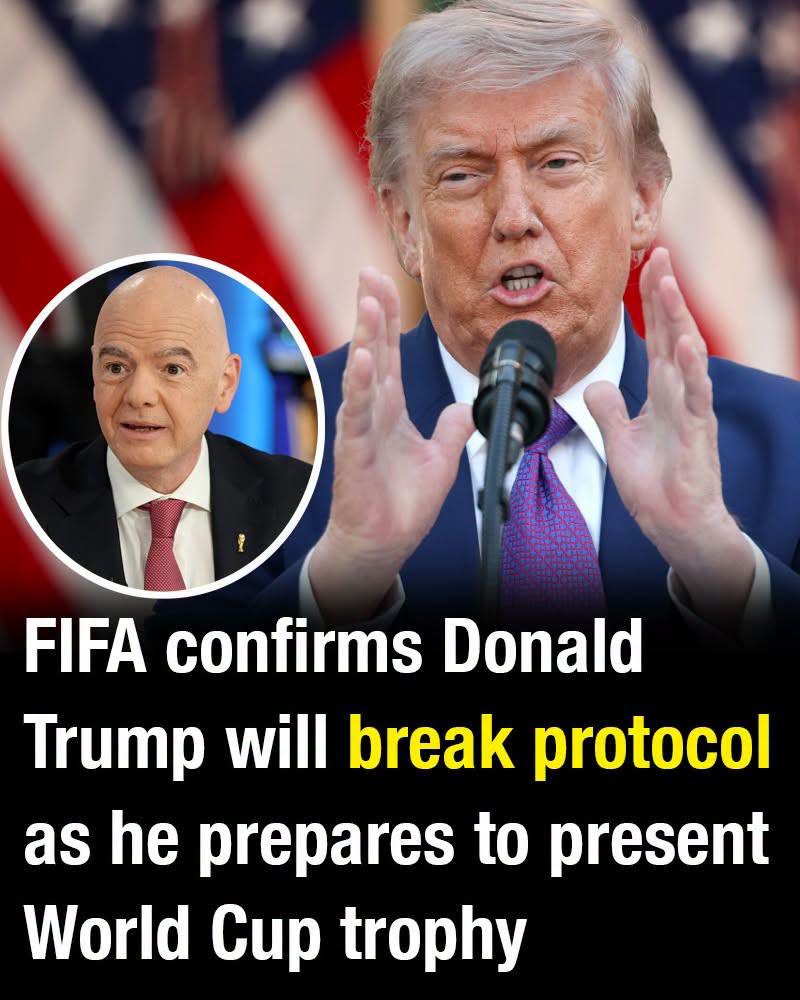
According to FIFA confirmations and ongoing reports, Trump is set to participate in the final ceremony, breaking with long-standing protocol that typically reserves the trophy presentation for FIFA officials and football dignitaries. The decision has sparked a wave of reaction across the sporting world, dividing fans, commentators, and political observers.
For supporters of the move, the image is powerful.
A former U.S. president standing on the world’s biggest football stage during a home World Cup is being framed as a symbol of national prominence and global influence. In their view, it reflects the importance of the United States as a host nation and underscores the scale of the tournament itself. They argue that football’s biggest moment deserves figures who match its global reach.
But for critics, the reaction is very different.
Many see the decision as a dangerous blending of sport and politics at a moment when FIFA has repeatedly insisted on football’s neutrality. The World Cup final is traditionally regarded as one of the rare global events that transcends political division, bringing together nations, cultures, and identities under a shared passion for the game. Introducing a highly polarizing political figure into that moment, they argue, risks undermining that unity.
Concerns have been further fueled by past incidents involving Trump at sporting events.
Observers point to previous appearances where his presence on or near ceremonial stages drew attention away from the athletes themselves. One widely discussed example involved a Club World Cup final celebration, where his presence on the podium became as talked about as the match itself. Critics argue that moments meant to highlight players and teams can quickly shift into broader media narratives when politics enters the frame.
There is also renewed discussion about past public moments where Trump’s off-script comments during sporting environments attracted attention unrelated to the games being played. Supporters dismissed those incidents as informal interactions, while critics saw them as evidence that sporting ceremonies can become entangled in political messaging when boundaries are not clearly maintained.
At the center of the current debate is FIFA President Gianni Infantino, whose relationship with Trump has been closely observed in recent years.
Infantino’s visible rapport with the former president has led some to view the decision as part of a broader pattern of FIFA aligning itself with powerful political figures. Supporters of Infantino argue that engaging global leaders is part of expanding football’s international reach and ensuring strong partnerships for large-scale tournaments. Critics, however, see it as a blurring of lines between governance, diplomacy, and sport.
The tension highlights a deeper question about what the World Cup represents in the modern era.
For many fans, it is more than a tournament. It is a global cultural moment, one of the few remaining events capable of capturing worldwide attention without the filter of political identity. The final match, in particular, is meant to be a culmination of athletic achievement, national pride, and sporting excellence.
That is why the trophy presentation carries such symbolic weight.
It is not merely a formality. It is the final image the world remembers.
Who lifts the trophy.
Who hands it over.
And who stands on the stage as history is made.
The concern among critics is that introducing a politically divisive figure into that moment could shift the focus away from the athletes and toward broader geopolitical narratives. Instead of the spotlight resting entirely on the winning team, attention could fracture into debates about symbolism, influence, and intent.
Supporters of Trump’s involvement reject that interpretation.
They argue that the World Cup has always included political figures in ceremonial roles, from heads of state to monarchs and royalty. In their view, the presence of a former U.S. president is no different, especially given that the tournament will be hosted in the United States. They also emphasize that fans ultimately care about the football itself, not the individuals handing over the trophy.
Still, the intensity of reaction suggests this will not be a quiet ceremonial detail.
It is already shaping expectations for the final match long before kickoff.
Social media discussions, sports commentary, and political analysis have merged into a single debate over whether the World Cup final should remain strictly apolitical or reflect the reality that global sport and global politics are often impossible to separate.
As anticipation builds toward 2026, FIFA finds itself in a familiar position: balancing tradition against spectacle, neutrality against visibility, and sport against influence.
For now, one thing is certain.
When the final whistle blows and the world turns its attention to the trophy presentation, it will not only be watching the champions being crowned. It will also be watching the stage itself, the symbolism it carries, and the figure who steps forward at the center of one of the most-watched moments in global sport.
Whether seen as a historic honor or an unnecessary intrusion, the decision has ensured that the 2026 World Cup final will be remembered for far more than just football.