At first glance, it looks like complete nonsense.
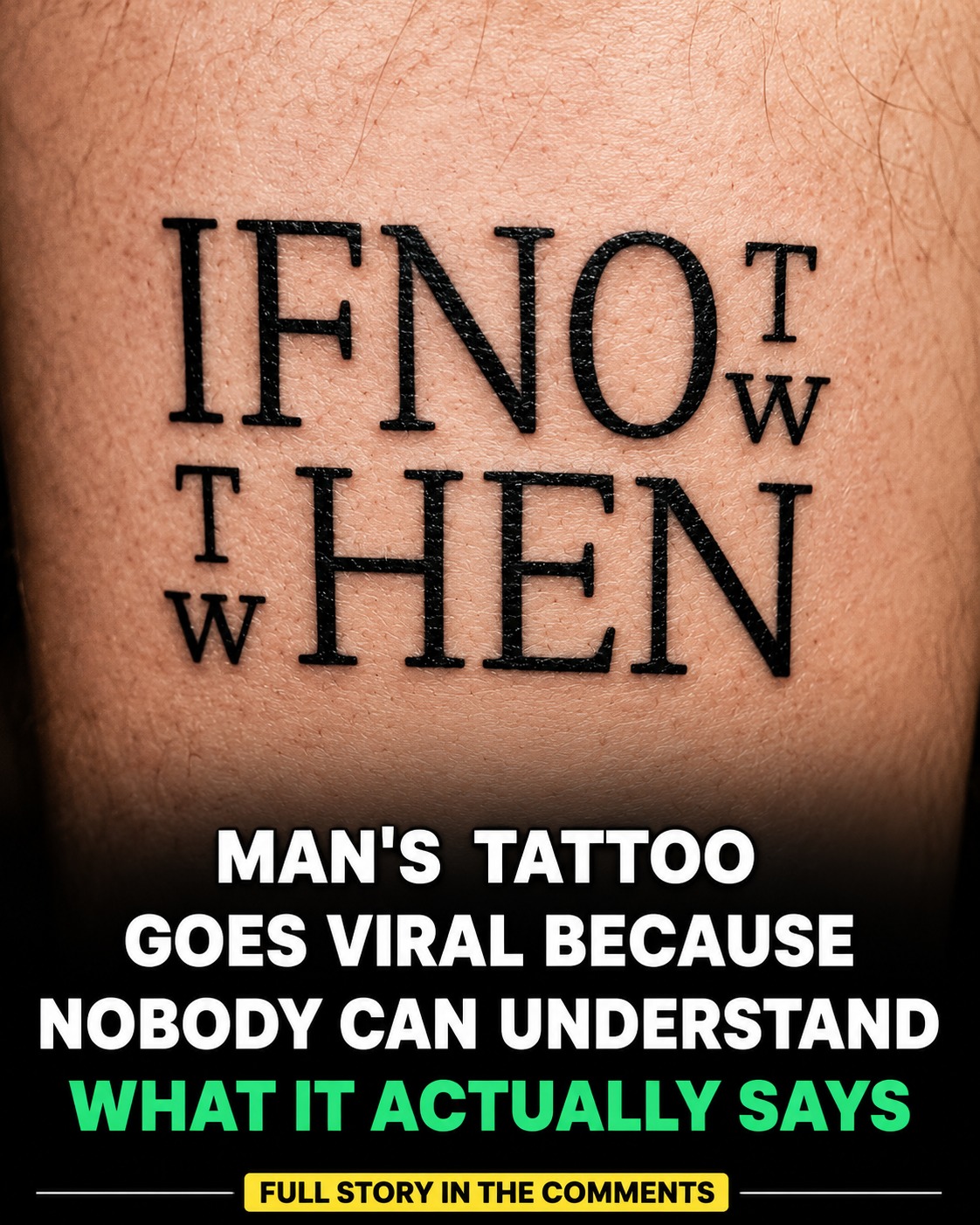
A man proudly shared a photo of a tattoo running down his forearm, expecting people to admire its meaningful message.
Instead, the image triggered a wave of confusion across social media. Thousands of viewers found themselves staring at the design far longer than they expected, trying to decipher what appeared to be a random collection of letters squeezed into an impossible arrangement.
The tattoo was clearly intended to display a motivational quote. The letters were large, bold, and impossible to ignore. Yet somehow, the more people looked at them, the less sense they seemed to make.
Comments began flooding in almost immediately.
“What am I even looking at?”
“I’ve been staring at this for ten minutes and still have no idea.”
“Is this written in another language?”
Some users claimed they could make out individual words but not the full sentence. Others thought it was a secret code. A few even suggested that the tattoo artist had made a catastrophic spelling mistake.
The unusual design forced viewers into a strange visual puzzle. Rather than presenting the quote in a traditional horizontal line, the words had been stacked vertically and compressed into a narrow shape. Letters overlapped visually, and spacing that normally helps readers understand language seemed to disappear entirely.
The result was a tattoo that looked more like an optical illusion than a piece of text.
As the image spread across the internet, people became obsessed with solving the mystery. Entire discussion threads emerged with users posting their own interpretations. Some were serious attempts. Others were hilariously wrong.
One person believed the tattoo said, “Life is not worth waiting.”
Another guessed, “If now then not when.”
Someone else confidently declared that it read, “Nothing is impossible.”
None of these answers were correct.
The more theories appeared, the more attention the tattoo received. What should have been a simple inspirational message transformed into an online challenge. People began sharing the image with friends and family, asking them to decode it without any hints.
Many failed.
Even those who eventually discovered the answer often admitted they could not understand how they had missed it.
Hours turned into days as the photograph continued circulating. Viewers zoomed in, tilted their screens, adjusted brightness settings, and even traced letters with their fingers. Some claimed that once they saw the hidden message, they could never unsee it. Others insisted the design remained confusing no matter how many times they looked.
Finally, the mystery was solved.
The tattoo actually reads:
“If not now, then when.”
A simple sentence. A familiar phrase. Four ordinary words that have appeared in countless motivational speeches, self-help books, and inspirational posters.
Yet in this tattoo, those words seemed to hide in plain sight.
For many viewers, discovering the answer brought a strange sense of relief. The puzzle was over. The mystery had been solved.
But something unexpected happened next.
Even after learning the correct phrase, many people still struggled to see it clearly.
Their eyes continued jumping from letter to letter, searching for patterns that never quite settled into place. The quote felt like one of those optical illusions where a hidden image suddenly appears, only to vanish again the moment you look away.
People described the experience as surprisingly frustrating.
“I know what it says now, but my brain refuses to read it.”
“It somehow makes less sense after I learned the answer.”
“I can see every letter individually, but together they still look wrong.”
These reactions only fueled the tattoo’s popularity. What started as a confusing image evolved into a fascinating example of how the human brain processes information.
Reading feels effortless because most people do it every day. Words are recognized almost instantly. Sentences flow naturally from one line to the next.
But remove the familiar structure, rearrange the spacing, and compress everything into an unconventional format, and suddenly the brain struggles with a task it usually performs automatically.
The tattoo exposed something people rarely think about: understanding language depends on far more than simply recognizing letters.
Spacing matters.
Arrangement matters.
Visual balance matters.
Without those elements, even the most common phrase can become nearly impossible to interpret.
As discussions continued online, opinions about the tattoo became divided.
Some people loved it.
They argued that the design transformed a simple quote into something memorable. Instead of being just another motivational slogan, it forced viewers to engage with the message. People had to work for it. They had to slow down, concentrate, and think.
Supporters claimed that this struggle actually reinforced the meaning of the quote itself.
“If not now, then when” is a statement about action. It challenges hesitation. It pushes people to stop waiting for the perfect moment and start moving toward their goals.
From that perspective, spending time deciphering the words became part of the experience.
Others disagreed completely.
Critics argued that a tattoo should communicate its message clearly. If thousands of people cannot read it, they said, the design has failed its most basic purpose.
“What’s the point of getting a quote tattooed on your body if nobody can tell what it says?”
“Looks cool, but readability should matter.”
“Great art, terrible typography.”
The debate continued for weeks.
Yet regardless of which side people supported, almost everyone agreed on one thing: the tattoo was impossible to forget.
Unlike countless images that appear online and disappear within hours, this one lingered in people’s minds. It sparked conversations, arguments, jokes, and endless attempts at interpretation.
Perhaps that is why it became so popular.
Not because of the quote itself.
Not because of the tattoo artist.
Not even because of the unusual design.
It became famous because it challenged something people take for granted every day the ability to instantly understand what they see.
In a world filled with endless scrolling and fleeting attention spans, this tattoo accomplished something remarkable. It made people stop.
They stared.
They puzzled over it.
They shared it with others.
And they kept coming back to it.
Whether viewed as a brilliant piece of visual art or a confusing design mistake, the tattoo achieved something most tattoos never do. It captured the attention of millions and turned four simple words into an unforgettable mystery.
Even now, people continue looking at the image, convinced they will understand it immediately.
Most discover the truth only after several minutes of intense concentration.
And once they finally read the message, many find themselves smiling at the irony.
A tattoo about taking action became famous because nobody could figure it out quickly enough.