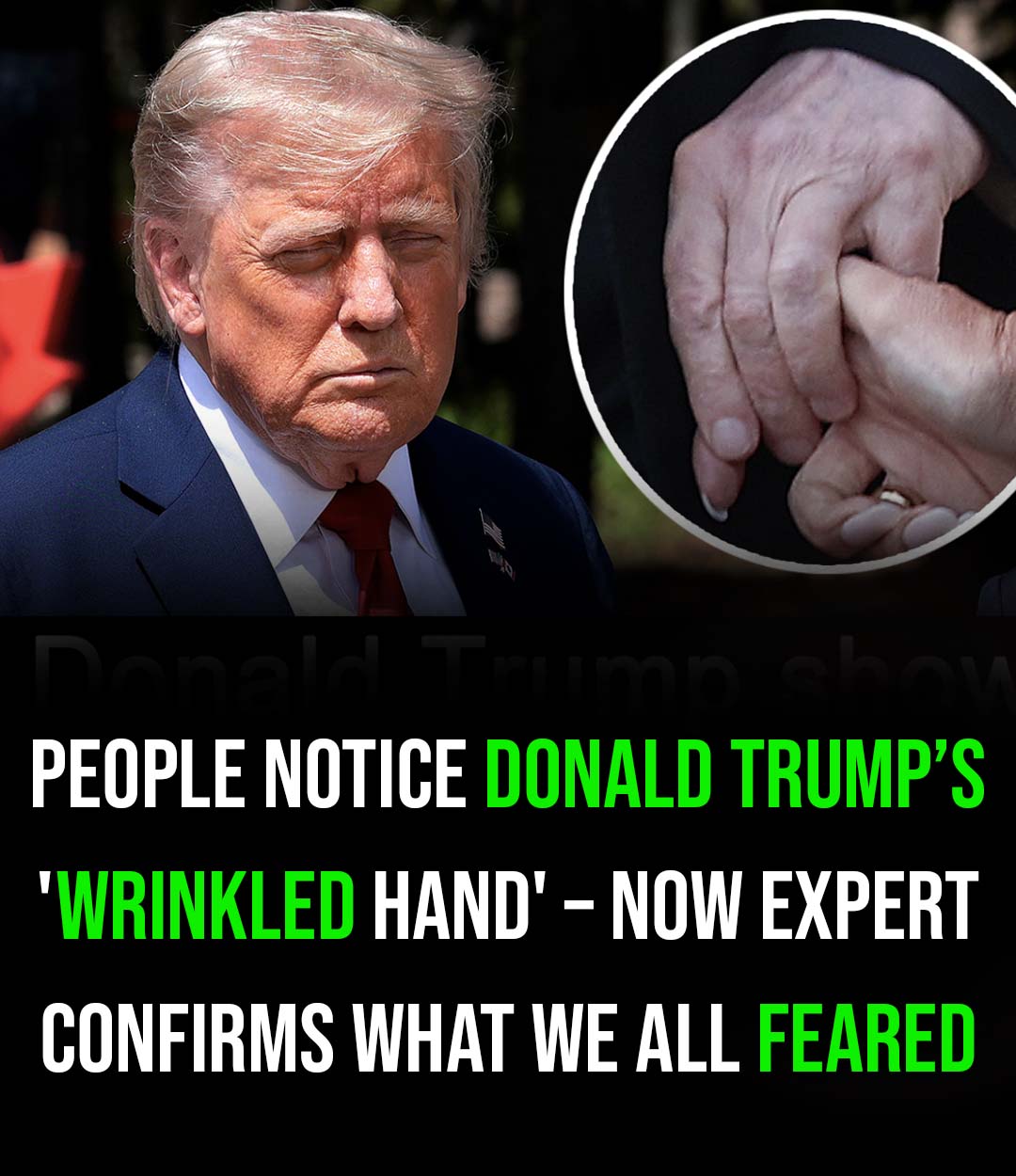
A series of close-up photographs showing Donald Trump’s hand has ignited a fresh storm of debate online, turning what might have been an ordinary moment into yet another national obsession.
What began with a few images quickly escalated into widespread speculation across social media platforms, political forums, and television discussions. Viewers zoomed in on every detail, examining visible bruising, skin texture, and what some described as unusually pronounced wrinkles. Within hours, countless theories emerged, ranging from harmless explanations to dramatic claims about hidden health problems.
For supporters, the discussion seemed overblown. For critics, the photographs raised questions they believed deserved answers. And for medical experts watching the frenzy unfold, the reaction offered a striking example of how quickly modern political discourse can transform a minor visual detail into a major controversy.
The images showed what appeared to be a bruise or discoloration on one of Trump’s hands. While the mark itself was relatively small, it immediately became the center of intense scrutiny. Online commentators enlarged the photographs, compared them to older images, and searched for patterns that might support their theories.
Soon, speculation was everywhere.
Some users suggested the bruise could indicate an undisclosed medical condition. Others proposed neurological disorders, circulation problems, or the effects of medical treatments. More elaborate theories claimed the photos revealed evidence of hidden health issues that were supposedly being concealed from the public.
As often happens in the digital age, assumptions began spreading much faster than verified information.
The discussion intensified when additional photographs surfaced from public appearances. Observers pointed to the appearance of Trump’s hands, focusing not only on the bruise but also on wrinkles and visible veins. For many online commentators, every new image became another piece of a puzzle they were determined to solve.
Political opponents seized on the photographs as evidence that questions about age and fitness should be discussed more openly. Meanwhile, supporters accused critics of engaging in baseless speculation and turning ordinary signs of aging into sensational headlines.
The White House and Trump’s allies pushed back against many of the claims, offering a far simpler explanation.
According to those defending the former president, the visible marks were nothing unusual. They argued that frequent public appearances, countless handshakes, and a demanding schedule could easily account for minor bruising and signs of wear. To them, the controversy represented another example of critics searching for hidden meanings where none existed.
Yet the photographs continued generating headlines.
Part of the reason was simple curiosity. Americans have long been fascinated by the health of their political leaders. Questions about physical fitness, stamina, and medical transparency often become major topics of public discussion, particularly during election seasons and periods of heightened political tension.
In Trump’s case, every detail seems to attract extraordinary attention.
Whether discussing his speeches, his schedule, his appearance, or his health, even minor observations can rapidly become national talking points. The hand photographs followed that familiar pattern.
As the debate grew louder, medical professionals began offering more measured perspectives.
Several doctors who reviewed publicly available images urged caution against drawing conclusions from photographs alone. They noted that diagnosing someone based solely on pictures is extremely unreliable and can easily lead to incorrect assumptions.
Their observations painted a much less dramatic picture than many online theories suggested.
According to experts, the visible discoloration appeared consistent with a superficial bruise, medically known as a contusion. Such bruises can occur from minor bumps, routine medical procedures, or everyday activities that many people barely notice.
In older adults, these marks can appear more pronounced than they would in younger individuals.
Doctors explained that aging naturally changes the skin. Over time, skin becomes thinner and loses some of the protective tissue that cushions blood vessels. As a result, even minor impacts can lead to bruising that appears larger or darker than expected.
Visible veins and wrinkles can also become more noticeable as skin elasticity decreases with age.
Experts emphasized that these changes are extremely common and do not automatically indicate serious illness.
Some physicians pointed out that routine medical procedures can also leave temporary marks. Blood tests, injections, and intravenous treatments may occasionally result in minor bruising, particularly in older individuals whose blood vessels are more fragile.
Additionally, certain medications can increase the likelihood of bruising.
Blood thinners, anti-inflammatory drugs, and other commonly prescribed medications can make bruises appear more easily and remain visible for longer periods. In many cases, a bruise that attracts significant attention online might be considered entirely unremarkable in a clinical setting.
For that reason, medical experts repeatedly cautioned against interpreting a single photograph as evidence of a broader health issue.
Despite those reassurances, speculation continued.
Some internet users remained convinced that the images revealed more than doctors were willing to acknowledge. Others argued that public figures, especially political leaders, should expect intense scrutiny regarding their health and appearance.
The debate soon evolved beyond the bruise itself.
Questions emerged about transparency, aging, and the role health plays in public leadership. Commentators from across the political spectrum used the photographs to advance broader arguments about fitness for office, media coverage, and public accountability.
In many ways, the conversation became less about Trump’s hand and more about the country’s deeply polarized political climate.
Every photograph seemed to reinforce existing beliefs.
Supporters saw evidence of unfair treatment and relentless criticism.
Opponents saw reasons for continued questioning.
Neutral observers often found themselves caught between competing narratives, unsure which claims deserved serious attention.
Meanwhile, doctors continued returning to the same conclusion.
Based on the available images, the visible bruise and wrinkles did not appear to provide clear evidence of a serious medical problem. While photographs can sometimes raise legitimate questions, they rarely offer enough information to support definitive conclusions.
That reality did little to slow the online discussion.
In an era when every image can be magnified, analyzed, and shared with millions of people within minutes, even the smallest physical detail can become a national topic of conversation. A bruise that might once have gone unnoticed instead became the subject of endless debates, expert commentary, and social media investigations.
The episode serves as a reminder of how modern politics operates.
Every appearance is scrutinized.
Every photograph is examined.
Every visible detail can become part of a larger narrative.
For some, the hand photographs represented a genuine health concern. For others, they were simply evidence of normal aging. And for many medical professionals, the controversy highlighted the dangers of attempting to diagnose anyone through a handful of images circulating online.
In the end, the most revealing aspect of the story may not be the bruise itself.
It may be the reaction it sparked.
A small mark on a hand became a nationwide discussion because millions of people were ready to interpret it through the lens of politics, suspicion, and speculation. What doctors largely viewed as an ordinary physical detail transformed into a symbol of a much larger debate—one that says as much about the public’s appetite for controversy as it does about the man at the center of it.
Long after the photographs first appeared, the arguments continue. Yet the central question remains surprisingly simple: was it a sign of something significant, or merely an ordinary bruise amplified by extraordinary attention?
For now, experts lean toward the simpler explanation, even as the internet continues searching for a more dramatic answer.