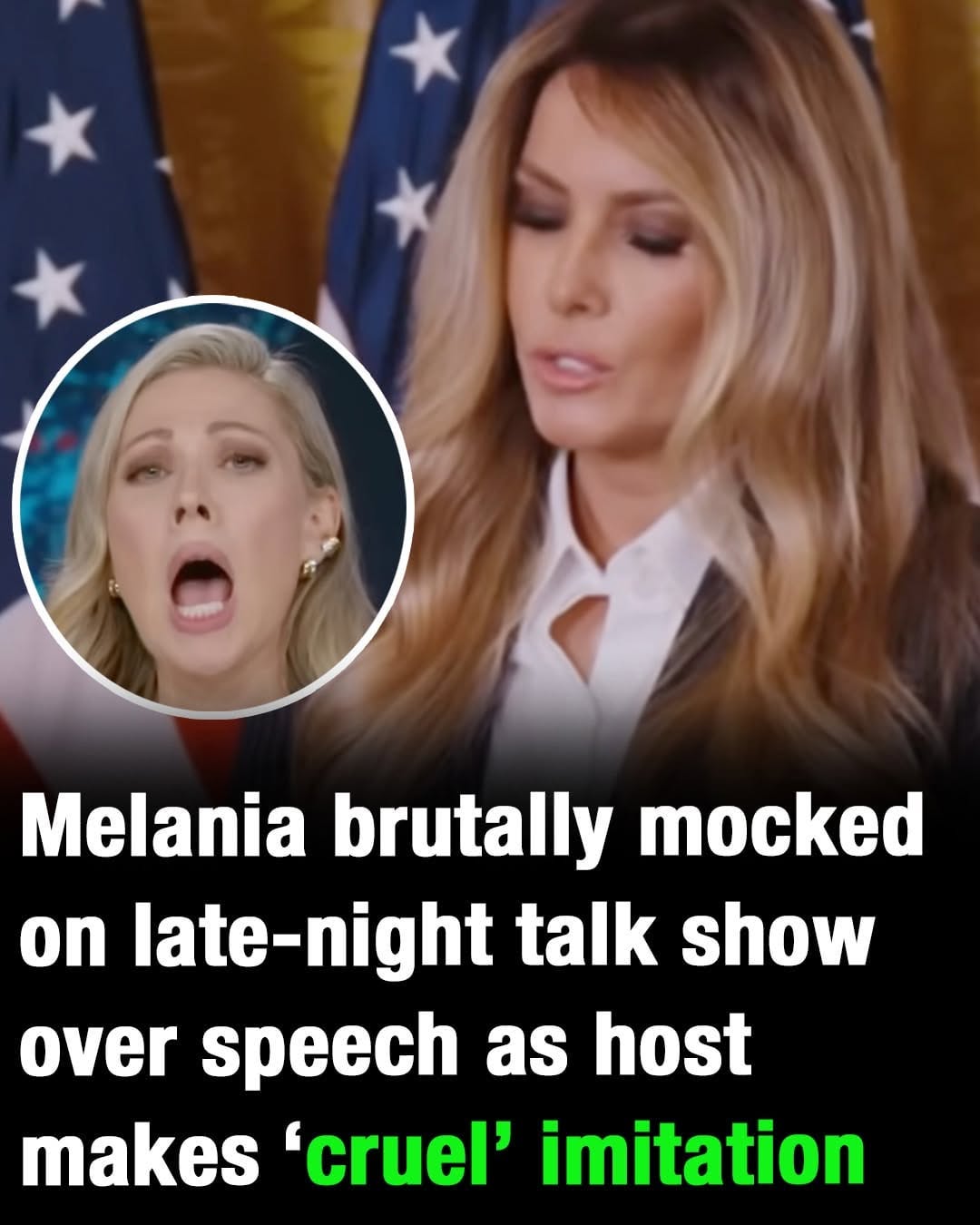
A recent late-night comedy segment targeting Melania Trump has ignited a wider conversation about the boundaries of political satire, the role of artificial intelligence in public discourse, and the way public figures especially those in highly scrutinized political families are portrayed in modern media.
The controversy stems from a speech in which Melania Trump discussed artificial intelligence and its growing influence on society. In her remarks, she touched on themes often associated with emerging technology: the integration of AI into healthcare, the potential use of autonomous systems in defense, and the broader transformation of education and industry in a rapidly digitizing world.
Her delivery, described by supporters as formal and aspirational, leaned heavily on metaphor and futuristic language. She framed the technological shift in almost science-fiction terms, emphasizing both the promise and disruption that AI could bring to future generations. Students and young people, she suggested, would be entering a world fundamentally shaped by machines capable of learning, adapting, and assisting in ways previously unimaginable.
However, rather than generating sustained discussion about the substance of her message, the speech quickly became the focal point of late-night comedy commentary.
On a recent broadcast, comedian Desi Lydic offered a satirical interpretation of the address, imitating Melania Trump’s tone and delivery while exaggerating its perceived artificiality. The sketch leaned into the idea that her speech sounded overly scripted, suggesting she was more like a “generated voice” than a spontaneous speaker. The performance drew immediate laughter from studio audiences, but also sparked a broader online reaction that quickly split into opposing interpretations.
For supporters of the segment, the impression was simply sharp political humor a continuation of a long tradition in late-night television of parodying public figures in positions of influence. They argued that satire has always relied on exaggeration and impersonation, and that Melania Trump, as a high-profile political figure, is naturally subject to comedic critique in the same way as presidents, lawmakers, and other public personalities.
Critics, however, saw the segment differently. Some argued that the impersonation shifted away from commentary on policy or ideas and instead focused on mocking tone, accent, and perceived personality traits. In their view, the sketch blurred the line between political satire and personal ridicule, raising questions about whether certain portrayals reinforce unfair stereotypes rather than engage with the actual substance of the speech.
This tension between satire as critique and satire as caricature has long existed in political comedy, but it has become more pronounced in an era where public figures are constantly visible and instantly shareable across digital platforms.
What makes this particular moment stand out is the subject matter of Melania Trump’s speech itself: artificial intelligence.
The rise of AI has already transformed industries ranging from medicine to transportation, education to entertainment. It is increasingly used in diagnostic tools, automated systems, creative applications, and even military planning. As governments and private companies race to define ethical frameworks around its use, public discussions about AI often oscillate between excitement and concern.
In that context, Melania Trump’s remarks were attempting to engage with a topic that is both technically complex and culturally charged. She described a future where AI could assist doctors in surgeries, support students in learning environments, and potentially reshape how nations approach security and warfare. While the phrasing was stylized and abstract, the underlying themes reflected broader conversations already taking place among policymakers, technologists, and educators.
Yet the late-night parody shifted attention away from those issues and back onto performance how the speech sounded, how it was delivered, and how it could be interpreted through humor.
That shift has prompted some commentators to ask whether modern media environments are equipped to seriously engage with complex technological subjects, or whether personality-driven content inevitably overshadows policy discussion.
Supporters of the satire argue that comedy’s role is not to replace policy analysis but to provide cultural commentary through exaggeration and humor. In their view, the segment reflected public skepticism toward overly polished or abstract political language, especially when discussing technologies as abstract and rapidly evolving as artificial intelligence.
Others counter that reducing such discussions to impersonation risks oversimplifying issues that already suffer from a lack of public understanding. AI, they note, is not a future concept but a present reality shaping decisions in healthcare, employment, surveillance, and global security. Turning those conversations into personality-driven jokes, they argue, can obscure the seriousness of the underlying subject.
The reaction online mirrored this divide. Clips of the segment circulated widely across social media, where users debated whether the impersonation was fair satire or unnecessary mockery. Some users focused on the humor itself, praising the comedian’s timing and delivery. Others criticized what they perceived as an unbalanced portrayal that prioritized ridicule over insight.
Meanwhile, discussions about the original speech continued in parallel, though with far less intensity than the comedy segment it inspired. Analysts noted that this pattern where satire becomes more widely discussed than the speech itself is increasingly common in the digital age. Moments of political communication are often reframed through entertainment before they can be fully examined on their own terms.
At a broader level, the incident highlights the evolving relationship between politics, media, and technology. As artificial intelligence becomes more deeply embedded in public life, the way leaders communicate about it and the way those communications are received will likely remain under intense scrutiny.
For some observers, the most important takeaway is not the impersonation or the controversy it generated, but the underlying topic that sparked the entire exchange: how society talks about AI at all. Whether through formal speeches, policy debates, or late-night comedy sketches, the conversation reflects a shared uncertainty about how to interpret a technology that is already reshaping the present while pointing toward an unpredictable future.
In that sense, the reaction to Melania Trump’s speech and its comedic reinterpretation becomes part of a larger cultural moment one where technology, politics, and entertainment increasingly overlap, and where meaning is often shaped as much by reaction as by original intent.