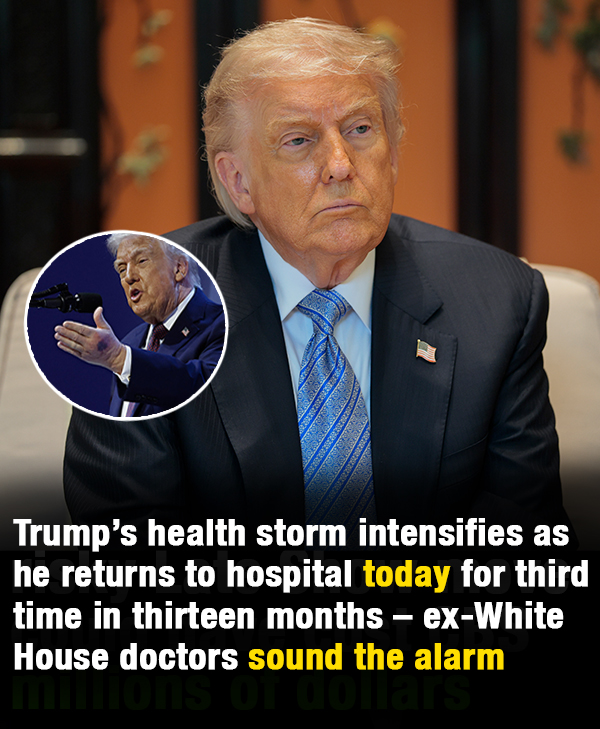
Donald Trump’s latest visit to Walter Reed National Military Medical Center has ignited a storm of speculation across America, once again placing the president’s health at the center of a deeply polarized national conversation.
The visit, described by aides as routine and nonurgent, marked his third known medical trip to the military hospital in just over a year. Yet the lack of advance notice, combined with growing public scrutiny surrounding his age and physical condition, has transformed what might otherwise have been an ordinary checkup into a political flashpoint.
For supporters, the reaction feels wildly exaggerated. They see Trump as a man who continues to maintain an almost relentless public schedule despite nearing 80 years old. Rally appearances, interviews, legal battles, campaign events, and late-night social media posts all feed the image of a politician who thrives on pressure and confrontation. To them, routine medical evaluations are simply part of responsible care for an aging leader carrying extraordinary responsibilities.
Critics, however, view the situation differently. To many of them, the hospital visit is not an isolated event but another piece in a larger puzzle that has fueled quiet concern for months. They point to repeated medical examinations, visible bruising on Trump’s hands during public appearances, moments of verbal confusion seized upon online, and increasingly combative late-night statements that some interpret as signs of mounting strain. In a country already consumed by debates over leadership, aging, and transparency, even small medical details become magnified into symbols of something much larger.
At the heart of the controversy lies a simple truth: very little concrete information has been released.
Official statements from Trump’s physician have remained brief and carefully worded. According to aides, the president underwent standard evaluations and treatment connected to what was described as “minor soft tissue irritation,” reportedly linked to aspirin use and frequent handshaking. Trump himself has repeatedly brushed aside concerns, insisting publicly that he feels as strong as he did decades ago. In typical fashion, he has framed questions about his health as politically motivated attacks rather than legitimate public interest.
Still, in the absence of detailed disclosure, speculation rushes in to fill the silence.
That dynamic is hardly unique to Trump. Throughout American history, presidential health has always existed in a strange space between public necessity and personal privacy. The nation expects strength from its leaders, yet voters also demand honesty about conditions that could affect a president’s ability to govern. That tension has shaped the presidencies of figures from Franklin D. Roosevelt to John F. Kennedy, Ronald Reagan, and Joe Biden. Every administration, regardless of party, wrestles with the same uncomfortable question: how much does the public truly deserve to know?
In Trump’s case, the question feels even more explosive because nearly everything surrounding him becomes amplified by political warfare. Supporters and critics no longer merely disagree about policy; they often inhabit entirely separate realities. One side sees resilience and stamina. The other sees warning signs and denial. A hospital corridor becomes more than a hallway. It becomes a battleground over credibility itself.
The symbolism of Walter Reed only intensifies the drama. The military hospital has long occupied a unique place in American political consciousness. It is where presidents undergo annual physicals, recover from surgeries, and confront the unavoidable reality that even the world’s most powerful office cannot escape human vulnerability. When presidential motorcades arrive there unexpectedly, the public pays attention.
This latest visit arrives at a particularly sensitive political moment. Trump’s age has become an increasingly prominent topic not only among opponents but within broader public discussion about American leadership. If he completes another presidential term, he would leave office older than any president in U.S. history. Questions surrounding physical endurance, cognitive sharpness, and the stresses of office have therefore become unavoidable parts of the national debate.
At the same time, Trump has built much of his political identity around projecting dominance and vitality. He rarely acknowledges weakness publicly and often mocks opponents over their own physical or mental fitness. That strategy has helped create an image of toughness that many supporters admire deeply. But it also means that even routine medical visits can appear unusually significant because they contrast with the larger-than-life persona carefully cultivated over decades.
The modern media environment adds another layer to the frenzy. In previous eras, presidential health updates moved slowly through newspapers and evening broadcasts. Today, every photograph, pause, facial expression, or bandaged hand can trigger viral theories within minutes. Social media transforms uncertainty into instant speculation, and speculation quickly hardens into conviction for millions of people online.
One blurry image can generate thousands of claims.
One unscheduled appointment can dominate headlines for days.
That atmosphere makes separating fact from narrative increasingly difficult. Some commentators portray Trump as secretly gravely ill. Others insist concerns are entirely fabricated political theater. Reality often exists somewhere in the middle: a nearly 80-year-old man under immense pressure receiving medical evaluations that may be entirely ordinary, yet inevitably scrutinized because of the position he holds.
Presidential health carries enormous symbolic weight because the office itself is tied so closely to perceptions of stability and control. Americans expect presidents to project certainty even during crises. Illness disrupts that image. It reminds the public that behind the motorcades, speeches, and security details stands an aging human body subject to the same fragility as everyone else.
That discomfort explains why health concerns surrounding presidents consistently generate intense emotional reactions. For supporters, questions about a leader’s condition can feel like attacks designed to weaken legitimacy. For opponents, lack of transparency can feel dangerous and irresponsible. Both impulses feed off each other, deepening distrust across the political divide.
Meanwhile, the actual medical facts often remain surprisingly mundane.
Doctors note that frequent evaluations become increasingly common with age, particularly for individuals under extreme stress. Cardiovascular monitoring, medication management, orthopedic concerns, circulation issues, and preventative screenings are all routine parts of care for older adults. In many cases, such visits are signs of caution rather than crisis.
But politics rarely rewards patience or nuance.
In today’s America, uncertainty itself becomes combustible. Every unanswered question invites competing interpretations shaped less by evidence than by existing loyalties and fears. Trump’s hospital visit therefore becomes more than a personal medical matter. It transforms into a mirror reflecting the anxieties of a divided nation.
Some Americans see vulnerability.
Others see persecution.
Some see normal aging.
Others see looming instability.
And somewhere beneath the noise, there may simply be an elderly president undergoing careful medical observation while carrying one of the most punishing jobs on Earth.
Until more verified information emerges, the speculation will almost certainly continue. Cable news panels will debate hidden meanings. Social media users will dissect photographs frame by frame. Allies will defend him fiercely, opponents will question everything, and millions of ordinary people will continue watching for clues about the condition of the man occupying the Oval Office.
Yet perhaps the deeper story is not the hospital visit itself, but what it reveals about the country surrounding it.
A routine medical appointment should not feel like a national crisis. But in an America fractured by mistrust, secrecy, and permanent political warfare, even a quiet walk through hospital doors can trigger a tidal wave of fear, suspicion, and symbolism. The facts may ultimately prove ordinary. The reaction, however, says something profound about the state of the nation itself.
For now, the public waits in that familiar modern fog between official reassurance and endless online speculation, searching for certainty in a moment where almost everyone seems determined to see what they already believe.