
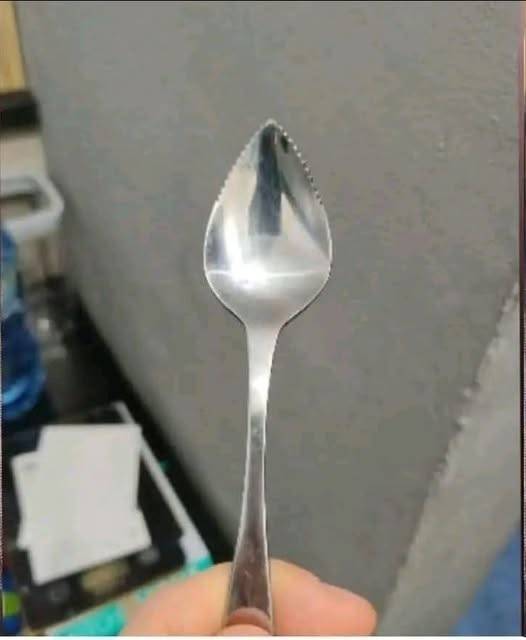
At first glance, it hardly looks important. Resting quietly in the back of a kitchen drawer, the grapefruit spoon often appears like an odd little utensil nobody asked for.
Smaller than a serving spoon, sharper than a dessert spoon, and edged with tiny teeth that seem strangely aggressive for breakfast, it’s the kind of object people inherit from parents or grandparents without ever fully understanding why it exists. Many have picked one up, turned it over in confusion, and tossed it aside, assuming it belonged to a forgotten era of overly complicated table manners.
But the moment you actually use one, something clicks.
Suddenly, this strange little spoon reveals itself not as a gimmick, but as one of the smartest pieces of kitchen design ever created. Its purpose is beautifully simple: to solve the frustrating little battle between humans and fruit. While ordinary spoons mash, slip, and struggle against tough membranes, the grapefruit spoon glides cleanly between flesh and peel, freeing perfect bites with almost surgical precision. What once felt messy and annoying becomes smooth, effortless, and oddly satisfying.
The tool was originally designed for grapefruit, a fruit notorious for resisting neat eating. Grapefruit may look inviting sliced in half, sparkling with juice under the morning light, but anyone who has tried eating one with a normal spoon knows the reality. The membranes cling stubbornly to the flesh. Juice sprays unexpectedly. Sections collapse into mush. What should feel refreshing quickly becomes sticky and irritating.
That’s where the spoon changes everything.
Its serrated edges gently cut through the thin walls separating each citrus segment. Instead of digging and scraping awkwardly, the spoon slides in naturally, tracing the fruit’s shape as if it were made specifically for it. With almost no effort, the juicy sections lift cleanly out of the rind. No wrestling. No knives. No frustration.
And yet grapefruit is only the beginning.
People who discover the spoon’s hidden talents quickly start reaching for it everywhere. Kiwi suddenly becomes easier to eat directly from the skin. Avocados separate cleanly from their shell. Passion fruit can be scooped without spilling seeds across the counter. Peaches, mangos, and even soft pears become easier to handle with the same delicate control. The spoon quietly transforms messy preparation into small, precise movements that feel strangely elegant.
That versatility is part of what makes the grapefruit spoon so fascinating. Unlike flashy modern kitchen gadgets advertised with loud promises and oversized packaging, this tool does its job almost invisibly. It asks for no batteries, no assembly, no instruction manual. It simply works.
Its design also reveals something deeper about the history of household objects. The grapefruit spoon emerged during a time when kitchen tools were often crafted with remarkable specificity. Earlier generations believed everyday routines deserved thoughtful engineering. Instead of forcing one generic tool to handle everything, designers created utensils tailored for particular tasks: butter curlers, tomato knives, egg scissors, citrus peelers. Each object reflected a belief that small improvements in daily life mattered.
The grapefruit spoon may seem humble, but it belongs to that tradition of practical elegance.
In many older households, these spoons were part of formal breakfast settings. During the early and mid-20th century, grapefruit itself symbolized health, freshness, and refinement. Hotels served chilled grapefruit halves before meals. Families placed them beside eggs and toast during leisurely breakfasts. A dedicated spoon wasn’t considered excessive; it was simply the proper tool for enjoying a popular fruit without unnecessary struggle.
Over time, however, eating habits changed. Fast breakfasts replaced slow ones. Kitchen drawers filled with multipurpose gadgets instead of specialized utensils. The grapefruit spoon slowly drifted into obscurity, becoming one of those mysterious objects younger generations often rediscovered without context.
That rediscovery usually happens in amusing ways.
Someone finds one at a thrift store and guesses it’s medical equipment. Another assumes it’s designed for seafood. Some think it’s an absinthe spoon, a sugar scoop, or even a tiny gardening tool. Online forums fill with photographs of these peculiar serrated spoons accompanied by confused captions asking what they are for. The answers often surprise people because the object feels simultaneously obvious and completely unfamiliar.
Once they learn the truth, many laugh at how long they ignored something so useful.
There is also something oddly satisfying about using a tool that performs exactly as intended. In modern life, people are surrounded by products that overpromise and underdeliver. Appliances break quickly. Apps become outdated overnight. Gadgets demand constant upgrades. The grapefruit spoon stands in complete opposition to that culture. Its design has barely changed in decades because it reached near perfection early on. There simply isn’t much to improve.
A handle. A shallow bowl. Tiny serrated edges.
That’s it.
And somehow, that simplicity continues outperforming far more complicated solutions.
Professional chefs and home cooks alike often appreciate tools like this because they reduce friction in subtle ways. They remove tiny irritations that people unconsciously accept as normal. Struggling with slippery fruit. Losing juice onto cutting boards. Mangling delicate flesh while trying to scoop it out. The spoon eliminates those annoyances so quietly that its brilliance can almost go unnoticed.
That quietness may be the most remarkable thing about it.
The grapefruit spoon never became glamorous. Nobody brags about owning one. It rarely appears in cooking shows or luxury kitchen catalogs. Yet people who use it regularly often become unexpectedly loyal to it. Once it earns a place in someone’s routine, it tends to stay there permanently.
There’s also an emotional layer to objects like this. Many people associate grapefruit spoons with childhood kitchens, grandparents’ breakfast tables, or memories of slower mornings before busy adult schedules took over. Seeing one can instantly transport someone back to a specific smell, a specific season, or a particular person carefully slicing citrus near a sunny window.
That emotional connection gives the utensil a kind of warmth modern gadgets rarely achieve.
In some ways, the grapefruit spoon represents an older philosophy of living. It reminds us that convenience does not always require technology. Sometimes the smartest inventions are the smallest ones, refined slowly over generations until they become nearly invisible in their efficiency.
Today, countless people still overlook the strange little spoon hidden among ordinary silverware. They see the tiny teeth and assume it must belong to some outdated ritual with no relevance to modern life. But those who finally try it usually discover something surprising: this odd-looking utensil solves problems they didn’t even realize they were tolerating.
And that may be the secret behind its enduring charm.
Not every great invention changes the world dramatically. Some simply make breakfast easier. Some rescue your avocado from turning into mush. Some save your hands from sticky juice and unnecessary frustration. Some quietly sit in a drawer for years, waiting patiently for the moment someone finally understands them.
The grapefruit spoon may never become famous. It may never trend online for long or inspire glamorous advertisements. But in kitchens everywhere, it continues doing exactly what it was designed to do: turning awkward little struggles into smooth, satisfying moments, one perfect scoop at a time.