For most families, a wedding is supposed to be a pause from chaos. A rare moment when politics, business pressures, public criticism, and global headlines briefly fade into the background so two people can focus on beginning a life together.
But for the Trump family, even love arrives under a microscope. Every appearance, every absence, every seating arrangement becomes a headline before the music even starts.
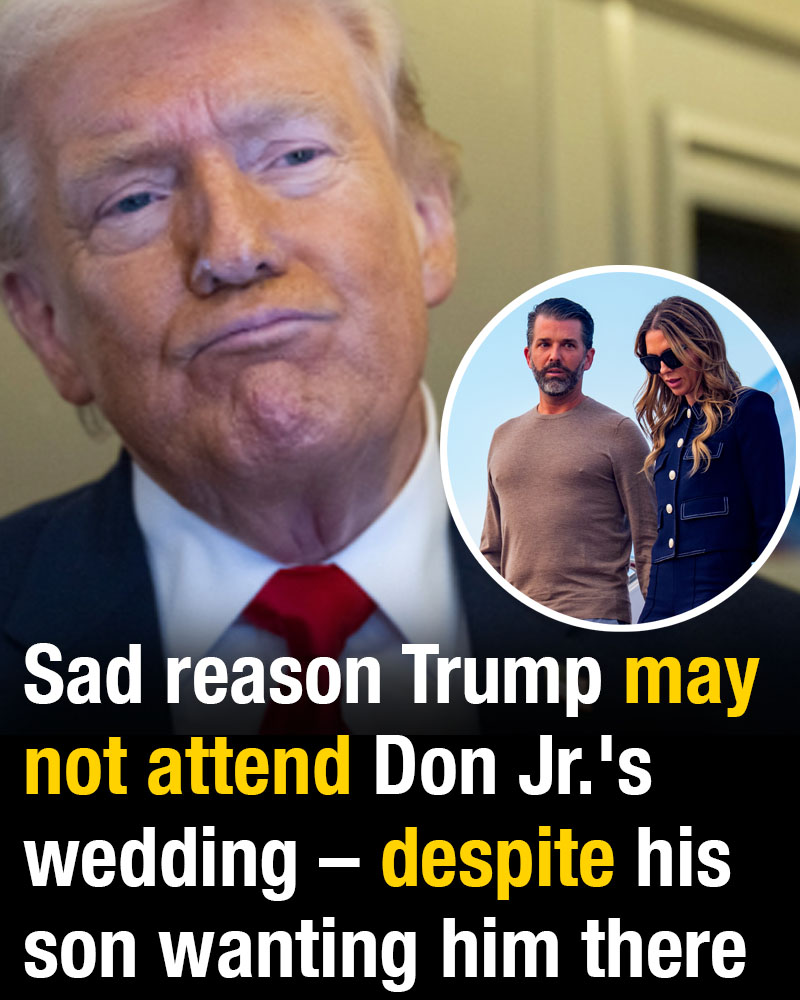
Now, as Donald Trump Jr. prepares to marry Bettina Anderson in what insiders describe as a carefully planned, intimate ceremony in the Bahamas, a surprising question has begun dominating conversations surrounding the event: will Donald Trump actually attend his own son’s wedding?
The possibility that the former president could miss such a major family milestone has shocked supporters and critics alike. Yet those close to the situation suggest the issue is not rooted in family conflict or personal tension. Instead, it reflects something far more complicated — the impossible collision between private life and public responsibility when your family exists permanently at the center of political spectacle.
Unlike the extravagant image many people automatically associate with the Trump name, the upcoming wedding is reportedly being designed as something surprisingly restrained. Sources describe a smaller guest list, limited publicity, and an atmosphere focused more on privacy than performance. For a family long associated with towering gold interiors, televised events, and lavish celebrations, the quieter approach has caught many observers off guard.
But perhaps that simplicity is exactly the point.
Donald Trump Jr. and Bettina Anderson appear to understand something many public figures eventually learn the hard way: attention can easily swallow intimacy whole. In an era where every celebrity wedding becomes instant social media content and every political family event turns into a battleground for commentary, creating something genuinely personal feels almost revolutionary.
The Bahamas setting reportedly reflects that desire for distance. An island ceremony offers separation not only from cameras, but from the nonstop machinery of American politics and media scrutiny. At least in theory.
Because no matter how carefully the couple tries to control the atmosphere, one reality remains unavoidable: the Trump name changes everything.
For Donald Trump himself, the decision surrounding attendance is believed to involve far more than simply clearing a date on a calendar. The former president continues to exist within one of the most intense political climates in modern American history. Every movement is analyzed through political lenses. Every appearance becomes symbolic. Every absence becomes a story of its own.
Attending the wedding could appear, to critics, like prioritizing celebration during a period filled with international conflict, economic anxiety, and domestic political tension. Remaining visible in public social settings while global crises dominate headlines risks fueling accusations of detachment or insensitivity. Political opponents would almost certainly seize on photographs of beachfront celebrations and luxury gatherings, framing them as evidence of disconnect from ordinary struggles.
At the same time, choosing not to attend carries emotional consequences that no political strategist can fully calculate.
Weddings are not campaign rallies. They are deeply personal memories that remain long after elections end and headlines disappear. A father’s absence from such a defining life moment cannot easily be explained away with scheduling conflicts or political necessity. Even if Donald Trump Jr. publicly defended the decision, the image of an empty chair or missing father figure would inevitably become part of the emotional narrative surrounding the wedding forever.
That tension reveals something strangely tragic about modern political life.
Families connected to power often lose the ability to experience ordinary milestones privately. Birthdays become statements. Vacations become controversies. Weddings become geopolitical calculations. The public rarely sees the emotional exhaustion hidden beneath those realities because political families are expected to continue functioning under scrutiny that would crush most people.
For Donald Trump Jr., the situation carries particular emotional weight because of his close public relationship with his father over the years. Unlike some political children who remain largely outside campaigns and media battles, Don Jr. has been one of the most visible defenders of the Trump political movement. He campaigned aggressively, appeared at rallies, gave interviews, and embraced a public role that tied his identity closely to his father’s political brand.
That closeness is precisely why the possibility of absence feels so emotionally significant to observers.
People naturally assume fathers attend their sons’ weddings. Especially fathers and sons whose lives have been publicly intertwined for years. The idea that political calculations might interfere with such a deeply personal moment strikes many as unsettling, even heartbreaking.
At the same time, the couple’s decision to avoid turning the ceremony into a grand political spectacle has earned quiet respect from some corners. In an age where visibility often feels like currency, choosing intimacy over performance sends a different kind of message. It suggests awareness that public celebrations during turbulent times can sometimes feel tone-deaf or excessive.
That awareness may also explain why reports suggest the couple deliberately rejected ideas of a larger White House-associated celebration or heavily publicized political guest list. Rather than staging an event designed to dominate headlines, they appear focused on protecting the ceremony itself from becoming consumed by external narratives.
Still, complete privacy may be impossible.
The Trump family occupies a unique place in American culture where personal events instantly become political symbols whether they want them to or not. Supporters project loyalty and admiration onto them. Critics project frustration and outrage. Even ordinary family milestones become cultural flashpoints shaped by larger national divisions.
And beneath all the political analysis lies something simpler and more human: a son wanting his father present on one of the most important days of his life.
That emotional reality often gets buried beneath commentary about optics, strategy, and public image. Yet weddings remain emotional landmarks precisely because they are about family continuity, memory, and connection. Long after news cycles move on, people tend to remember who stood beside them during life’s defining moments.
For Donald Trump, the choice reportedly reflects a brutal balancing act between competing responsibilities. Public figures are often expected to behave as if personal emotions should always come second to political obligation. But families do not operate according to campaign logic. Children do not measure love in polling data or media narratives.
What makes the situation especially striking is how it highlights the invisible cost of permanent public life. Political families may possess wealth, influence, and access few people can imagine, but they also surrender forms of normalcy most people take for granted. Even joy becomes complicated. Even celebration becomes risky.
The wedding itself now symbolizes more than romance. It reflects the difficult intersection between public scrutiny and private longing. Between image management and emotional loyalty. Between a family trying to preserve a meaningful moment and a world determined to turn that moment into another national conversation.
Whether Donald Trump ultimately attends or not, the story surrounding the wedding already reveals something profound about modern fame and politics: there is almost no space left untouched by public judgment.
And perhaps that is why the couple reportedly chose something smaller and quieter in the first place.
Not because they wanted less joy, but because they understood how fragile joy becomes once the world starts watching.
In the end, the wedding may not be remembered for luxury, celebrity guests, or political symbolism. It may instead be remembered for a far more emotional question lingering quietly behind every report and photograph.
When the ceremony begins and the music finally plays, who will actually be standing there beside the people they love most?