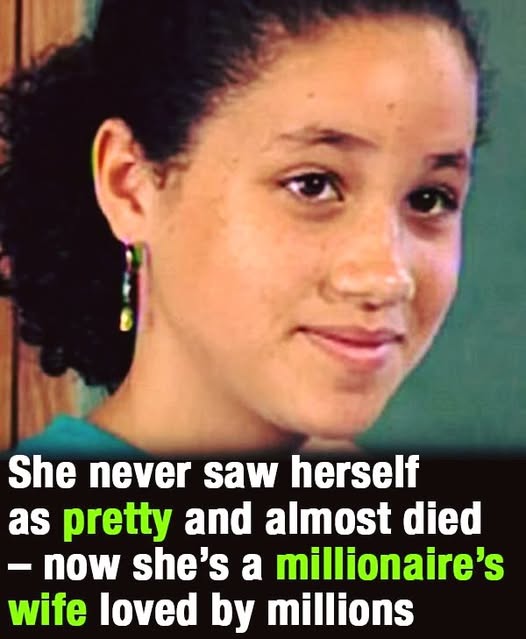
Long before the palace walls, royal titles, and relentless headlines, Meghan Markle was simply a young girl trying to figure out where she fit in.
Before the world knew her as the Duchess of Sussex, she was a shy teenager in Los Angeles navigating questions about identity, belonging, ambition, and self-worth while growing up between two very different worlds. Her journey to becoming one of the most recognizable women on Earth was not built on fairy tales or instant privilege. It was shaped through loneliness, resilience, public pressure, personal heartbreak, and moments that nearly changed her life forever.
Today, Meghan remains one of the most debated public figures in modern culture. Admirers see strength, independence, and courage. Critics see controversy and disruption. But beneath all the noise lies a far more human story about a woman who spent much of her life fighting to be understood.
Born in California to a Black mother and a white father, Meghan experienced the complexities of race from an early age. Her mother, Doria Ragland, worked as both a makeup artist and social worker, while her father, Thomas Markle Sr., worked behind the scenes in television lighting and production. Although her father’s career connected the family loosely to Hollywood, Meghan’s childhood was far from glamorous.
Her parents worked long hours to provide opportunities for her, which often left her spending afternoons alone after school. Meghan later described herself as a “latchkey kid,” heating microwave meals, watching television game shows, and learning independence earlier than many children do. Those quiet routines may have seemed ordinary, but they shaped much of the discipline and self-reliance that later defined her public image.
Even as a child, Meghan became aware that people viewed her family differently. She has spoken openly about moments when strangers assumed her mother was the nanny rather than her parent because of their different skin tones. Those experiences planted difficult questions about identity and acceptance at an age when most children are simply trying to fit in.
Instead of hardening her, however, those moments helped sharpen her awareness of injustice and stereotypes. They also fueled a determination that would follow her into adulthood: the refusal to let other people define who she was allowed to be.
After her parents divorced, Meghan spent significant time living with her father while maintaining a close bond with her mother. The contrast between their lives exposed her to different perspectives and environments, helping her develop adaptability and emotional intelligence. Friends and teachers often described her as thoughtful, focused, and mature beyond her years.
Yet beneath that confidence, Meghan struggled privately with insecurity.
She later admitted that as a teenager, she rarely felt like the girl who naturally commanded attention. She did not see herself as especially glamorous or conventionally beautiful. Instead, she poured energy into academics, writing, and achievement. While others chased popularity, Meghan became known as the smart, ambitious student who pushed herself relentlessly.
One defining moment came when she was just eleven years old. After seeing a television commercial that implied women belonged in the kitchen, Meghan wrote letters challenging the advertisement’s sexist messaging. Remarkably, the company later changed the commercial. The experience showed her that speaking up could actually create change, a lesson that stayed with her long before activism became associated with her public identity.
Despite early exposure to television sets through her father’s work, breaking into Hollywood proved difficult. Like countless aspiring actors, Meghan faced rejection after rejection. Casting directors often struggled to categorize her appearance, describing her as “ethnically ambiguous.” She was told she was not “Black enough” for certain roles and not “white enough” for others.
Those comments reflected the entertainment industry’s rigid expectations at the time and left Meghan stuck between categories that never fully embraced her. But rather than abandoning her ambitions, she continued pushing forward through uncertainty, auditions, side jobs, and financial stress.
Her breakthrough finally arrived when she landed the role of Rachel Zane on the legal drama Suits. The series transformed her career and introduced audiences to her sharp intelligence, confidence, and natural charisma. As the show grew in popularity, Meghan also began building a public voice beyond acting through lifestyle writing, interviews, and humanitarian work.
For the first time, she seemed to be creating a life entirely on her own terms.
Then everything changed.
In 2016, Meghan met Prince Harry, and within months the relationship became a global obsession. Suddenly, the actress who had spent years trying to find her place in Hollywood found herself thrust into the center of one of the world’s oldest institutions. The scrutiny was immediate and overwhelming. Headlines dissected her race, family background, career history, behavior, and appearance with relentless intensity.
Supporters viewed her as a modern figure capable of helping transform the monarchy into something more inclusive and contemporary. Critics, however, often subjected her to harsh and deeply personal attacks. The pressure surrounding the relationship quickly escalated into something far larger than celebrity gossip.
Still, Meghan and Harry moved forward together.
Their 2018 wedding at St George’s Chapel in Windsor Castle became one of the most watched events in the world. Millions saw the ceremony as a historic moment for the British royal family, symbolizing change and modernization. Meghan officially became the Duchess of Sussex, but behind the grandeur of royal life existed pressures few outsiders fully understood.
Public appearances, rigid expectations, relentless media attention, and constant criticism created an environment that Meghan later described as emotionally devastating. The woman who once fought to build her own identity now found herself trapped inside a system where nearly every aspect of her life was scrutinized, interpreted, and judged.
Motherhood brought both joy and pain.
After welcoming Prince Archie and later Princess Lilibet, Meghan began speaking publicly about deeply personal struggles that many women endure silently. She revealed that she suffered from postpartum preeclampsia, a rare and potentially life-threatening condition that can occur after childbirth. The experience forced her to confront serious health complications during what should have been one of the happiest periods of her life.
Her openness about the condition resonated with women worldwide because it highlighted how dangerous childbirth complications can remain even for people with access to extraordinary resources.
Meghan also shared the heartbreak of suffering a miscarriage, describing the emotional devastation in deeply personal terms. Her essay about the loss touched countless readers because it broke through the silence that often surrounds grief, especially pregnancy loss. By speaking honestly about pain, vulnerability, and recovery, she connected with many people who saw parts of their own struggles reflected in her story.
That willingness to discuss difficult experiences has become one of the defining features of Meghan’s public life. Whether discussing racism, mental health, motherhood, or personal loss, she has repeatedly chosen openness even when doing so invites criticism.
And criticism has never been in short supply.
To some people, Meghan represents independence and courage. To others, she symbolizes disruption within an institution built on tradition and restraint. Few modern public figures inspire such sharply divided reactions. But regardless of opinion, her journey remains undeniably remarkable.
From a lonely girl eating microwave dinners in Los Angeles to a woman standing under the glare of global scrutiny, Meghan Markle’s life has been shaped by persistence more than privilege. The titles, headlines, and palace stories may dominate public attention, but they are only part of a much larger narrative.
At its core, Meghan’s story is about identity, survival, and the exhausting challenge of trying to remain yourself while the world constantly insists on telling you who you are supposed to be.
Behind the royal titles and international fame remains the same determined woman who once felt caught between worlds, trying to prove that she belonged somewhere. And perhaps that is why her story continues to resonate so deeply with millions of people across the globe.
Because beneath the glamour, controversy, and spectacle is something unmistakably human: the lifelong search to be seen, understood, and accepted exactly as you are.