For a few terrifying seconds, the heart of Washington felt less like the center of American power and more like a city under siege. Tourists screamed, reporters dropped behind concrete barriers, and Secret Service agents sprinted into action as gunfire erupted near one of the most heavily protected buildings in the world.
What began as a tense and confusing scene outside a White House security checkpoint quickly spiraled into national headlines after authorities identified the shooter as 21-year-old Nasire Best, a man witnesses claimed had been behaving erratically moments before the attack.
People standing along 17th Street initially mistook the sharp cracks for fireworks or construction noise. It was a warm afternoon filled with the usual rhythm of Washington life: visitors taking photos through the White House fence, television crews preparing live shots, and security personnel monitoring the steady movement of pedestrians near the restricted zone. Then everything changed in an instant.
According to eyewitness accounts, Best appeared agitated long before the shooting began. Several people later described seeing him pacing near the checkpoint, mumbling to himself and making alarming statements about religion and destiny. Some claimed he repeatedly referred to himself as Jesus Christ, speaking in fragmented sentences about judgment, power, and being chosen for a mission. At first, most nearby pedestrians assumed he was simply another unstable individual wandering through the city. Washington, like many major urban centers, often sees public mental health episodes that draw uneasy glances but rarely escalate into violence.
This time was different.
Without warning, Best allegedly pulled a revolver and raised it toward officers stationed at the checkpoint. Witnesses described hearing a rapid burst of gunfire almost immediately afterward. Secret Service agents, trained for exactly this kind of worst-case scenario, responded within seconds. The speed of their reaction likely prevented a far greater tragedy.
Multiple agents returned fire almost simultaneously, unleashing a barrage that struck Best before he could move closer to the protected area. The exchange lasted only moments, but those moments were enough to send crowds scattering in panic. Cellphone footage captured tourists diving to the pavement while journalists abandoned cameras mid-broadcast. One live feed reportedly continued rolling as terrified voices shouted warnings in the background and sirens began approaching from every direction.
In the chaos, a nearby civilian was wounded. Authorities later confirmed that the individual was struck during the exchange of gunfire, though officials did not immediately specify whether the injury came from the suspect’s weapon or from return fire by agents. Emergency medical teams rushed the victim to a nearby hospital while law enforcement secured the area.
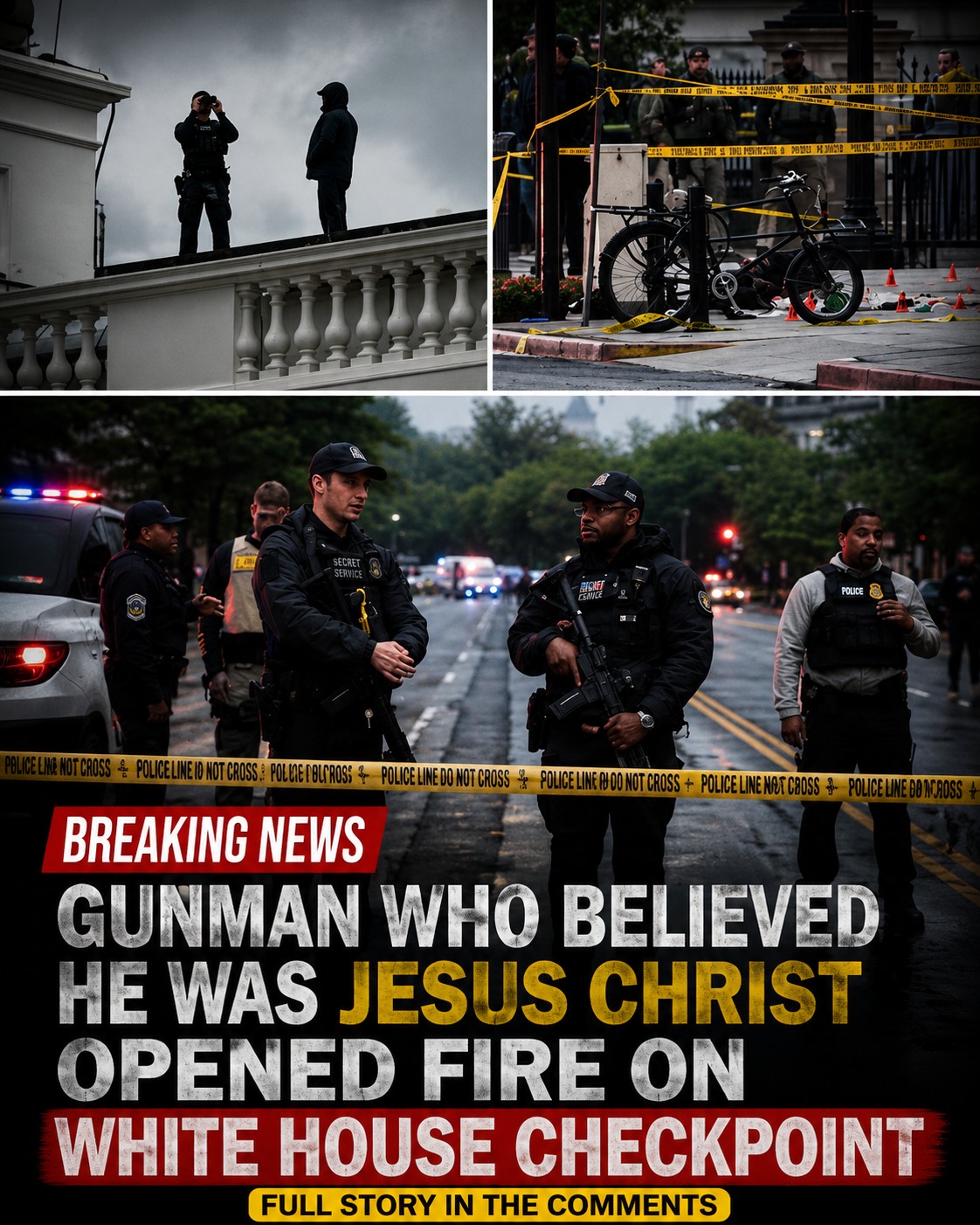
Within minutes, the entire zone surrounding the White House transformed into a lockdown scene. Streets were sealed off with emergency vehicles. Federal agents spread across intersections while helicopters circled overhead. Yellow evidence markers appeared across the pavement as investigators documented shell casings and traced the trajectory of bullets fired during the confrontation.
Inside the White House itself, security protocols were activated immediately. Staff members reportedly received emergency instructions while portions of the complex were temporarily restricted. President Donald Trump was said to be working in the Oval Office at the time of the incident, adding another layer of urgency to an already explosive situation.
The mere possibility of an armed breach near the White House carries enormous psychological weight in the United States. The building is more than a residence or office; it functions as a symbol of continuity, authority, and national stability. Any violent incident near its perimeter instantly becomes larger than the event itself because it strikes at a place deeply embedded in the American imagination.
As investigators pieced together the suspect’s background, attention quickly shifted toward questions about mental health and warning signs. Early reports suggested that Best may have struggled with severe psychological instability for some time before the shooting. Law enforcement sources indicated that investigators were reviewing online activity, personal writings, and communications that could help explain what led to the attack.
Several officials urged the public not to jump immediately to political conclusions. Although political violence remains a growing fear in the United States, authorities cautioned that the available evidence pointed more toward delusion and personal instability than organized extremism. That distinction, however, did little to calm public anxiety.
Across social media, reactions exploded almost instantly. Some users focused on the bravery and rapid response of the Secret Service agents, praising them for preventing what could have become a catastrophic attack near the White House grounds. Others raised concerns about the increasing frequency of public mental health crises escalating into violence. The incident also reignited debates about gun access, security vulnerabilities, and the emotional strain carried by federal law enforcement officers tasked with protecting national institutions.
Political leaders from both parties released statements condemning the violence and expressing gratitude to emergency responders. Yet beneath the carefully measured language was an unmistakable sense of alarm. America has spent years navigating an atmosphere of growing political hostility, conspiracy theories, and public distrust. Even when incidents are not overtly ideological, they unfold inside a culture already strained by fear and division.
For journalists who were present during the shooting, the experience left a lasting mark. Some later described hearing bullets strike nearby surfaces while scrambling for cover behind barricades and vehicles. Others recalled the eerie silence that followed the gunfire, broken only by shouted commands from agents securing the scene. One cameraman reportedly continued filming instinctively even while lying flat against the pavement, capturing raw images of panic that would soon spread across television and the internet.
The event also highlighted the extraordinary pressure placed on Secret Service personnel. Agents assigned to White House security operate under the assumption that every suspicious movement could become deadly within seconds. Their training is built around split-second decisions where hesitation can cost lives. In this case, officials indicated that their rapid intervention almost certainly prevented the suspect from reaching a more dangerous position near the checkpoint.
As night fell over Washington, investigators remained at the scene collecting evidence under bright floodlights. News helicopters hovered overhead while police tape stretched across usually crowded streets. Tourists who had arrived expecting sightseeing instead found themselves witnesses to one of the most frightening security incidents near the White House in recent memory.
Meanwhile, the broader national conversation continued to unfold. Some viewed the tragedy primarily as a mental health failure. Others saw it as another warning sign of a society increasingly consumed by instability, paranoia, and rage. Many simply focused on the human reality beneath the headlines: terrified civilians, wounded victims, and a young man whose apparent descent into delusion ended in violence and death.
What happened outside the White House lasted only seconds, yet the emotional impact reached far beyond those barricades. For many Americans, the images were a chilling reminder of how fragile public safety can feel in an age defined by tension, spectacle, and uncertainty. One moment, people were taking photos in the nation’s capital. The next, they were running for their lives as gunfire echoed steps away from the most powerful office in the world.
And long after the shell casings are cleared and the barricades removed, that sound will continue to linger in the minds of everyone who was there.