
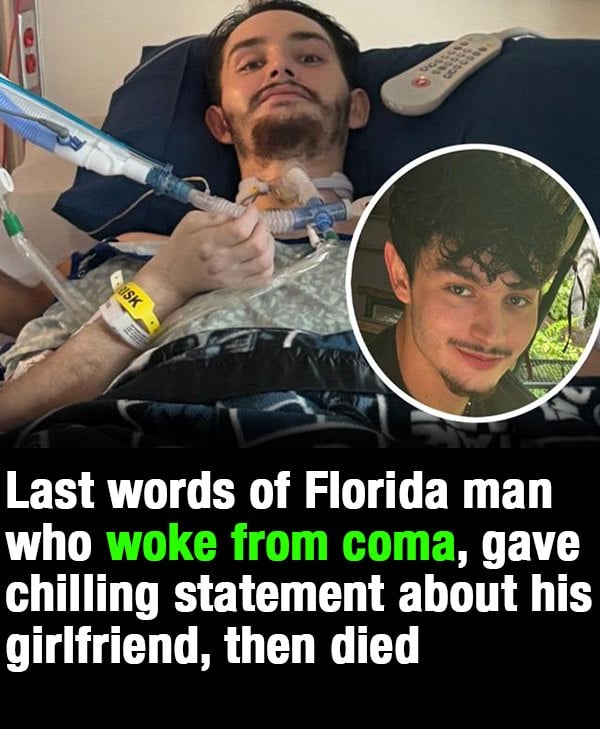
What should have been an ordinary drive home on Super Bowl Sunday became the beginning of a tragedy that would unravel across hospital rooms, court filings, grieving relatives, and a child who would enter the world surrounded not by celebration, but by heartbreak and unanswered questions.
For months, Daniel’s loved ones lived suspended between hope and fear, praying he would wake up long enough to explain what had happened during those final moments before a devastating crash changed every life connected to him.
When he finally opened his eyes after weeks in a coma, what he allegedly told investigators and family members stunned everyone around him. According to relatives, Daniel did not describe the crash as a simple accident. Instead, he reportedly claimed that an argument inside the vehicle had spiraled into something far darker, accusing his pregnant girlfriend of turning anger into something deadly. Those statements would later become central to a growing criminal investigation that transformed a traffic collision into a possible homicide case.
By the time Daniel died in October 2025, the story had already gripped people far beyond the two families at its center. What began as concern over a hospitalized young man became a deeply emotional legal battle involving grief, blame, and the future of a newborn child now caught between two sides of a shattered relationship.
According to accounts shared by family members, the couple had been driving through Florida on the night of the crash after tensions reportedly escalated during an argument. Details remain heavily disputed, but investigators later examined whether emotions inside the car contributed directly to the violent collision that followed. Emergency responders arriving at the scene found Daniel critically injured, suffering trauma so severe that doctors warned his survival was uncertain from the very beginning.
For his relatives back in New York, the days that followed became a nightmare measured in phone calls, medical updates, and endless waiting. Loved ones described living in emotional limbo, unable to speak to him yet unwilling to let go of the hope that he might recover enough to explain what really happened.
Weeks turned into months.
Machines breathed beside him while family members traveled back and forth between states, clinging to every sign of progress. Nurses reportedly described small moments of responsiveness that gave relatives cautious optimism. A hand movement. A flicker of recognition. A brief opening of the eyes. Tiny moments became enormous victories inside hospital walls where hope often survives only in fragments.
Then came the moment everyone had prayed for.
Daniel regained consciousness long enough to communicate with investigators and loved ones. According to people close to the case, his version of events painted a deeply troubling picture. Relatives claim he described a heated confrontation moments before the crash and suggested the collision was not simply caused by weather, distraction, or reckless driving. Instead, they say he believed the vehicle had been intentionally used during the argument.
Those allegations immediately shifted the tone of the investigation.
What had once appeared to be a tragic roadway incident suddenly carried the weight of possible criminal intent. Detectives reportedly began reviewing evidence more aggressively, including crash reconstruction reports, witness statements, cellphone data, and any communication exchanged before the collision. Prosecutors faced the difficult task of determining whether Daniel’s statements, delivered while gravely injured, were reliable enough to support criminal proceedings.
Meanwhile, the emotional stakes only grew more intense after the birth of the couple’s child.
The newborn, who entered the world while Daniel remained hospitalized, quickly became the emotional center of the unfolding conflict. Family members described the child not only as a living connection to Daniel, but as the final piece of him left behind. Relatives later claimed that during brief periods of clarity, Daniel repeatedly expressed one overwhelming wish: that his child remain connected to his side of the family and be raised surrounded by the people and place that shaped him.
That wish now hangs over an increasingly painful custody dispute.
What makes the situation especially heartbreaking is the collision of grief and suspicion between two families forever tied together by tragedy. On one side are relatives mourning a son they say fought desperately to survive long enough to tell the truth. On the other are people facing public suspicion while also navigating the trauma of a catastrophic crash and its aftermath. As legal arguments intensify, the child at the center of the case grows up surrounded by a story already shaped by accusations, headlines, and emotional wounds that may never fully heal.
Cases like this often capture public attention because they force people to confront uncomfortable questions about relationships, anger, and how quickly ordinary moments can spiral into irreversible consequences. A car ride after a football game sounds painfully mundane. Millions of couples argue in vehicles every year. Most make it home safely. But investigators say emotionally charged confrontations inside moving vehicles can become uniquely dangerous, especially when emotions overpower judgment.
Friends who knew Daniel described him as deeply excited about becoming a father. Several said he often talked about wanting stability and a future centered around family. Those memories now carry a haunting weight for people trying to reconcile the hopeful version of Daniel they knew with the horrifying circumstances surrounding his final months.
His death in October 2025 marked a devastating turning point. Though he had survived the initial crash and coma, complications from his injuries reportedly continued to worsen over time. Loved ones described watching him endure repeated medical setbacks while still hoping for recovery. When news of his death finally arrived, many relatives said it felt as though they lost him twice: once during the crash itself, and again months later when his body could no longer continue fighting.
The legal consequences following his death became even more serious.
Once a victim dies from injuries connected to a suspected act of violence, investigators often reevaluate charges entirely. Prosecutors now faced mounting public attention as they examined whether the evidence justified pursuing homicide-related allegations. Court hearings became emotional scenes filled with grieving relatives, tense exchanges, and photographs of a man whose life had become the subject of competing narratives.
Yet beneath every legal filing and public statement lies something simpler and far sadder: a young family destroyed before it ever truly began.
For Daniel’s relatives, the fight is no longer only about punishment or blame. They say it is about preserving his memory and protecting the child he never had the chance to raise. Family members have repeatedly emphasized that they want the child to know who Daniel was beyond the headlines: not just a victim in a criminal investigation, but a son, brother, friend, and father who dreamed about a future he never got to live.
The tragedy also reveals how fragile life can become when anger collides with vulnerability. A single argument, a single moment of lost control, and suddenly entire generations are left dealing with consequences that stretch far beyond one night on a Florida road.
Today, Daniel’s story continues through courtroom battles, family memories, and the child whose future remains uncertain. Every hearing now carries emotional weight because it is no longer just about reconstructing a crash. It is about trying to understand the final words of someone who woke from a coma long enough to leave behind a warning, an accusation, and a final plea for the child he loved.
And for everyone still searching for answers, that voice continues to echo long after his death.