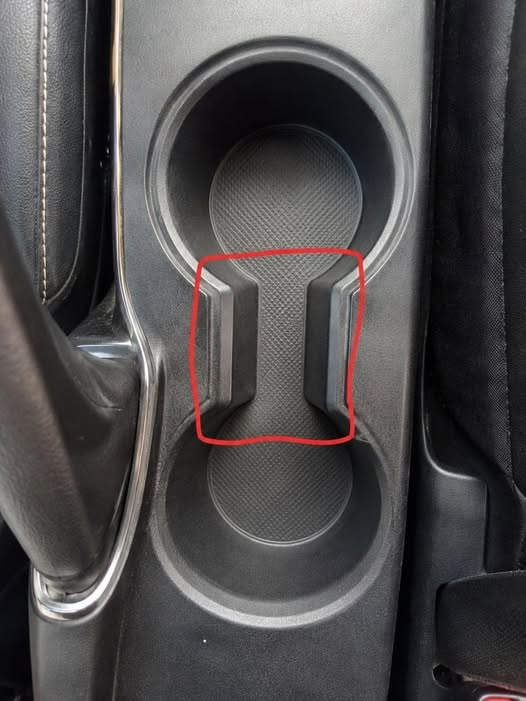
For years, millions of drivers have looked at the narrow gap sitting between their car’s cup holders without giving it much thought. It is one of those tiny design details that blends so naturally into the vehicle’s interior that most people assume it exists purely for appearance.
Some think it is there to separate drinks. Others believe it is simply leftover empty space from the molding process. A few never notice it at all. Yet hidden inside that small strip of plastic is one of the smartest and most overlooked convenience features quietly built into modern cars.
What many drivers are only now discovering is that the mysterious slot between cup holders was actually designed with a practical purpose in mind. It serves as a simple way to stabilize and hold bag handles while driving, helping grocery bags, takeout orders, purses, and small shopping bags stay upright instead of collapsing onto the floor during turns and sudden stops.
It sounds almost too simple to matter. But once people realize what the feature is for, they suddenly begin seeing it differently every single time they get behind the wheel.
The design works because the divider between the cup holders creates a narrow anchor point where bag handles can rest securely. Instead of placing a bag loosely on the passenger seat or floorboard where it tips over instantly, drivers can slide the handles into the gap so the bag hangs upright between the cup holders. The weight stays balanced, the contents remain stable, and fragile items like eggs, drinks, soups, sauces, or glass jars are far less likely to spill or roll around the car.
For many people, the discovery feels strangely satisfying because it solves a problem they never realized had an intentional solution. Almost everyone has experienced the frustration of hearing groceries tumble over during a turn or arriving home to find spilled drinks soaking through a takeout bag on the floor. Most drivers simply accepted that chaos as part of everyday life. They adapted by placing bags carefully, driving slower, or awkwardly holding items in place at red lights.
Yet somewhere along the way, automotive designers quietly engineered a solution directly into the center console.
What makes the feature especially fascinating is how invisible it has remained despite existing in vehicles for years. Unlike flashy touchscreen systems, panoramic sunroofs, or expensive sound systems, this tiny divider rarely appears in advertisements or dealership sales pitches. Car companies spend enormous amounts of money promoting horsepower, fuel efficiency, and high-tech features, while one of the most genuinely useful conveniences in the cabin often goes completely unmentioned.
That silence is part of what makes people so intrigued once they learn the truth.
It represents a kind of thoughtful engineering that does not demand attention or praise. Instead, it simply exists in the background, waiting for someone to discover its purpose naturally. In an era dominated by loud innovation and endless marketing, there is something oddly charming about a feature designed purely to make daily life a little easier without announcing itself.
Drivers online have reacted with surprise after realizing the purpose of the slot. Many admitted they had owned their vehicles for years without understanding what it was for. Others joked that they thought it was meant for coins, phones, parking tickets, or absolutely nothing at all. Some people even described the discovery as life-changing after testing it with grocery bags for the first time and realizing how well it actually worked.
Once people learn about the feature, they begin noticing it everywhere. Older Hondas, Toyotas, SUVs, sedans, minivans, and family crossovers all contain variations of the same practical design. While not every vehicle uses the slot in exactly the same way, the concept appears surprisingly often across multiple manufacturers and generations of cars.
The widespread use of the feature reflects an important truth about automotive design: some of the best innovations are not the most expensive or technologically advanced. Often, the most appreciated features are the ones solving tiny frustrations drivers experience every single day.
Car interiors are filled with these subtle details. Small hooks inside trunks for shopping bags. Hidden compartments beneath armrests. Tiny arrows beside fuel gauges showing which side the gas tank is on. Fold-flat seats, textured dashboard surfaces that reduce glare, and steering wheel controls designed to keep eyes on the road. Individually, none of these features feels revolutionary. Together, they quietly shape the comfort and practicality of modern driving.
The cup holder divider belongs to that category of invisible convenience: thoughtful design that improves ordinary life without demanding recognition.
Psychologically, discoveries like this also appeal to people because they create a small moment of hidden knowledge. Humans enjoy uncovering secret functions in everyday objects. It transforms something ordinary into something clever. Suddenly, a boring plastic divider becomes evidence that designers anticipated real-world problems most drivers barely articulated themselves.
There is also something comforting about realizing that not every product is designed purely for profit or appearance. Sometimes, engineers genuinely think about human behavior in surprisingly practical ways. Someone somewhere observed groceries spilling during car rides and quietly created a solution simple enough to disappear into the background.
That simplicity may be why the feature survived for so long.
Unlike complicated systems requiring updates, batteries, or maintenance, the divider works passively forever. It cannot crash, freeze, or become obsolete. It asks nothing from the driver except recognition of its purpose. In many ways, it represents a kind of old-school practicality increasingly rare in modern consumer products.
As vehicles become more digital and automated, drivers often complain that simple usability gets sacrificed for flashy technology. Giant touchscreens replace physical buttons. Menus become more complicated. Features require tutorials. Against that backdrop, the humble cup holder gap feels refreshingly human-centered.
Its purpose is immediate once understood. No instructions needed.
The internet’s fascination with the feature also reflects a larger cultural trend: people love discovering overlooked functions hidden in plain sight. Everyday objects suddenly become fascinating when their true purpose is revealed. Whether it is the tiny hole in a pen cap, the extra fabric swatches attached to clothing tags, or the arrows on dashboard fuel icons, these discoveries create a sense of shared curiosity about the world around us.
In the case of the cup holder gap, the emotional response goes beyond practicality. People are not just impressed that it works. They are amazed they never realized it before.
That reaction speaks to how much of daily life becomes invisible through routine. Humans stop questioning familiar objects after seeing them enough times. The brain filters out ordinary details automatically. Then one moment of explanation suddenly transforms something unnoticed into something brilliant.
And perhaps that is why this tiny feature resonates with so many drivers once discovered.
It reminds people that cleverness does not always arrive with fanfare. Not every useful invention changes the world dramatically or announces itself through giant advertising campaigns. Some of the smartest ideas are quiet, practical, and humble. They simply wait patiently inside the ordinary routines of life until the day someone finally understands what they were designed to do all along.