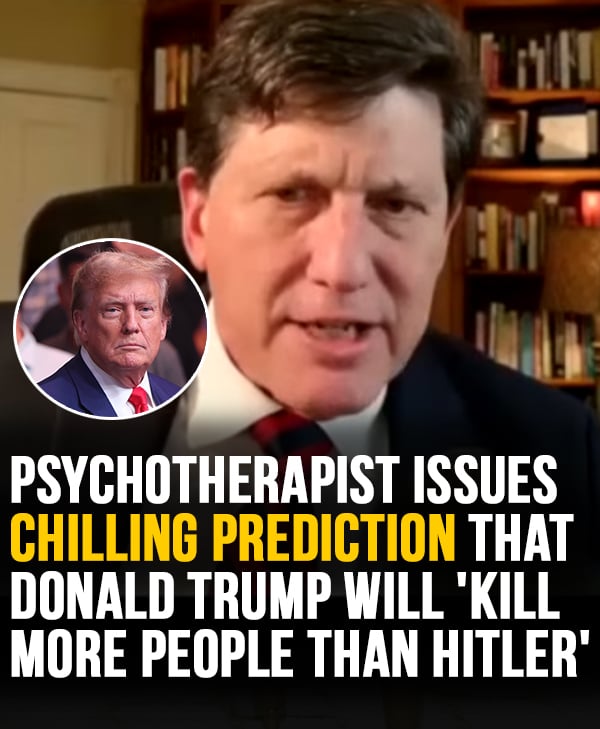
A fierce new political and psychological controversy has erupted after psychotherapist Dr. John Gartner issued one of the most alarming public warnings yet about Donald Trump’s mental fitness and the potential consequences of returning to power.
The remarks immediately ignited outrage, debate, and fear across social media, with supporters dismissing the comments as reckless political hysteria while critics of Trump argued they reflected concerns that many Americans have quietly carried for years.
Dr. Gartner, a psychotherapist and founder of the organization Duty To Warn, has spent years publicly criticizing Trump’s behavior, speech patterns, and leadership style. But his latest comments pushed the conversation into even more explosive territory. During recent appearances and discussions surrounding Trump’s political future, Gartner warned that the former president’s alleged psychological decline, combined with the enormous military power attached to the presidency, could create catastrophic consequences on a global scale.
His most shocking statement came when he suggested Trump could potentially “kill more people than Hitler,” a comparison so extreme that it instantly dominated headlines and triggered fierce backlash from across the political spectrum.
The comment was not presented as a formal clinical diagnosis, nor was it tied to any specific future action. Instead, Gartner framed it as a public warning rooted in what he sees as escalating signs of instability, grandiosity, and cognitive deterioration in Trump’s public behavior. According to Gartner, the danger does not come from one isolated statement or policy position, but from what he describes as the combination of immense political power and a personality increasingly disconnected from restraint, accountability, and reality itself.
For critics of Trump, Gartner’s warning reflects a broader fear about the tone and direction of American politics. Many opponents argue that Trump’s rhetoric has become increasingly aggressive, conspiratorial, and personal in recent years. They point to his public feuds, attacks on institutions, inflammatory social media posts, and frequent declarations portraying himself as uniquely powerful or historically significant.
Gartner specifically referenced moments where Trump compared himself to major historical or religious figures, including comments invoking Jesus, Napoleon, Caesar, and Alexander the Great. To Gartner, these comparisons are not simply examples of ego or political branding. He argues they may indicate dangerous levels of grandiosity and narcissistic thinking in someone who could potentially regain control of the United States military and nuclear arsenal.
That possibility is precisely what makes the discussion so emotionally charged. The presidency of the United States remains one of the most powerful positions in the world, with enormous influence over military operations, foreign policy, intelligence agencies, and nuclear command structures. For those who already view Trump as unpredictable, the idea of psychological instability inside that level of power becomes deeply unsettling.
At the same time, many mental health professionals strongly reject the idea of diagnosing public figures from afar. Critics of Gartner argue that attempting to publicly analyze someone’s mental condition without direct examination is professionally irresponsible and ethically questionable. Some also warn that using psychiatric language as a political weapon risks stigmatizing legitimate mental health conditions and undermining public trust in psychology itself.
This debate is not new. Questions surrounding the mental fitness of political leaders have surfaced repeatedly throughout history, especially during periods of national division and uncertainty. However, the Trump era has intensified these discussions dramatically, partly because of the former president’s unusually dominant public presence and highly unconventional communication style.
Trump’s supporters argue that accusations of instability are politically motivated attacks disguised as psychological concern. They point to his continued popularity among millions of voters, his survival through countless political battles, and his ability to dominate media coverage unlike almost any modern political figure. To them, his confrontational behavior represents strength, confidence, and resistance against political elites rather than evidence of decline.
Many supporters also note that Trump has repeatedly passed official cognitive and physical examinations while in office. His allies argue that critics selectively interpret his statements while ignoring similar exaggerations or rhetorical flourishes made by other political figures throughout history.
Still, the controversy surrounding mental fitness in politics continues growing because it taps into a deeper anxiety within American society. The country remains sharply polarized, emotionally exhausted, and increasingly distrustful of institutions. In such an environment, fears about leadership become magnified.
For some voters, the concern is not necessarily whether Trump meets formal medical definitions of impairment. Instead, it is whether his behavior reflects the temperament required to manage crises involving war, diplomacy, civil unrest, or nuclear conflict. Gartner’s warning amplified those fears by framing them in stark and emotionally explosive terms.
The organization Duty To Warn itself emerged during Trump’s first presidency, bringing together mental health professionals who argued they had an ethical responsibility to publicly discuss what they viewed as dangerous behavior from national leaders. The name references the psychological principle that professionals may have a duty to warn others if they believe someone poses a serious threat.
That approach remains deeply controversial. Opponents argue that mental health professionals should not become political actors or speculate publicly about individuals they have not personally evaluated. Others counter that remaining silent in the face of perceived danger could itself become ethically troubling.
The tension between those positions reflects a larger cultural divide over expertise, authority, and public trust. Americans increasingly disagree not only about politics, but about who gets to define reality itself. Doctors, journalists, academics, and government officials now face levels of public skepticism that would have been difficult to imagine decades ago.
Trump’s political rise accelerated many of those fractures. His presidency reshaped conversations around truth, media, nationalism, conspiracy theories, and political identity. Even years after leaving office, he remains the gravitational center of American political life, capable of generating enormous emotional reactions from both supporters and opponents.
That emotional intensity helps explain why comments like Gartner’s spread so quickly online. Supporters of Trump see such warnings as proof that establishment figures are consumed by fear and desperation. Critics, meanwhile, interpret them as confirmation that the risks surrounding Trump’s leadership are too serious to ignore.
Social media has only amplified this cycle. Extreme statements generate massive engagement, pushing nuanced discussions aside in favor of outrage, fear, and viral conflict. In today’s political environment, moderation often struggles to compete with emotional intensity.
At the same time, the controversy raises difficult questions about the relationship between personality and power. History contains numerous examples of leaders whose personal psychology shaped global events in devastating ways. That reality makes discussions about temperament and judgment unavoidable when evaluating anyone seeking enormous political authority.
Yet there is also danger in reducing complex political disagreements into amateur psychiatric battles. Once politics becomes framed primarily through mental health accusations, public debate risks collapsing into mutual dehumanization. Opponents stop being seen as wrong and instead become portrayed as mentally unfit, dangerous, or incapable of legitimate participation in democracy.
That trend is already visible across much of modern political discourse. Americans increasingly describe opposing political camps not merely as misguided, but as existential threats to the nation itself. The result is a climate of constant escalation where fear becomes a permanent feature of public life.
Gartner’s comments landed directly inside that atmosphere. His warning was not merely about one politician, but about what can happen when enormous power collides with deep national division and emotional distrust. Whether people view his statements as courageous truth-telling or irresponsible alarmism often depends entirely on how they already feel about Trump himself.
What remains undeniable is the level of fear and uncertainty surrounding modern politics. Public trust has eroded across institutions, media systems, and political parties. Many Americans no longer feel confident that the system can reliably protect the country from instability, extremism, or abuse of power.
That anxiety creates fertile ground for both dire warnings and fierce backlash. Every statement becomes amplified into a larger battle over truth, legitimacy, and national identity. And in that environment, figures like Trump continue to dominate attention not only because of their political influence, but because they symbolize larger fears about where the country itself may be heading.
As the next election cycle intensifies, these debates are unlikely to disappear. Questions about leadership, age, temperament, cognitive fitness, and political power will remain central to public discussion. What makes the current moment different is how emotionally charged those questions have become.
For millions of Americans, politics no longer feels like an argument about taxes, laws, or policy alone. It feels like a struggle over reality, morality, and survival itself. And it is inside that atmosphere of fear, suspicion, and polarization that warnings like Gartner’s continue to echo far beyond the world of psychology.