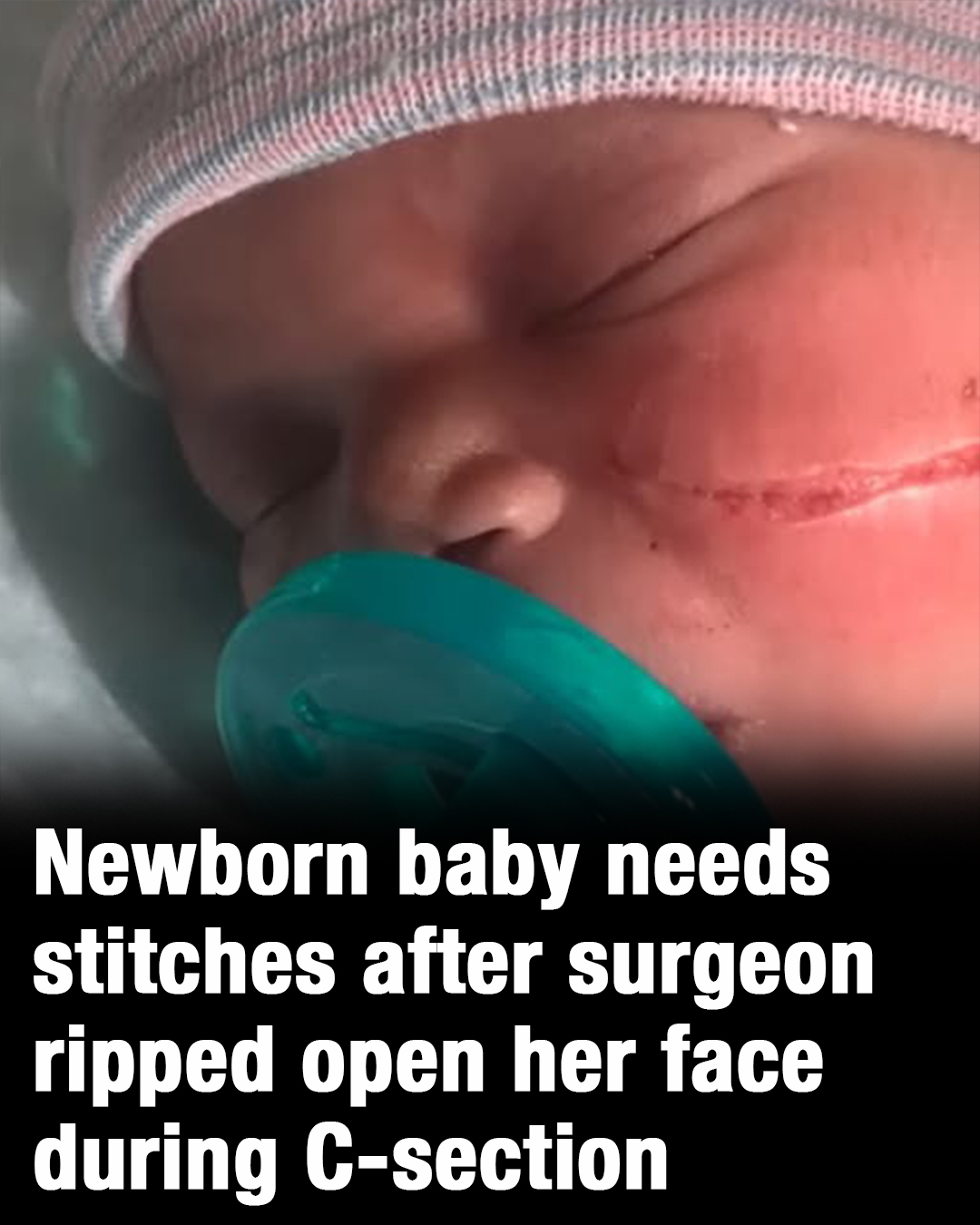
What was supposed to be the first peaceful moment between a mother and her newborn daughter became a scene of panic, confusion, and heartbreak that the family says they will never forget.
Instead of hearing soft congratulations and feeling her baby placed gently against her chest, Reazjhana watched doctors rush frantically around the operating room as fear replaced celebration in a matter of seconds. Moments earlier, medical staff had reportedly struggled to locate the baby’s heartbeat, triggering an emergency cesarean section that quickly transformed the atmosphere from controlled routine to urgent crisis.
In the middle of that chaos, something went terribly wrong.
When baby Kyanni was finally delivered, her family says she did not arrive wrapped in the joyful calm most parents imagine after childbirth. Instead, the newborn suffered a severe facial injury during the operation — a deep cut across her cheek that required 13 stitches almost immediately after birth.
For Reazjhana, the emotional shock was overwhelming.
While many mothers spend their first moments memorizing tiny fingers, counting eyelashes, and listening to their newborn’s first cries, she says she watched her daughter disappear through hospital doors toward a plastic surgeon before she had even fully processed what had happened.
The image still haunts her.
Her baby, only moments old, being carried away not into her arms but into another medical emergency.
The family says the injury happened during the rushed attempt to deliver Kyanni safely after complications escalated rapidly inside the operating room. According to their account, doctors were responding to signs of distress when the procedure became increasingly urgent.
Emergency cesarean sections are among the most high-pressure situations medical teams can face. Physicians often have only minutes to act when fetal distress occurs, balancing the desperate need to deliver the baby quickly against the immense physical complexity of surgery itself. In such moments, every second feels critical.
But understanding the urgency has not erased the emotional devastation for the family.
The wound stretching across Kyanni’s tiny face became more than a surgical complication. To her parents, it symbolized the terrifying moment where joy and fear collided at once.
The hospital later described such injuries as rare but known complications associated with difficult emergency procedures. Medically, the explanation may have sounded clinical and procedural. Emotionally, however, the family says it felt impossible to absorb those words while staring at fresh stitches crossing the face of a newborn child.
There is something uniquely painful about seeing visible injury on a baby.
Adults can rationalize scars. They can contextualize accidents and understand explanations. But a newborn feels impossibly fragile, untouched by the world, still carrying the softness and innocence of first breath. Any harm to that tiny body strikes parents with a kind of helplessness difficult to describe.
For Reazjhana, the contrast between expectation and reality made the experience even more traumatic.
Like many mothers, she had imagined the birth countless times before the actual day arrived. She imagined holding her daughter skin-to-skin. Hearing reassurance. Taking photographs filled with exhausted happiness. Beginning motherhood with tears of relief and joy.
Instead, those first memories became tangled with fear, surgical lights, hurried voices, and uncertainty.
Even after the operation ended, the emotional aftermath lingered heavily over the family. They found themselves caught between gratitude that Kyanni survived the emergency and grief over the injury she sustained entering the world.
That emotional contradiction became difficult to explain to others.
How do parents simultaneously celebrate birth while mourning trauma attached to the same moment?
How do they feel thankful toward the medical team that saved their daughter while also struggling with the visible scar left behind?
Those complicated emotions often define medical trauma. Human experiences rarely divide neatly into gratitude or anger alone. Families frequently find themselves carrying both at the same time.
As news of Kyanni’s story spread online, however, strangers across the country began responding with overwhelming compassion.
Messages flooded social media.
Parents shared their own frightening birth stories.
Mothers described emergency deliveries that permanently altered how they viewed childbirth.
Others focused on hope, reassuring the family that scars fade, surgeries improve, and children often grow stronger than anyone expects.
Support eventually expanded beyond emotional encouragement alone. Donations reportedly poured into the family’s fundraiser as strangers offered financial help for future medical care, treatments, and recovery expenses.
For the family, that support became a lifeline during an emotionally disorienting time.
In moments of trauma, isolation often deepens pain. People begin feeling trapped inside experiences nobody else can fully understand. But public compassion, even from strangers, can soften that loneliness slightly. It reminds families that others see their suffering and care about their healing.
Reazjhana reportedly clung tightly to one belief through the hardest moments: her daughter is far more than the injury she sustained.
That conviction became increasingly important as photographs of Kyanni’s stitched cheek circulated online. Public attention can be double-edged during personal tragedy. While support offers comfort, visibility can also make families fear that the scar itself will become the defining feature of their child’s story.
Parents naturally want the world to see the child first.
Not the wound.
Not the trauma.
Not the headline.
Just the child.
And by all accounts, that is exactly what Reazjhana wants for her daughter moving forward. She speaks not only about healing physically, but about ensuring Kyanni grows up understanding that her worth has never depended on flawless skin or untouched beauty.
The scar may remain part of her story.
But it will not become her identity.
In many ways, the emotional weight of visible scars extends beyond medicine itself. Society often places enormous emphasis on appearance, especially for girls and women, making parents deeply protective of anything that could expose their children to cruelty later in life.
Those fears are understandable.
Yet many survivors of childhood injuries eventually develop a powerful relationship with their scars — not as symbols of brokenness, but as evidence of survival. Over time, what once represented pain can transform into proof of resilience.
Kyanni’s family appears determined to help shape that perspective from the very beginning.
Already, they speak less about hiding the scar and more about helping her grow into confidence despite it. They want her to know she entered the world fought for fiercely. That the chaos surrounding her birth reflected urgency to save her life, not carelessness about her future.
That distinction matters deeply to them.
Meanwhile, conversations sparked by the incident have also reignited broader discussions around emergency childbirth complications, surgical risk, and the emotional realities families face after traumatic deliveries. Many parents admitted online that they had never realized babies themselves can sometimes suffer accidental injuries during emergency cesarean procedures.
Though rare, such complications do happen.
Medical professionals often work under immense pressure during fetal emergencies, making split-second decisions where delays can carry catastrophic consequences. The line between rescue and risk can become painfully thin.
Understanding that reality does not erase suffering, but it does reveal the impossible complexity surrounding emergency medicine.
For now, however, the family’s focus remains firmly on healing.
Each day brings small improvements.
The stitches.
The swelling.
The slow process of recovery.
And alongside those physical changes comes another quieter transformation: the rebuilding of emotional trust after a birth experience that shattered expectations so suddenly.
For Reazjhana, motherhood began not with calm certainty, but with fear, confusion, and heartbreak. Yet even through that trauma, one image continues to anchor her forward the sight of her daughter surviving.
Scarred, yes.
But alive.
And in the eyes of her family, that tiny child already carries something far stronger than perfection could ever provide:
Proof that she fought her way into the world from her very first breath.