It is one of those questions many people quietly think about but rarely say out loud.
What would actually happen if Donald Trump were to die while serving as president?
The topic may feel uncomfortable, even morbid, but it has become part of a much broader national conversation surrounding presidential age, health, succession, and stability. Ever since Trump returned to the White House for a second term at age 78, discussions about the physical demands of the presidency have intensified across television panels, political debates, and social media.
If he completes a full term, Trump would leave office in his eighties, making him one of the oldest presidents ever to serve. That reality alone has caused many Americans to revisit a question the United States Constitution was specifically designed to answer long ago:
What happens if a sitting president suddenly dies?
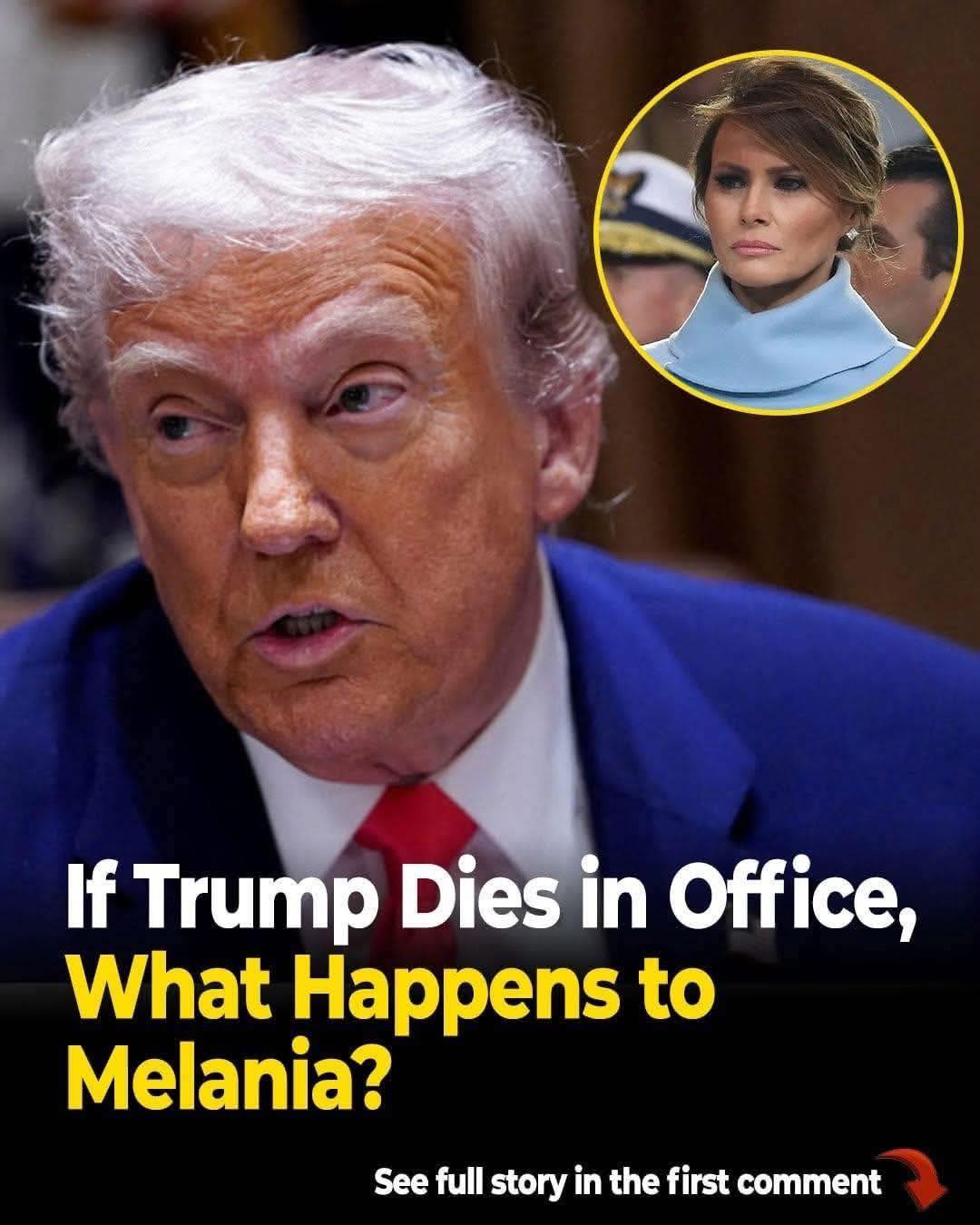
Most people immediately focus on politics and the transfer of power. But behind the scenes, another deeply human story would unfold at the same time one centered on Melania Trump, her family, and the enormous personal upheaval that follows the death of a president serving in office.
The truth is that while emotions would dominate headlines, the legal process itself would move with remarkable speed and precision.
The United States has spent more than two centuries preparing for exactly this kind of emergency.
Under Section 1 of the Twenty-Fifth Amendment to the Constitution, the moment a president dies, the vice president immediately becomes president. There is no waiting period, no nationwide vote, no temporary arrangement, and no constitutional confusion.
Power transfers instantly.
That amendment was formally ratified in 1967 after years of concern about gaps in presidential succession procedures, particularly following the assassination of John F. Kennedy in 1963. The nation realized it needed clearer rules for moments of sudden crisis.
So if Donald Trump were to die in office, Vice President JD Vance would immediately become president of the United States in full constitutional authority.
Not acting president.
Not temporary leader.
The president.
And the contrast would be striking.
Within hours, the country would shift from one of the oldest presidents in American history to one of the youngest modern presidents ever to assume office. Born in 1984, Vance represents a completely different political generation, style, and public image. That sudden generational shift alone would dramatically reshape the atmosphere in Washington overnight.
But while the machinery of government would move rapidly, the emotional reality inside the White House would become something else entirely.
Melania Trump would instantly stop being First Lady the moment presidential succession occurred.
The title itself is not elected or permanent. It belongs only to the spouse of the sitting president. Once power transfers, the role transfers too. That means Usha Vance would become First Lady immediately alongside her husband’s inauguration into the presidency.
For Melania, however, the transition would be far more personal than political.
In a matter of hours, she would move from First Lady of the United States to presidential widow.
That shift carries enormous symbolic and emotional weight in American history.
The death of a sitting president is not treated as an ordinary loss. It becomes a national event layered with constitutional ritual, military ceremony, public mourning, and relentless global attention. The private grief of a family unfolds under the gaze of an entire nation.
And despite years of public scrutiny, Melania Trump has consistently remained one of the more private first ladies in modern history. Her guarded public image, controlled appearances, and preference for distance from political chaos have long distinguished her from more openly visible presidential spouses.
That privacy would become nearly impossible during a presidential death.
By longstanding tradition and federal protocol, the widow of a deceased president becomes a central figure in the mourning ceremonies that follow. Those procedures are not improvised after tragedy strikes. Every administration quietly prepares for such possibilities in advance, coordinating detailed plans with the Military District of Washington and other federal agencies.
If a sitting president dies in office, the nation enters an officially structured mourning period.
Flags across the country are lowered to half-staff for 30 days.
Military honor guards are mobilized.
The White House becomes both a residence of grief and the center of state ceremony.
Typically, the president’s body is first honored in a lying-in-repose ceremony at the White House before being transported to the Capitol Rotunda for a lying-in-state viewed by political leaders, dignitaries, and members of the public.
The final state funeral service traditionally takes place at the Washington National Cathedral, attended by world leaders, former presidents, diplomats, military officials, and grieving citizens.
Melania would stand at the center of those ceremonies beside her son, Barron Trump, and other family members.
History offers many examples of these moments becoming defining national images. Americans still remember the dignity of Jacqueline Kennedy Onassis walking beside her husband’s casket after Kennedy’s assassination. They remember the funerals of Ronald Reagan, George H. W. Bush, and Jimmy Carter as moments where personal grief became national reflection.
Melania Trump would likely face that same impossible balancing act between mourning privately and representing the nation publicly.
Yet even after the ceremonies ended, many aspects of her life would remain protected by federal law.
One major protection involves security.
Under current U.S. law, former presidents and their spouses receive lifelong Secret Service protection unless the spouse remarries. That protection was permanently restored through legislation signed during the Obama administration after earlier limits had briefly been imposed.
As a result, Melania Trump would continue receiving full Secret Service protection for the rest of her life. Barron Trump would also retain security protections according to the legal rules governing presidential children and their ages.
Financially, the situation becomes more complicated and largely private.
While widows of former presidents are entitled to modest federal pensions and certain allowances, those amounts would likely represent only a tiny fraction of the Trump family’s wealth. Donald Trump’s fortune has long been tied to businesses, properties, investments, licensing agreements, and complex financial structures spanning decades.
Much of what would happen financially would depend on private estate planning, wills, trusts, inheritance law, and prenuptial agreements that remain inaccessible to the public.
Speculation about exact figures would almost certainly dominate media coverage, but the true details would likely stay confined to lawyers, accountants, and family members.
Where Melania would ultimately choose to live afterward also remains uncertain.
Many assume she would divide time between Mar-a-Lago and Trump properties in New York. Unlike a sitting First Lady, however, she would no longer have official residence obligations or ceremonial duties requiring constant public visibility.
In many ways, she could retreat from political life almost entirely if she chose.
And that possibility raises another interesting reality about presidential widows throughout American history.
Some become highly public figures after tragedy.
Others disappear quietly from public life.
Much depends on personality, grief, age, and circumstance.
Melania has often appeared uncomfortable with the relentless exposure attached to politics. If confronted with such a devastating event, she might choose privacy over public influence far more decisively than many before her.
Yet beyond the family itself lies the larger national significance.
The death of a sitting president always reshapes the country psychologically.
Americans often imagine the presidency as permanent and continuous, even though history repeatedly proves otherwise. Eight presidents have died while serving in office, including Abraham Lincoln, Franklin D. Roosevelt, and John F. Kennedy. Each death forced the nation to confront uncertainty while relying on constitutional systems designed precisely for moments of instability.
That is ultimately the deeper purpose of succession planning.
Not politics alone.
Continuity.
The system exists to reassure Americans that no matter how shocking the tragedy may feel emotionally, the government itself continues functioning immediately. Leadership transfers peacefully. Institutions remain intact. The country moves forward even through grief.
No one hopes to see those plans activated.
But their existence reflects one of the oldest lessons in American political history: the nation prepares for emergencies precisely because history guarantees that eventually, somewhere, somehow, the unexpected arrives.