As policymakers debate the future of cannabis in legislative chambers, a very different conversation is unfolding behind the closed doors of operating rooms. The contrast is striking.
On one side, discussions revolve around classification, taxation, and regulation. On the other, surgeons confront the physical realities that never make it into policy briefings. Among them is Jeremy London, a heart surgeon whose firsthand experiences have added a sobering dimension to the broader conversation about marijuana use.
London has described cases that challenge the widespread perception of cannabis as largely harmless. During complex cardiac procedures, he has encountered lungs that appear darkened and damaged, resembling those typically associated with long-term heavy smoking. What makes these cases particularly unsettling, he notes, is that some of these patients report never having smoked traditional cigarettes. Instead, their histories point to regular marijuana use, raising questions about assumptions many people have come to accept without much scrutiny.
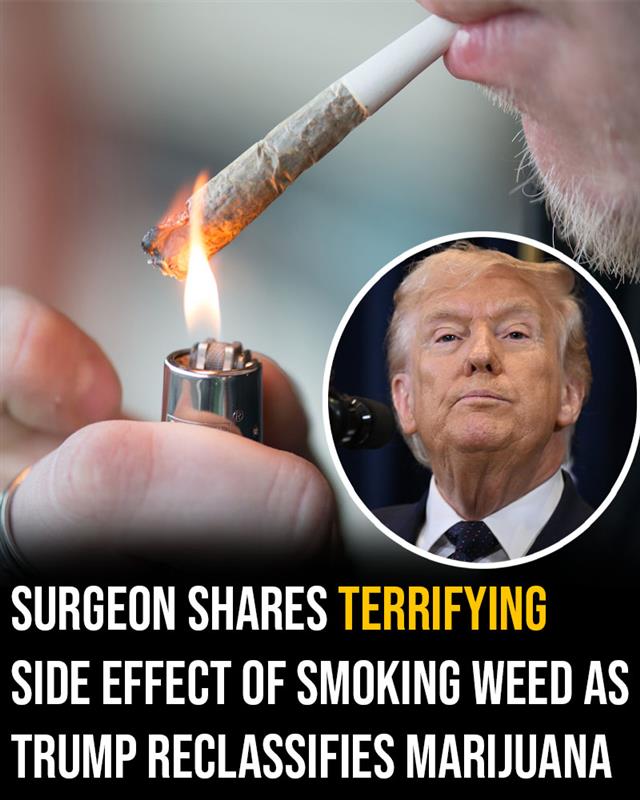
These observations arrive at a moment when Donald Trump has moved to reclassify marijuana, a policy shift that could reshape how the substance is studied, prescribed, and regulated. Supporters of the change argue that it opens the door to more rigorous scientific research, improved medical applications, and a clearer understanding of both benefits and risks. For years, researchers have faced significant barriers when attempting to study cannabis in controlled, clinical settings. Reclassification promises to ease some of those restrictions, potentially leading to more comprehensive data and better-informed decisions.
Yet London’s perspective highlights a tension at the heart of this evolving landscape. While policy changes may encourage optimism about medical potential, they do not alter the biological effects of inhaling smoke. In the operating room, the body tells its own story one that is not influenced by political framing or public perception. The tissues he works with reflect cumulative exposure, not intentions or beliefs. For him, the message is not about rejecting research or dismissing potential therapeutic uses, but about confronting a reality that can be uncomfortable: inhaling combusted substances carries risks, regardless of their source.
The distinction between perception and physiology becomes particularly important when considering how marijuana is often discussed in public discourse. Compared to tobacco, cannabis is frequently framed as a safer alternative, sometimes even as a benign or “natural” option. This framing can shape behavior, influencing how often and how casually people use it. But as London’s experiences suggest, the body does not differentiate between types of smoke in the way public narratives sometimes do. The respiratory and cardiovascular systems respond to particles, toxins, and inflammation in ways that are governed by biology, not branding.
Patients who find themselves on an operating table often confront this reality in the most direct way possible. According to London, some express genuine surprise at the severity of their condition. They arrive with symptoms that require urgent intervention blocked arteries, compromised lung function, or other serious complications and struggle to reconcile these outcomes with their understanding of marijuana as relatively low-risk. The phrase he recalls hearing from some patients, “I thought it was safe,” underscores the gap that can exist between expectation and experience.
This gap is not unique to marijuana, but it is particularly relevant at a time when the substance is undergoing significant legal and cultural shifts. As more jurisdictions move toward legalization or decriminalization, access increases, and with it, usage patterns evolve. For many, cannabis becomes part of daily life, integrated into routines in ways that might not have been possible or acceptable in the past. In this context, clear and balanced information about potential risks becomes essential.
London’s warning does not dismiss the potential benefits of cannabis, especially in medical contexts where it may provide relief for certain conditions. Rather, it calls for a more nuanced understanding one that acknowledges both possibilities and limitations. The method of consumption, in particular, plays a critical role. While smoking remains one of the most common ways people use marijuana, it is also the method most directly associated with inhalation-related risks. Alternative forms, such as edibles or tinctures, may present different profiles, though they come with their own considerations.
The broader debate surrounding marijuana often becomes polarized, with strong opinions on both sides. Some emphasize its therapeutic potential and relatively lower risk compared to other substances, while others focus on possible health consequences and long-term effects. What London’s perspective adds is a grounded, clinical viewpoint one informed not by ideology, but by repeated encounters with patients in critical condition.
As research expands in response to policy changes, the hope is that a clearer picture will emerge. More data could help differentiate between levels of risk, identify factors that increase vulnerability, and guide recommendations for safer use. Until then, anecdotal evidence from practitioners like London serves as an important, if incomplete, piece of the puzzle. It reminds both the public and policymakers that real-world outcomes can complicate even the most well-intentioned narratives.
In the end, the conversation about marijuana is unlikely to be settled by a single study, policy decision, or personal account. It will continue to evolve as new information becomes available and as societal attitudes shift. But amid that evolution, certain principles remain constant. The human body responds to exposure in ways that cannot be negotiated or redefined by law. Smoke, regardless of its source, interacts with the lungs and cardiovascular system in measurable, sometimes harmful ways.
For those considering how marijuana fits into their lives, this reality invites a more thoughtful approach. It does not demand a single conclusion, but it does suggest the importance of awareness. Understanding potential risks, considering methods of use, and paying attention to emerging research can help individuals make more informed choices.
London’s message, shaped by the stark environment of the operating room, cuts through the noise of political debate and cultural perception. It is not a call for alarm, but for clarity. In a moment when marijuana is being reconsidered at multiple levels of society, that clarity may be more important than ever.