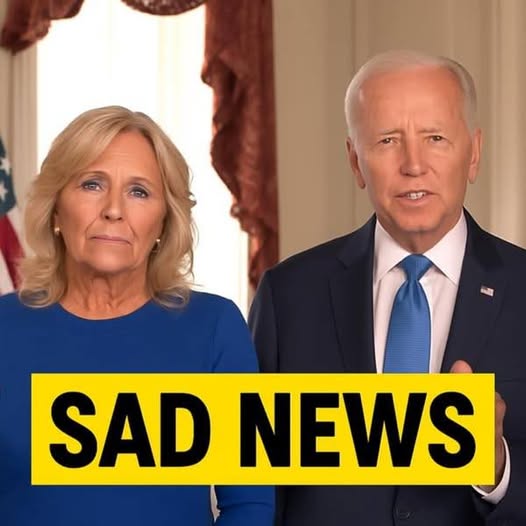
In a political era defined by relentless ambition and carefully guarded appearances, the sight of Joe Biden standing before the nation with visible emotion marked a rare and deeply human moment.
His voice, steady but heavy with meaning, carried a message few had truly expected: he would step aside from the race, not out of defeat, but out of conviction. It was not framed as surrender, but as a decision rooted in something larger than personal victory a belief that the moment demanded a different standard of leadership.
For decades, Biden’s story had been one of persistence. From his early days in Scranton to the long arc of his career in Washington, he built a reputation on endurance, on showing up again after loss, after setbacks, after moments that might have ended another political life. That history gave added weight to his announcement. This was not a man unfamiliar with fighting through adversity. This was someone choosing, deliberately, to stop fighting for himself in order to clear a path for something or someone else.
At the center of that transition stood Kamala Harris, whom Biden endorsed as his successor in the race. The endorsement was more than procedural; it was symbolic. In passing the torch, he placed not only the machinery of a campaign into her hands, but also the expectations, pressures, and uncertainties that come with it. Harris’s candidacy immediately took on historic dimensions, representing a continuation of the administration’s vision while also marking a new phase in the country’s political evolution.
The moment carried an undeniable sense of gravity. In stepping aside, Biden reframed his role in real time. He remained president, still responsible for governing, still tasked with navigating the complexities of domestic and international challenges. Yet he was no longer a candidate, no longer focused on the next election cycle. That shift altered the lens through which his remaining time in office would be viewed. Every decision, every speech, every action would now be interpreted not as part of a campaign, but as part of a legacy.
For Harris, the transition was immediate and intense. She moved from vice president to the center of the political stage, inheriting both the strengths and vulnerabilities of the administration. Supporters saw an opportunity for renewal, a chance to build on existing foundations while bringing new energy to the campaign. Critics questioned whether the transition could happen smoothly, whether the coalition that had carried Biden to victory could remain unified under new leadership.
The broader public reaction reflected a mixture of surprise, respect, and uncertainty. In a system where holding onto power is often seen as the ultimate objective, Biden’s decision stood out precisely because it challenged that assumption. It suggested that leadership might, in some cases, involve stepping back rather than pushing forward. For some, this was a refreshing departure from the norm. For others, it raised questions about timing, strategy, and the risks of such a dramatic shift.
What made the moment particularly striking was its tone. There was no sense of spectacle, no attempt to dramatize the decision beyond what it inherently carried. The emotion visible in Biden’s expression did not feel staged; it felt earned. It reflected the weight of a career, the accumulation of years spent in public service, and the recognition that certain choices define how that service will be remembered.
As the political landscape adjusted, attention quickly turned to what this meant for the future. Harris’s campaign became the focal point, with analysts examining how she might reshape messaging, strategy, and outreach. The question was not only whether she could win, but how she would define her own leadership within the framework she had inherited. Would she emphasize continuity, presenting herself as the natural extension of Biden’s presidency? Or would she carve out a distinct identity, signaling a shift in direction while maintaining core principles?
Meanwhile, Biden’s role evolved in subtle but significant ways. Freed from the demands of campaigning, he had the opportunity to focus entirely on governance. This could allow for a different kind of presidency in its final months one less constrained by electoral considerations and more oriented toward long-term impact. At the same time, his presence remained central to the narrative. His decision to step aside did not remove him from the story; it repositioned him within it.
The historical context of such a move cannot be ignored. Moments when sitting presidents voluntarily relinquish a path to continued power are rare, and they tend to carry lasting significance. They invite comparisons, interpretations, and debates about what leadership truly entails. In Biden’s case, the decision will likely be analyzed not only for its immediate political consequences but also for what it reveals about his priorities and values.
For the country, the transition represents both a challenge and an opportunity. It introduces uncertainty into an already complex political environment, but it also opens space for new possibilities. The outcome will depend on a range of factors campaign dynamics, voter sentiment, external events but the starting point has already shifted in a way that few could have predicted.
As the months unfold, the focus will remain divided between two parallel narratives. One is forward-looking, centered on Harris and the path ahead. The other is reflective, centered on Biden and the meaning of his decision. Together, they form a story about leadership, transition, and the choices that shape not just individual careers, but the direction of a nation.
In the end, Biden’s announcement was not just about stepping aside. It was about redefining what it means to lead at a moment when the stakes feel unusually high. By choosing to withdraw, he placed trust in a successor and in the system itself, suggesting that the strength of a democracy lies not only in competition, but in the willingness to pass responsibility when the moment calls for it.
Whether that choice will ultimately be seen as a turning point or a gamble remains to be determined. What is certain is that it has already altered the trajectory of the political landscape, setting in motion a sequence of events that will shape the near future in ways still unfolding. And at the center of it all is a single, quiet decision one that transformed an expected campaign into a defining chapter of a long and complex public life.