In the world of royal diplomacy, words are often the least important part of the message. Speeches are drafted, rehearsed, and filtered through layers of tradition, but symbolism subtle, precise, and deliberate can carry a meaning far deeper than any carefully delivered sentence.
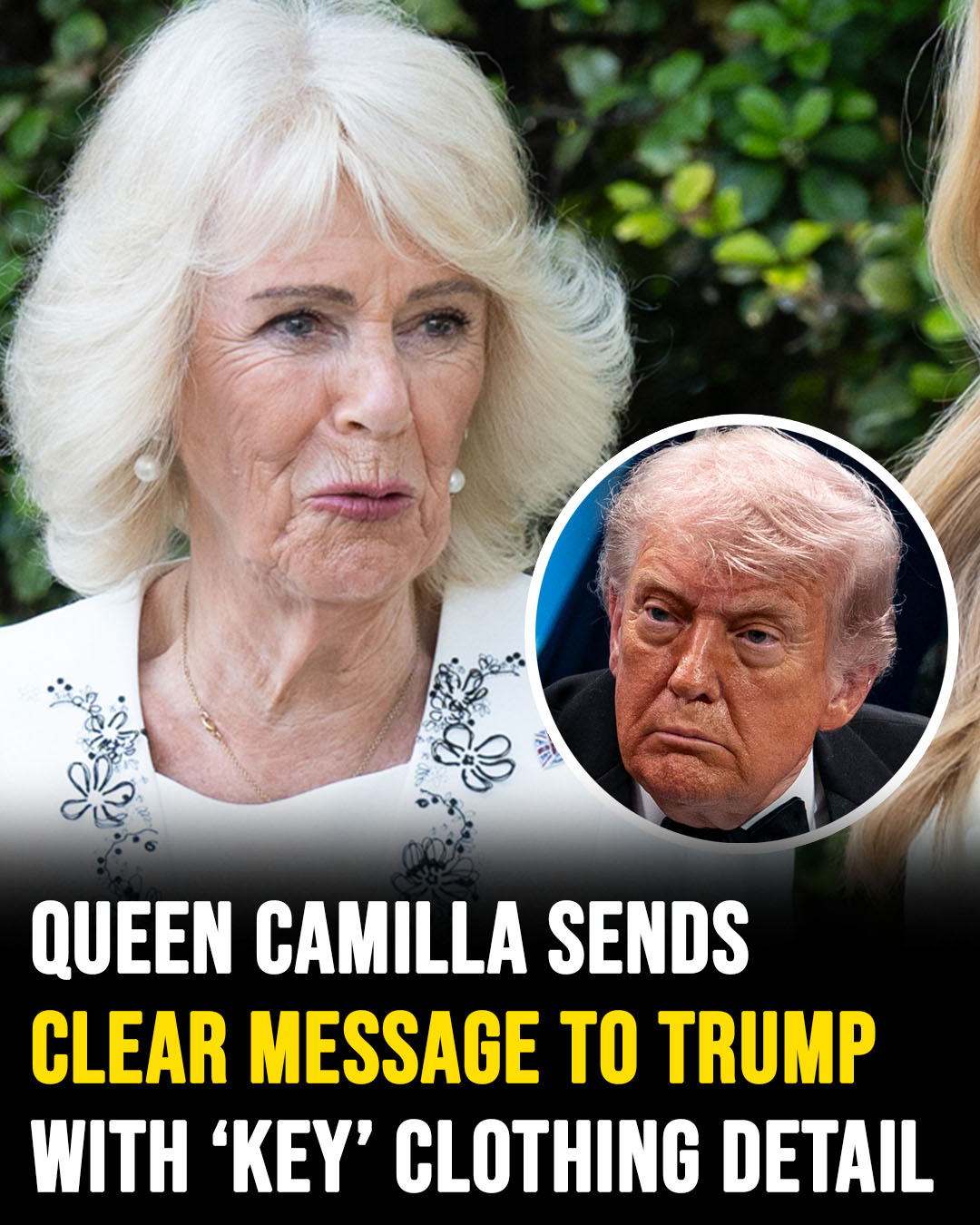
When Queen Camilla stepped off the plane to begin a high-profile visit alongside King Charles III, it wasn’t her greeting or her expression that drew the most attention. It was a small, gleaming detail pinned over her heart, one that quietly reframed the entire moment.
The brooch she chose was not an accessory selected at random. It carried with it a layered history, one that stretched back decades to a time when the relationship between the United Kingdom and the United States was framed with far more certainty and far less tension. The piece itself, combining elements of the Union Jack and the Stars and Stripes, had originally been presented as a gift to Queen Elizabeth II in 1957 by a New York mayor. In its design, it symbolized unity, shared identity, and a bond that was understood to be enduring rather than negotiable.
By choosing to wear it at that exact moment, Camilla was doing more than honoring tradition. She was placing that history directly into the present, inviting anyone paying close enough attention to draw a line between what once was and what now is. It was a visual reminder of a “special relationship” that has long been described as unshakable, even as recent years have tested that assumption in ways few could have predicted.
The timing of the gesture made it even more significant. As Donald Trump prepared to engage in a visit marked by both ceremony and underlying tension, the atmosphere surrounding the meeting was anything but simple. Political rhetoric, shifting alliances, and public disagreements had all contributed to a sense that the once-effortless partnership between the two nations had grown more complicated, more conditional, and perhaps more fragile.
Against that backdrop, King Charles was expected to play his part in the traditional way through language that emphasized unity, continuity, and the possibility of renewal. His role, as always, would be to soothe, to steady, and to project a sense of enduring connection even when circumstances suggested otherwise. But Camilla’s approach operated on a different level entirely. Without speaking a single word, she introduced a narrative that ran parallel to the official one, subtle enough to avoid confrontation yet clear enough to invite interpretation.
The brooch functioned as both a memory and a message. It recalled a period when the alliance between the United States and the United Kingdom was not subject to constant reassessment, when it was framed as a given rather than a question. At the same time, it highlighted how much that perception has shifted. By bringing that symbol into the present moment, Camilla seemed to be asking without ever forming the words whether that sense of certainty could still exist.
For Trump, who has at times described the relationship between the two countries in poetic terms, likening them to different verses of the same composition, the gesture carried a particular resonance. It echoed his own past language while also challenging the current tone of political discourse. In that sense, it could be seen as both an acknowledgment and a quiet pushback, a way of saying that the ideals once expressed in those comparisons have not disappeared, even if they have been overshadowed.
What makes the moment especially compelling is the way it reflects the unique role of the royal family in modern diplomacy. Unlike elected officials, they are not expected to argue policy or engage in direct political debate. Their influence lies in nuance, in the ability to communicate through gesture, timing, and symbolism. A piece of jewelry, chosen with intention, can carry a message that is both deniable and unmistakable, depending on how closely one chooses to look.
Camilla’s choice exemplifies that balance. It does not accuse, it does not confront, and it does not demand a response. Instead, it presents a perspective one rooted in history, continuity, and the idea that relationships are built over time and can be strained, but not necessarily broken. It leaves space for interpretation, allowing observers to project their own understanding onto the gesture while still maintaining the formal neutrality expected of her position.
At the same time, the brooch serves as a reminder that diplomacy is not only conducted in meeting rooms and press conferences. It unfolds in the details, in the small decisions that shape how larger moments are perceived. In an era where every interaction is analyzed and every image is scrutinized, those details can take on a significance that far exceeds their size.
For those watching closely, the message seemed clear: the past still matters, and it still has something to say about the present. The relationship between the United States and the United Kingdom is not defined solely by current disagreements or shifting rhetoric. It is also shaped by decades of shared history, cooperation, and mutual influence. That history does not disappear simply because it becomes less visible.
In that sense, Camilla’s gesture can be seen as both a reflection and a challenge. It reflects what has been built over time, while also challenging those involved to consider what they are doing with that legacy. It suggests that the connection between the two nations is not something to be taken for granted, but neither is it something that can be easily undone.
As the visit continued, speeches were delivered, hands were shaken, and the formal aspects of diplomacy unfolded as expected. Yet the image of that brooch small, deliberate, and quietly powerful lingered in the background. It became a focal point for interpretation, a detail that invited observers to look beyond the surface and consider the deeper currents shaping the moment.
In the end, what Camilla achieved was not a statement, but a suggestion. She did not tell anyone what to think or how to respond. Instead, she offered a symbol and allowed it to speak in its own way. In doing so, she demonstrated that sometimes the most effective messages are the ones that are never spoken aloud, the ones that require attention, context, and a willingness to see what is placed, quite deliberately, right in front of us.