The moment was meant to be ceremonial, polished, and predictable a meeting wrapped in centuries of protocol and modern political choreography.
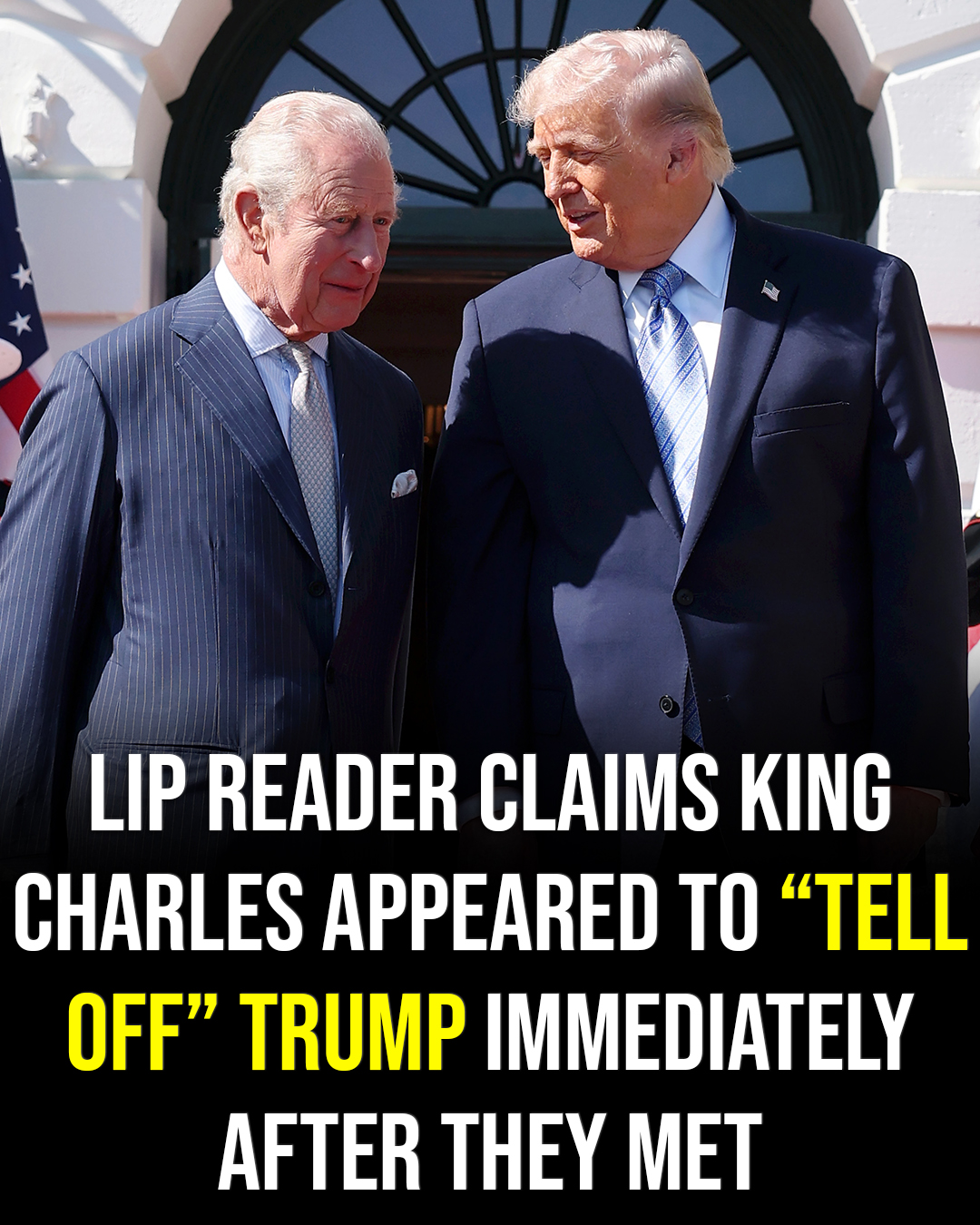
When Donald Trump and King Charles III came face to face, the cameras captured smiles, handshakes, and the familiar rhythm of diplomatic courtesy. But beneath that carefully constructed surface, something more unsettled appeared to be unfolding, something that a lip reader now claims revealed a far more strained and human exchange than the public ever saw.
The timing alone made the encounter unusually fragile. Just hours earlier, reports of a suspected gunman near a high-profile political gathering had sent waves of anxiety through Washington. Security had tightened, nerves had sharpened, and the illusion of complete control so central to events of this magnitude had been quietly shaken. Yet the visit continued. The symbolism of the meeting, representing continuity, alliance, and stability, was deemed too important to interrupt. And so, the stage was set, even as the atmosphere carried an undercurrent of unease.
According to interpretations of their brief, low-voiced exchange, Trump appeared to reference the earlier incident almost immediately. It was not the kind of topic typically introduced in the opening moments of a diplomatic meeting. These occasions are usually guided by neutral pleasantries weather, travel, shared values anything that maintains a tone of calm. But if the lip reader’s account is accurate, Trump’s mention of “this shooting” cut through that script, introducing a note of reality that protocol is designed to keep at bay.
In that instant, the polished surface of diplomacy seemed to crack, even if only slightly. The conversation, instead of remaining in the safe territory of ceremony, brushed against the unpredictability of the world outside. It was a reminder that no amount of planning or tradition can fully insulate leaders from the events unfolding around them. The weight of what had just happened lingered in the air, whether acknowledged openly or not.
King Charles’s reported responses added another layer to the moment. Phrases interpreted as “I feel I shouldn’t be here” and “another time” suggest a monarch grappling with competing instincts. On one hand, there is duty the expectation to proceed, to represent continuity, to embody stability even in uncertain times. On the other, there is human reaction the instinct to question whether the timing is right, whether the circumstances allow for genuine engagement rather than symbolic performance.
If those words were indeed spoken, they reflect a tension that is rarely visible in public life. Leaders are expected to project certainty, to move forward without hesitation. Doubt, discomfort, or second thoughts are typically hidden behind composed expressions and measured language. Yet here, in a fleeting and nearly inaudible exchange, there may have been a glimpse of something more candid: a moment where the weight of the situation briefly broke through the formal script.
The conversation reportedly did not remain anchored to that initial topic. Trump’s remarks, as interpreted, shifted quickly from the immediate concern of domestic security to broader warnings about global instability. This leap from a specific incident to the possibility of wider conflict added to the sense of disorientation. It was as if the conversation was moving faster than the moment itself, jumping between scales of concern without settling on any one point.
For Charles, whose role often emphasizes continuity and measured perspective, such a shift may have required a different kind of response. His position is not to engage in rapid political framing, but to maintain a steady presence, to anchor the moment rather than amplify its volatility. If he attempted to redirect the conversation, it would align with that responsibility to bring the exchange back to a space where it could proceed within the bounds of diplomacy.
What makes the reported interaction particularly striking is how quickly it seems to have transitioned again. From references to danger and uncertainty, the conversation allegedly pivoted toward something far more mundane: renovations, ballrooms, the physical spaces that host events like the one they were attending. The contrast is almost jarring. One moment, the discussion touches on violence and instability; the next, it settles on architecture and aesthetics.
That shift can be interpreted in different ways. It might have been an attempt to restore normalcy, to return the conversation to safer ground where both participants could engage without tension. It might also reflect a broader human tendency to move away from discomfort by focusing on something concrete and manageable. In the context of a highly visible meeting, it could serve as a way to reestablish the expected tone, ensuring that the public-facing aspect of the encounter remained intact.
For observers, the idea that such a layered exchange could occur within seconds hidden behind smiles and handshakes adds a new dimension to how these moments are understood. What appears seamless on the surface may, in reality, be composed of rapid adjustments, unspoken calculations, and brief flashes of authenticity that never fully reach the audience.
The role of the lip reader in this narrative also highlights the modern reality of public life. In an era where every movement is recorded and analyzed, even the smallest gestures can become subjects of intense scrutiny. Words that were never meant for public consumption can be reconstructed, debated, and interpreted, sometimes with certainty that exceeds the available evidence. This raises questions not only about what was said, but about how much meaning can or should be drawn from such fleeting moments.
At the same time, the public’s fascination with these details speaks to a deeper curiosity about the people behind the roles. There is an enduring interest in seeing beyond the formal exterior, in understanding how leaders react when the script falters, even briefly. Moments like this, whether fully accurate in their interpretation or not, offer a glimpse into that hidden layer.
Ultimately, the meeting between Trump and King Charles was intended to symbolize continuity and cooperation. That purpose remains, regardless of what may have been said in a quiet aside. But the possibility that their first exchange carried a trace of tension, shaped by events unfolding just outside the frame, adds complexity to the image.
It suggests that even in the most controlled environments, the world has a way of intruding. Protocol can guide behavior, but it cannot eliminate uncertainty. And sometimes, in the smallest, most easily overlooked moments, that uncertainty becomes visible not in grand gestures, but in a few quiet words that hint at everything happening just beyond the spotlight.