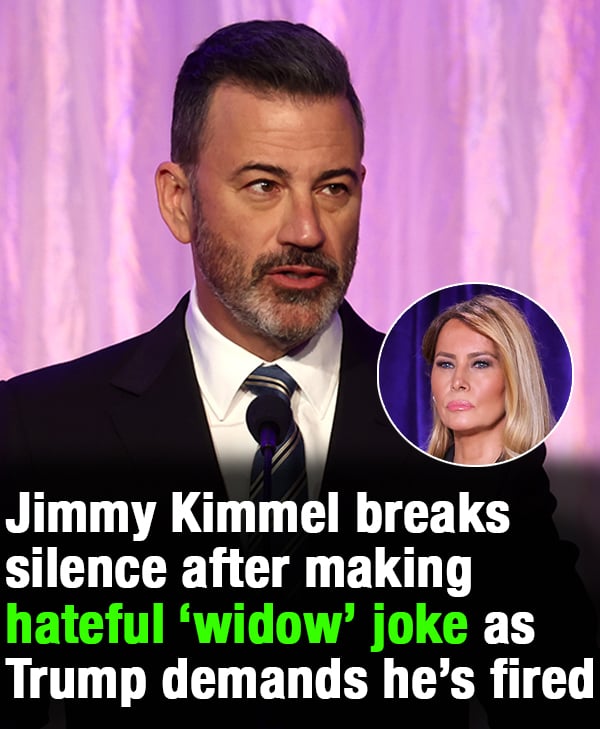
When Jimmy Kimmel finally addressed the backlash surrounding his now-infamous remark about Melania Trump, his response was anything but simple.
It was measured, but not apologetic; reflective, but not retreating. In a moment where public figures are often pressured into immediate and total retractions, Kimmel chose a more complicated path one that tried to balance accountability with defiance, and humor with the increasingly heavy weight of real-world consequences.
The joke at the center of the controversy referring to Melania as an “expectant widow” had originally been delivered in the familiar cadence of late-night satire. For years, Kimmel and others in his space have relied on sharp, often personal humor aimed at politicians and public figures, operating under the assumption that exaggeration and provocation are part of the genre. But this time, the reaction was different. The line, once aired and quickly circulated online, collided with a moment of heightened tension, transforming what might once have been dismissed as typical late-night commentary into something far more charged.
In his response, Kimmel framed the remark as part of a long tradition of comedic roasting, particularly focused on age gaps and public relationships. He insisted that the intent was never to suggest harm or violence, emphasizing that his broader body of work has consistently included criticism of gun culture and political extremism. From his perspective, the joke existed within a context that had been stripped away in the outrage that followed, leaving only the most provocative fragment to stand on its own.
Yet even as he explained his reasoning, Kimmel stopped short of offering a full apology. Instead, he acknowledged that the timing of the joke coming so close to a real and frightening security incident involving Donald Trump had changed how it was received. In another moment, under different circumstances, it might have passed with little more than a brief wave of criticism. But in this context, with fear still fresh and emotions running high, the line took on a different meaning, one that he appeared to recognize without fully conceding fault.
Trump’s reaction was swift and unequivocal. Calling for Kimmel’s firing, he framed the joke as emblematic of a broader problem within media and entertainment a culture that, in his view, has normalized hostility toward political figures and blurred the line between satire and something more dangerous. For his supporters, the incident became further evidence of what they see as a pattern of disrespect and dehumanization directed at those aligned with Trump, particularly from high-profile voices in Hollywood.
On the other side, Kimmel’s defenders saw the situation through a different lens. To them, the demand for his removal represented a threat to free expression, a reaction that risked turning political pressure into a tool for silencing criticism. They argued that comedy, by its nature, often pushes boundaries and provokes discomfort, and that drawing a hard line around what can and cannot be said would fundamentally alter the role it plays in public discourse.
Caught between these opposing interpretations is a broader cultural tension that extends far beyond a single joke. The incident highlights how difficult it has become to separate humor from the realities that surround it. In a time when political violence is no longer an abstract concern but a lived fear, the space for satire has narrowed. What once felt exaggerated or absurd can now feel uncomfortably close to reality, forcing both comedians and audiences to reconsider where the line should be drawn.
For Melania Trump, the remark landed in an especially fraught context. The idea of loss, even when framed as a joke, carried a different weight in the shadow of a recent security threat that had already shaken those close to her. While she did not publicly respond in detail, the situation underscored how quickly humor can intersect with personal vulnerability, particularly when public and private lives are so tightly intertwined.
Kimmel’s attempt to navigate this moment reflects a broader challenge facing anyone who operates in the space between commentary and entertainment. The expectations placed on public figures have shifted. Audiences are more fragmented, reactions are more immediate, and the consequences of a single line can escalate far beyond what was originally intended. In that environment, every word carries a level of scrutiny that leaves little room for ambiguity.
At the same time, the incident raises questions about responsibility both for those who create content and those who interpret it. Is it the role of the comedian to anticipate every possible reading of a joke, especially in a climate where context can be lost within seconds? Or does the responsibility also lie with audiences to engage with that context, to distinguish between intent and interpretation, even when emotions are running high?
There is no easy answer, and Kimmel’s response seems to acknowledge that. By neither fully retreating nor doubling down without reflection, he occupies a middle ground that is increasingly rare. It is a position that accepts the complexity of the moment, even as it resists the pressure to reduce it to a simple narrative of right and wrong.
The clash between Kimmel and Trump ultimately reveals something larger than a personal dispute. It exposes a cultural landscape where humor, politics, and fear are no longer separate spheres, but overlapping forces that shape how events are experienced and understood. In that landscape, a joke is never just a joke not because it cannot be funny, but because it exists within a reality that is constantly shifting, constantly being reinterpreted.
For the audience watching it all unfold, the reaction has been just as complex. Some see the controversy as an overreaction, a sign that humor is being unfairly constrained. Others see it as a necessary reckoning, a reminder that words have consequences, especially when they touch on themes that are no longer hypothetical. And many find themselves somewhere in between, uncertain about where the balance should lie.
What remains clear is that the space for casual provocation has narrowed. The stakes feel higher, the margins for error smaller. In that environment, even the most familiar forms of expression late-night jokes, political satire, public commentary are being reevaluated in real time.
Kimmel’s response does not resolve that tension, nor does it attempt to. Instead, it reflects it, capturing a moment where certainty is elusive and every perspective feels incomplete. It is a reminder that the lines between humor and harm, intention and impact, are not fixed. They shift with context, with circumstance, and with the collective mood of a society trying to make sense of itself.
And perhaps that is what makes this moment linger. Not the joke itself, or even the backlash that followed, but the uneasy realization that something has changed. That what once felt harmless no longer always does. That laughter, in certain moments, can carry an echo of something more serious. And that navigating that reality requires more than quick reactions or simple answers it requires a willingness to sit with the discomfort and acknowledge just how complicated it has become.