A single photograph can sometimes become far bigger than the moment it was meant to capture. What appears to be an ordinary family snapshot can suddenly transform into a worldwide conversation, with strangers analyzing every detail, searching for hidden meanings, and forming conclusions about people they have never met.
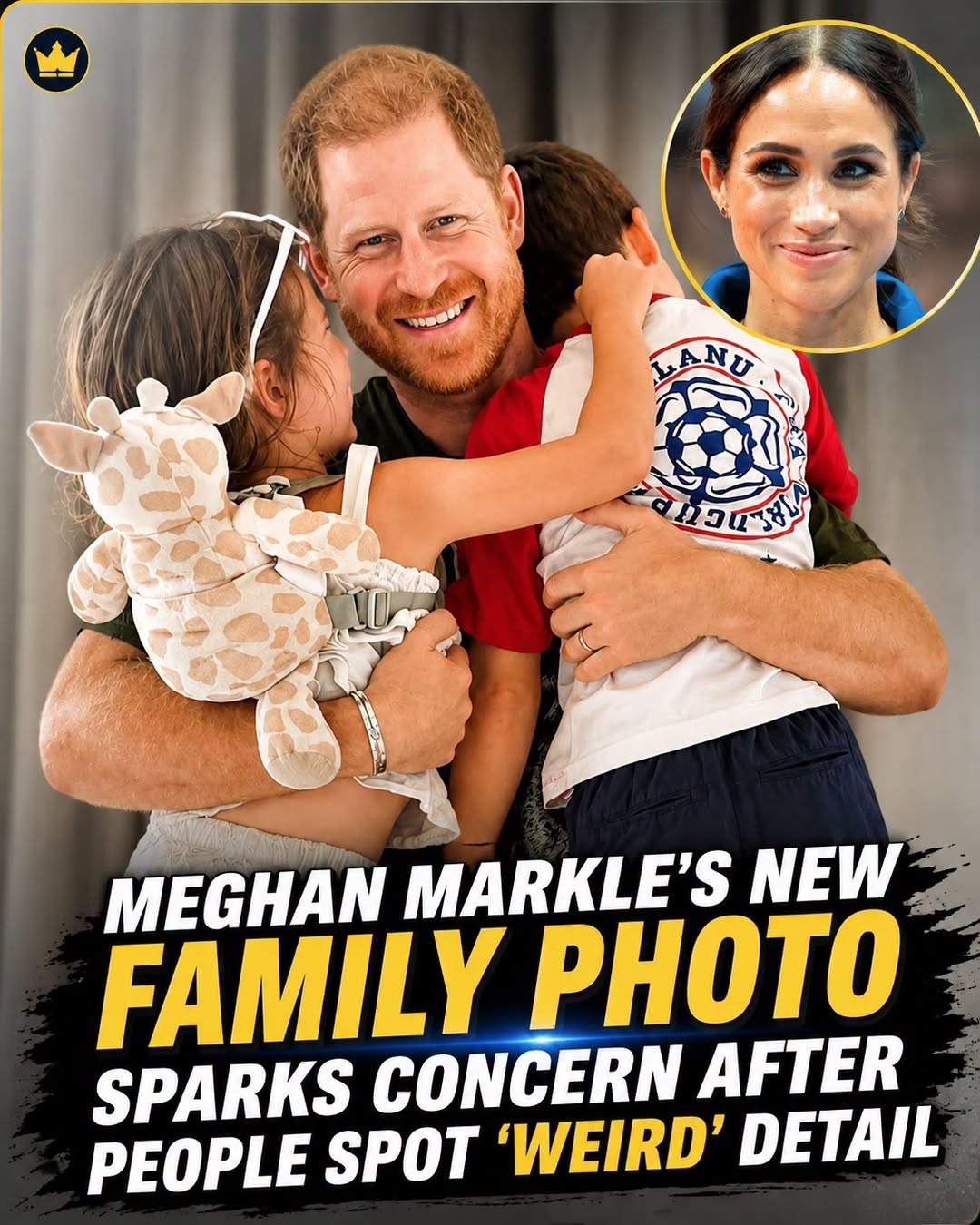
That is exactly what happened after a recent image featuring Prince Harry and his children began circulating online.
The photo was intended to offer a simple glimpse into family life a father spending time with his children, away from the intense spotlight that has followed him and Meghan Markle for years.
But instead of being viewed as a quiet family moment, the image quickly became the center of heated debate.
Some viewers described the picture as sweet and natural, seeing nothing more than a parent enjoying time with his children.
Others reacted differently.
They focused on small details and questioned what those details might represent.
The children’s clothing, their relaxed appearance, their body language, and even the fact that they were not facing the camera became subjects of intense discussion.
What one person saw as a normal childhood moment, another interpreted as something concerning.
The disagreement revealed something much larger than a single photograph.
It showed how difficult it has become for public figures especially those who have stepped away from traditional royal expectations—to share any part of their lives without inviting judgment.
For years, Harry and Meghan have spoken about wanting greater privacy for their children, Archie and Lilibet.
Their decision to protect their children from constant public exposure has been one of the most discussed aspects of their life outside the royal spotlight.
Supporters argue that every child deserves the opportunity to grow up away from endless cameras, headlines, and public speculation.
They believe keeping their children’s lives private is a responsible choice, especially considering the intense attention surrounding their parents.
Critics, however, often argue that public figures who share glimpses of family life should expect those moments to receive public reaction.
That tension has followed the couple since they stepped away from their senior royal roles and began creating a different path for themselves.
The latest debate reflects a familiar pattern.
A photograph appears.
Millions of people look at it.
And everyone brings their own assumptions to what they see.
Some viewers immediately notice warmth.
They see a father walking with his children, a relaxed environment, and a family moment that feels intentionally ordinary.
Children rarely behave like adults in carefully staged portraits.
They turn away.
They move around.
They get messy.
They ignore cameras.
For many parents, those details are not signs of a problem they are simply signs of childhood.
A child wearing comfortable clothes, walking barefoot, or avoiding the camera is hardly unusual.
In fact, many families would recognize the scene as completely familiar.
Children are naturally unpredictable.
They explore.
They play.
They become distracted.
They do not always pose perfectly for photographs.
Yet when the children belong to famous parents, ordinary behavior often receives extraordinary analysis.
A simple choice can suddenly become a theory.
A casual moment can become evidence.
A normal expression can be interpreted as something deeper.
This is especially true in the age of social media, where photographs are rarely allowed to remain just photographs.
Every image becomes open to commentary.
Every detail can become part of a larger narrative.
The reaction to Harry and Meghan’s family photo highlights a growing conversation about the boundaries between public curiosity and personal privacy.
Many people are fascinated by celebrity families, especially those connected to royalty.
The public has always been interested in watching famous children grow up.
From royal heirs to Hollywood families, audiences often feel a connection to people they have followed for years.
But there is also a growing awareness that children should not carry the same expectations as adults.
They did not choose fame.
They did not choose their parents’ public roles.
They did not choose to become subjects of online debate.
That reality makes discussions about famous children particularly sensitive.
The desire to understand public figures is natural.
But the line between interest and intrusion can become blurred.
A person can be curious without assuming they know the full story.
A photograph captures a second.
It does not reveal an entire family dynamic.
It does not show what happened before or after.
It does not explain emotions, relationships, or private experiences.
Still, the internet often tries to turn single moments into complete stories.
That tendency says as much about the audience as it does about the people being observed.
When viewers see the same image, they often see different things.
Someone who already supports Harry and Meghan may interpret the photo positively.
Someone who has criticized them in the past may view it through a more skeptical lens.
The photograph itself remains unchanged.
The interpretation changes.
That is why public reactions to celebrity images often become debates about perception rather than reality.
The controversy surrounding this picture is not really about a backpack, bare feet, clothing, or whether children looked toward the camera.
Those details became symbols because people attached meaning to them.
They represented larger conversations about parenting, fame, privacy, and trust.
For some, the image represented a family trying to create normal experiences despite extraordinary circumstances.
For others, it raised questions about how public figures present their lives.
Both reactions reveal how much emotional weight people place on celebrities they feel connected to.
In many ways, the photo became a reflection of the modern relationship between celebrities and audiences.
People want access, but they also debate whether that access should exist.
They want authenticity, but they often criticize what they see when authenticity does not match their expectations.
They want to know more, yet sometimes forget that what they are seeing is only a small piece of a much larger life.
Ultimately, the image offers no simple answers.
It does not prove the assumptions made by critics.
It does not erase the concerns of those who question public figures.
It is simply one moment captured in time.
A father with his children.
A family outside the spotlight.
A brief glimpse into a private world.
Perhaps the most revealing part of the entire debate is not what the photograph shows, but how quickly people rush to fill in everything it does not show.
In the end, the picture became a conversation not only about Harry and Meghan, but about the way society watches, judges, and interprets the lives of others.
Sometimes the story we create says more about ourselves than the image we are looking at.